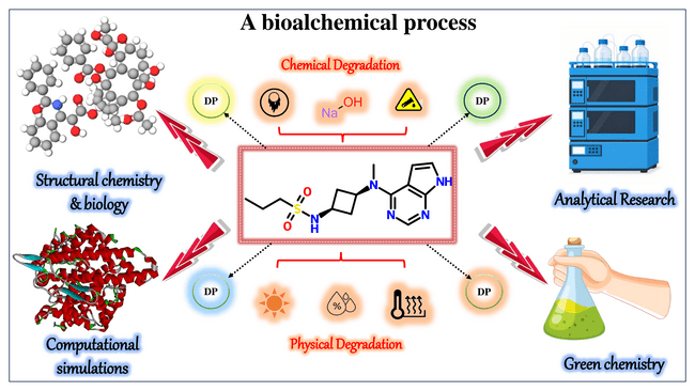
Pharmaceutical science has always been driven by one fundamental objective: improving human health. Yet, as the demand for medicines continues to increase, an important question is emerging alongside this objective: Can we develop and manufacture medicines in ways that are not only effective and safe for patients, but also safer for the environment?
The future of pharmaceutical science will increasingly depend on answering this question. Green and sustainable practices are no longer limited to reducing laboratory waste or replacing a hazardous solvent with a safer alternative. Sustainability is becoming a broader design principle that can influence how medicines are discovered, synthesized, manufactured, analyzed, packaged and ultimately introduced into healthcare systems. One of the biggest unanswered questions is how to achieve this transformation without compromising pharmaceutical quality, safety, affordability, or accessibility. A pharmaceutical process must satisfy stringent requirements for purity, potency, stability, reproducibility and patient safety. The challenge is therefore not simply to make a process “greener,” but to redesign it so that environmental responsibility becomes an intrinsic part of pharmaceutical quality.
From green chemistry to sustainable-by-design pharmaceuticals
A major opportunity lies in moving sustainability upstream. Traditionally, environmental considerations may receive greater attention during process development or manufacturing. However, decisions made much earlier during drug discovery and route selection can determine the environmental footprint of a medicine for years to come. Solvent choice is a particularly important example. Recent analysis has highlighted the enormous contribution of solvents to pharmaceutical waste and environmental impact, with solvents accounting for a substantial proportion of waste streams associated with pharmaceutical manufacturing. This means that sustainability should begin when scientists select synthetic routes, reaction conditions, purification strategies and analytical methods. Choosing reactions with better atom economy, reducing unnecessary protection and deprotection steps, minimizing solvent-intensive purification and considering solvent recovery or recycling can collectively produce substantial improvements.
The next step is to move from “greener processes” to “sustainable-by-design pharmaceuticals.” This requires considering environmental impact alongside conventional parameters such as yield, cost, purity and scalability from the earliest stages of development.
The analytical laboratory must become greener too
An often-overlooked component of pharmaceutical sustainability is analytical science, where repeated testing across the drug development and quality-control lifecycle can result in significant cumulative consumption of solvents, reagents and other resources, despite the use of samples from micro to ultra-micro range. Every pharmaceutical product requires extensive analytical testing throughout research, development, manufacturing, quality control and stability assessment. Chromatographic techniques such as high-performance liquid chromatography are indispensable for pharmaceutical analysis, but they can consume significant quantities of organic solvents and generate analytical waste.
This creates an important opportunity for Green Analytical Chemistry.
Analytical methods should aim to reduce solvent consumption, hazardous reagents, energy requirements, sample preparation and waste while maintaining or improving analytical performance. Approaches such as shorter chromatographic methods, miniaturized analytical platforms, safer solvents, direct analysis, automation and solvent-efficient separation technologies can contribute to this transition that we reported in our previous works.
Importantly, sustainability should not be treated as an afterthought added to an already established method. The analytical procedure itself should be designed with sustainability in mind. Green metrics can help scientists quantitatively compare methods rather than relying solely on qualitative claims of being “green.” This shift toward measurable sustainability is particularly important because a method can appear environmentally friendly in one aspect while creating another hidden burden. A truly sustainable assessment should therefore consider the complete life cycle of materials, energy consumption, waste generation, occupational safety and environmental impact.
Artificial intelligence as an accelerator for sustainability
Artificial intelligence and machine learning could become important enablers of sustainable pharmaceutical science. AI can help scientists predict molecular properties, identify promising compounds, optimize synthetic routes, select experimental conditions and reduce the number of experiments required during development. In manufacturing, digital technologies can support process monitoring, anomaly detection, predictive maintenance and adaptive process control. The FDA already identifies automation, digitization, artificial intelligence, process intensification and smart manufacturing among important areas of advanced manufacturing. However, AI should not be viewed simply as a faster way of doing conventional pharmaceutical science. Its greater potential may lie in enabling different ways of designing pharmaceutical processes.
Imagine a future in which an AI-assisted platform evaluates a proposed drug synthesis not only for predicted yield and cost, but simultaneously for solvent toxicity, material consumption, energy demand, waste generation, scalability and overall environmental impact. Scientists could then compare multiple synthetic pathways before entering the laboratory.
Such systems could transform sustainability from a retrospective assessment into a predictive design parameter.
What breakthroughs are still needed?
Several scientific and technological advances will be necessary to realize this vision.
- First, we need better standardized sustainability metrics that allow meaningful comparisons between pharmaceutical processes. Metrics such as process mass intensity, solvent intensity, energy consumption, carbon footprint, water use and waste generation are valuable, but they need to be integrated into decision-making rather than reported only after a process has been established.
- Second, greener alternatives must be practical, scalable and economically competitive. Replacing a hazardous solvent in a laboratory experiment is not enough if the alternative cannot be recovered, supplied reliably, or implemented at manufacturing scale.
- Third, we need greater integration between chemistry, biology, engineering, analytical science, data science and regulatory science. Sustainability is inherently multidisciplinary. No single technology will solve the pharmaceutical industry’s environmental challenges.
Finally, sustainability assessments must consider the entire lifecycle of a pharmaceutical; from raw materials and discovery through manufacturing, distribution, use and disposal. Our recent works in pharmaceutical research has highlighted the growing importance of green chemistry principles in drug testing and analytical processes, reinforcing the need to extend sustainability beyond the manufacturing stage and throughout the pharmaceutical lifecycle.
The future of Health
Over the next decade, I expect pharmaceutical sustainability to move from being a specialized area of research toward becoming a more integrated component of pharmaceutical development. We are likely to see wider adoption of continuous and intensified manufacturing, increased use of safer solvents and catalytic processes, greater emphasis on solvent recovery and circularity and continued development of greener analytical methodologies. Mechanochemistry and other low-solvent or solvent-free approaches are also promising areas for investigation, particularly where they can be translated successfully from laboratory studies to scalable manufacturing.
At the same time, AI and digital technologies may increasingly connect molecular design with process design. The most exciting developments may occur where these disciplines converge: AI-guided drug discovery combined with sustainable chemistry, automated experimentation, real-time analytics and intelligent manufacturing.
The pharmaceutical laboratory of the future may therefore look very different from today’s laboratory. It may be more automated, more data-driven, more resource-efficient and increasingly capable of making sustainability decisions in real time.
Ultimately, the goal should not be to choose between pharmaceutical innovation and environmental responsibility. The challenge and opportunity are to advance both simultaneously.
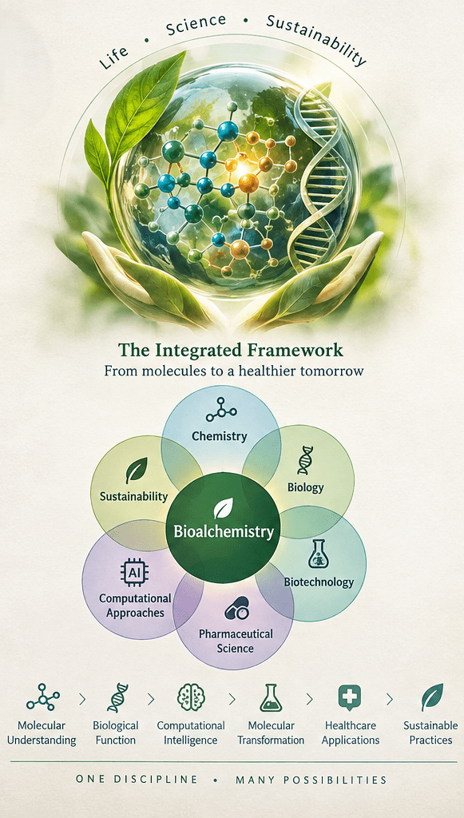
I am working toward the development of a first-of-its-kind emerging scientific discipline, for which I have proposed the term ‘Bioalchemistry” derived from “bio” (life and biological systems) and “alchemy” (an ancient tradition of natural philosophy and early scientific inquiry that sought to transform matter, achieve universal healing and discover an elixir of immortality). My ongoing work focuses on defining its scope, scientific foundations, applications, and potential contribution to the future of health sciences. “Bioalchemistry is the proposed scientific discipline and the terms “Bioalchemical”, “Bioalchemy” and “Bioalchemist” applies to the process, process of practicing and the professional who practices “Bioalchemistry” respectively.
The terms are intended to symbolize the modern scientific transformation of biologically relevant molecules through the integration of chemistry, biology, biotechnology, pharmaceutical science, computational approaches and sustainability. While established disciplines such as biochemistry, chemical biology, medicinal chemistry, computational chemistry and bioinformatics address important aspects of these areas, “Bioalchemistry” is proposed as an integrative concept that brings together molecular understanding, biological function, computational intelligence, molecular transformation, technological advancement, healthcare applications, and sustainable scientific practices within a unified perspective. Through this concept, I aim to provide a broader terminology for interdisciplinary research concerned with understanding, designing and transforming biologically relevant molecules and translating such knowledge toward sustainable applications in drug discovery, molecular design, chemical biology, healthcare and allied disciplines.
A healthier tomorrow requires more than discovering new medicines. It requires us to rethink how those medicines are created. By embedding green chemistry, sustainable analytical science, advanced manufacturing, pharmaceutical and intelligent technologies into healthcare development, we can work toward a future in which better medicines and a healthier planet are not competing objectives, but complementary achievements.