This article is currently maintained under temporary RFCSR publication support until 13 June 2026.
Skin is the largest sense organ helping us interact with external world and maintain a constant internal milieu within the physiological boundaries. Science increasingly recognizes the intimate connection between gut health, hormones, immunity, emotions, and the skin’s appearance. The complexion we wear is often an autobiography written by our habits, environment, and inner wellness. Care for the skin, therefore, is not merely to apply creams or conceal imperfections, but to listen deeply. For the skin does not betray us — it informs us. It is both shield and storyteller, manifesting the hidden toxicities of the body while inviting us toward healing, balance, and renewal from the inside out. We try to bring out one such uncommon skin manifestation of a chronic toxicity.
“The skin is often the body’s first warning system, revealing hidden toxic exposures long before the underlying cause is recognized.”
Mercury is a volatile metal with applications in industries and traditional medicinal systems around the globe. It is used for treating fever, convulsions, skin ailments and as an aphrodisiac and immunity booster. Since the recognition of toxic effects, the use of mercury has been banned in medical equipments. Use in industries has been strictly regulated. Acute or chronic exposure to mercury leads to multisystem manifestations and presents a diagnostic dilemma without a forthcoming history. Delay in management can lead to irreversible multi organ dysfunction and death due to central nervous system complications.
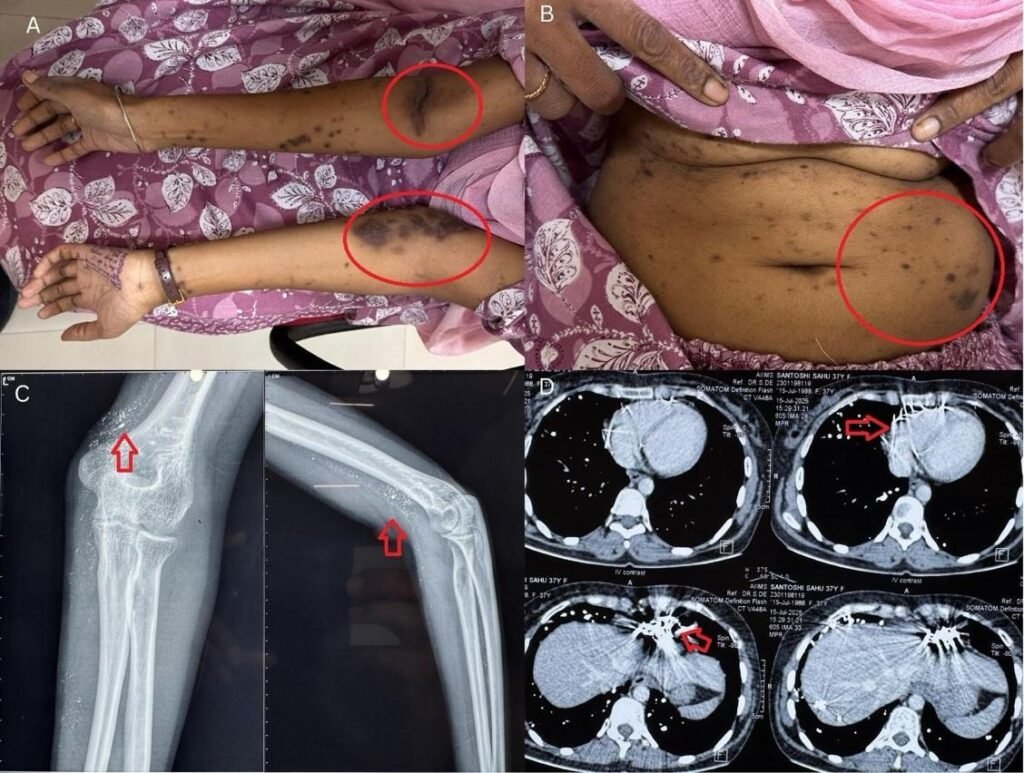
A middle aged teacher came to us with, cough, breathlessness, loss of weight from past six months. She was developing multiple dark skin patches over the arm extending to abdomen, back and lately over the tongue. They are gradually increasing from past three years, these lesions over the arm form small nodules and rupture into surface discharging rounded metallic globules mixed with blood and pus. Lately had been experiencing inability to concentrate while teaching and frequent mood changes. She had been developing these lesions following multiple intravenous injections She had received these injections from a traditional medicine practitioner for an acute febrile illness three years back. After about seven days, she started developing these skin lesions over the arm near the injection site and later becoming widespread. She had consulted dermatologist for the same on multiple occasions, skin biopsy performed twice gave no definitive diagnosis. The common diseases that considered with this presentation are Pulmonary tuberculosis due to here chronic cough, Systemic parasitic infections, chronic kidney disease and least likely chronic heavy metal poisoning including silver, arsenic, lead and lastly mercury.
Chest X ray done three years back shows multiple, nodular/spine shaped, radiopaque shadows in subcutaneous planes and lungs giving a starry sky like appearance over chest wall, which was dismissed as artifacts. X ray of upper limb also shows metallic deposits in the subcutaneous planes. CT of thorax shows metallic attenuation noted in bilateral axillary regions, pericardium, bilateral lung fields, liver, gall bladder, bilateral kidneys, pelvic region, uterus, right gluteal region. Urine routine microscopy showing 2+ proteinuria and nephrotic range protein urea in 24 hour urinary protein estimation. The serum mercury levels were normal but her 24 hour urinary mercury levels were high; she also had to undergo three sessions of dialysis due to renal dysfunction. Patient was started on D penicillamine 250mg 6th hourly for ten days with improvement in her mental and renal function over ten days duration, her repeat serum mercury level and now high with fall in urinary levels, and patient is still being treated with chelation.
Mercury or Hydragyrum, abbreviated “Hg” derived from Greek terms “Hydr” and “Argyros” meaning silver-water, due to dense silvery liquid globule appearance at room temperature and vaporizes at 356.7 0C to a colourless, odourless gas. Mercury is used in dental amalgams, vaccine preservative; thiomersal (ethylmercury), antiseptics and disinfectants (mercuric chloride), laxatives: mercurous chloride (calomel). Mercury oxide was used in skin ointments and skin lightening creams. Mercury is used in Ayurveda, Siddha and Unani as Bhasma (incinerating mercury along with herbs) and topical preparations.
Only 7-15% of ingested inorganic mercury is absorbed, mercuric salts due to greater solubility and corrosive effects are absorbed easily and reach highest levels in kidneys. Metallic mercury outgassed from amalgams is 80% inhaled and reaches brain, heart, liver, kidneys, thyroid, sweat glands. The excretory half-life of metallic mercury is several day to months, but persists in brain for years. Organic mercury is absorbed through lungs and accumulates in brain especially foetal brain, placenta, bone marrow. Overtime organic mercury gets demethylated to inorganic forms and leads to toxic effects5. Exposure by injection mercury can occur only by suicidal intent or in traditional systems of medicine or spiritual purpose.
Acute manifestations following inhalation can mimic metal fume fever, later manifest as lung fibrosis, emphysema and air leak syndromes of lung. Large Volume exposure can lead to fatal acute respiratory distress syndrome. Chronic exposure presents with classical triad of gingivitis, tremors and erethism along with central nervous system symptoms and also lead to chronic immunosuppressive state. Small fraction of patients develop “Pink disease” characterized by redness of palms and soles, skin peeling, itching and loss of appetite with muscle flabbiness. Injections lead to local site accumulation and wide spread patchy skin lesion, embolization of vascular beds and vital organs. Blood levels of mercury are temporarily elevated and normalize soon, hence measurements are not recommended. Urinary levels remain elevated as it is the main route of excretion, twenty four hour urinary levels is a preferred test, as described in our patient. Mercury can get deposited in various soft tissues planes and visceral planes and on CXR PA view this can mimic artifacts to untrained eyes.
Treatment includes removal of source following ingestion or injection. Chelation with D penicillamine, meso 2,3-dimercaptosuccinic acid (DMSA), sodium 2,3-dimercapto-1-propanesulfonate (DMPS), N-acetyl-d,l-penicillamine (NAP) and calcium disodium ethylenediaminetetraacetic acid (EDTA) increases urinary excretion and relieve symptom.
“In mercury poisoning, timely diagnosis is critical early treatment can reverse symptoms, while delays may lead to irreversible multi-organ damage.”
Conclusion: Mercury is still being in alternative systems of medicine but is toxic in all its forms, manifestations depend on volume, type and routes of exposure and biomagnification. Mercury toxicity can mimic multi system disorders including pulmonary tuberculosis and present a diagnostic dilemma, delay in diagnosis can leads to irreversible organ damage and poor outcome. Timely can result in rapid improvement of symptoms when implemented timely and always listen to your skin, as it’s the mirror of your inner self.