Functionality Engineered Framework Materials for Clean Energy and Environmental Sustainability.
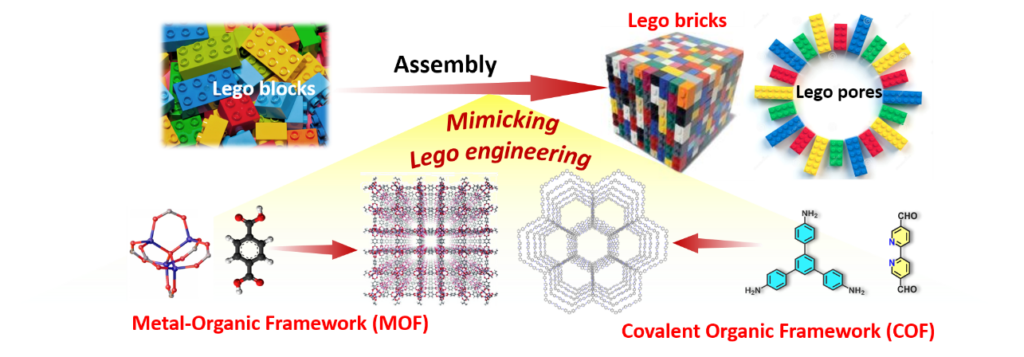
In today’s world, where climate change, energy demand, and environmental pollution are becoming increasingly critical challenges, advanced materials offer practical scientific solutions for building a more sustainable future. Advanced materials are specially engineered substances whose structure and properties are carefully tailored at the molecular or atomic level to perform specific functions. These materials are central to the development of clean energy technologies because they directly influence how efficiently we can capture carbon dioxide, produce hydrogen fuel, store energy, or purify water. My research primarily focuses on two classes of porous crystalline materials, especially metal–organic frameworks (MOFs) and covalent organic frameworks (COFs). These porous framework materials are attractive because they possess exceptionally high surface areas, tunable pore environments, and chemically functional interiors. Such features allow them to selectively interact with gases, ions, or molecules, making them promising candidates for carbon capture, atmospheric water harvesting, water splitting, catalysis, hazardous chemical monitoring, and radioactive waste remediation. A particularly exciting development for the field was the recognition of reticular and framework chemistry in the 2025 Nobel Prize in Chemistry, which highlighted the transformative impact of MOFs. The award reflected how precise molecular-level design can create materials with programmable porosity, selective adsorption properties, and tunable catalytic behaviour. This recognition strongly validates the growing importance of framework materials in addressing global challenges related to clean energy, carbon capture, hydrogen generation, and environmental sustainability. For researchers engaged in MOFs and COFs, 2025 Nobel Prize represents not merely a scientific achievement but also a powerful reminder that such rational materials design can fundamentally transform future energy and environmental technologies.
What inspired me to work in this area was the realization that many global challenges are fundamentally materials problems. Whether it is clean hydrogen generation, carbon neutrality, freshwater production, or detection of toxic pollutants in water and the environment, the efficiency of the process often depends on the material being used. I was particularly fascinated by how a small molecular-level modification in a material could dramatically alter its behavior and performance. The interdisciplinary nature of framework chemistry, combining inorganic chemistry, organic synthesis, materials science, spectroscopy, and energy research, further motivated me to explore this field.
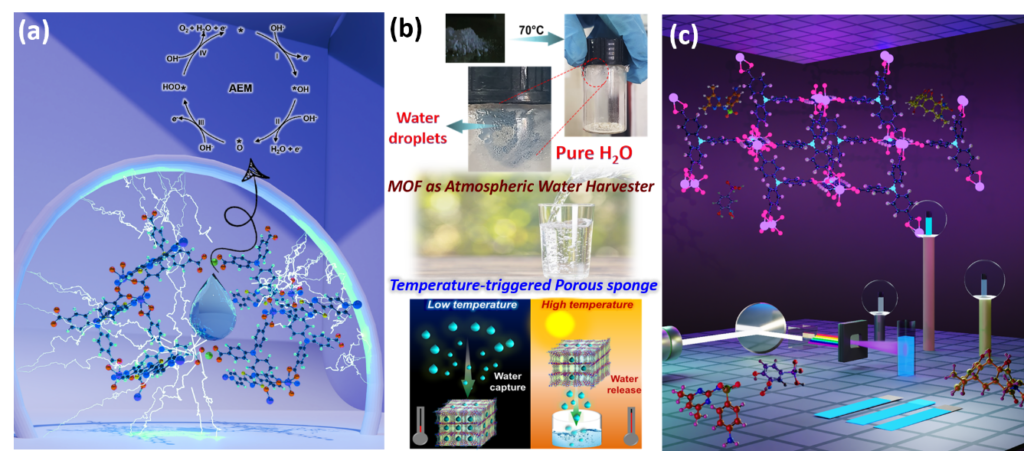
In simple terms, MOFs can be imagined as molecular sponges constructed from metal ions and organic linkers. These frameworks contain nano-sized pores that can trap, transport, or recognize specific molecules. For example, in gas capture applications, the pore walls can be decorated with functional groups that preferentially interact with carbon dioxide, enabling selective separation from industrial gas mixtures. Similarly, in water splitting, MOFs can act as electrocatalysts that accelerate the oxygen evolution reaction and hydrogen evolution reaction, thereby improving the efficiency of hydrogen fuel generation from water. In atmospheric water harvesting, porous frameworks can adsorb water vapour from air even under low-humidity conditions and subsequently release it as usable water upon mild heating. We have also explored luminescent and electrochemical framework materials for monitoring environmentally hazardous chemicals such as antibiotics, pesticides, and explosive nitroaromatic compounds through selective sensing responses. Because their structures can be precisely engineered, MOFs and COFs provide enormous flexibility in designing materials for targeted applications.
One of the most important lessons from my research is that very small structural modifications can create large functional differences. Introducing heteroatoms, tuning ligand electronics, creating open metal sites, or adjusting pore geometry can significantly influence adsorption strength, charge transport, catalytic activity, sensing selectivity, and stability. For instance, incorporating redox-active ligands into MOFs can facilitate electron transfer during electrocatalysis, while functional groups such as azo, carboxylate, nitrogen-rich moieties, or hydrogen-bonding sites can improve gas affinity, water uptake, or analyte recognition. Another exciting discoveries during my research journey has been observing how cooperative interactions between metal nodes and organic ligands can produce remarkable electrocatalytic activity for overall water splitting. Traditionally, metal centers were considered the primary active sites in many catalytic systems. However, our studies demonstrated that carefully designed ligands can actively participate in charge transfer and catalytic processes, creating synergistic effects that substantially improve performance. Another exciting aspect has been the ability of functionalized porous materials to selectively capture environmentally significant species such as carbon dioxide, iodine vapor, and uranium ions under challenging conditions. I strongly believe that research on advanced framework materials can contribute significantly to real-world technologies. Efficient electrocatalysts can support green hydrogen production, porous adsorbents can help mitigate industrial carbon emissions, and selective extraction materials can assist in environmental remediation and resource recovery. In the future, these materials may also be integrated into membranes, sensors, and portable purification systems for field applications.
However, several challenges, including cost-effective synthesis, scalability, and device integration still remain before large-scale implementation becomes possible. Additionally, understanding structure–property relationships at a deeper mechanistic level remains essential for rational material design. Combining experimental research with computational modelling and engineering approaches will be crucial for translating laboratory discoveries into practical technologies. Looking ahead, I believe the future of clean energy and sustainable environmental research will rely heavily on intelligent material design. By engineering porous materials with precisely controlled functionality, stability, and electronic properties, we can develop next-generation systems capable of addressing some of the most pressing environmental and energy challenges facing humanity. Each novel material we develop imparts essential insights into the utilization of chemistry for fostering a cleaner and more sustainable environment.