What motivated you to study persistent organic pollutants (POPs) in India, and why is this topic important today?
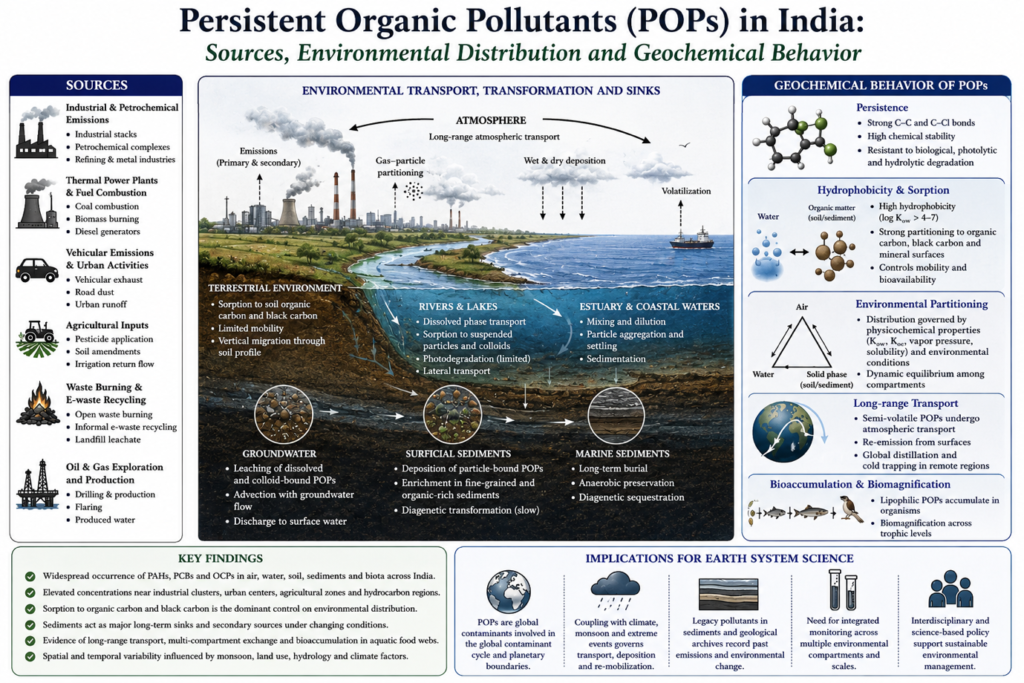
The motivation behind this study arose from the growing recognition that environmental sustainability is one of the defining scientific challenges of the 21st century. India is experiencing rapid industrialization, urbanization, energy transition, and agricultural expansion, which are essential for economic development but can also increase the release of persistent organic pollutants (POPs) into the environment. Unlike conventional contaminants, POPs persist for decades, circulate across air, water, soil, sediments, and biota, and can migrate far beyond their original source regions. Their persistence, toxicity, and bioaccumulation potential have made them a major global environmental concern under the Stockholm Convention. This issue is especially relevant for India as the country advances toward sustainable development goals and the vision of Viksit Bharat 2047, emphasizing environmental resilience, cleaner technologies, and ecological security. Our study therefore aimed to understand the environmental distribution, geochemical behavior, and long-term risks of POPs to support science-based environmental management strategies.
In simple terms, what are POPs, and why are they considered dangerous for the environment and human health?
POPs are toxic chemical compounds that resist natural degradation and remain in the environment for long periods. They can accumulate in living organisms, move through food chains, and eventually reach humans. Examples include polycyclic aromatic hydrocarbons (PAHs), polychlorinated biphenyls (PCBs), and organochlorine pesticides such as DDT. These contaminants originate from combustion processes, chemical usage, waste disposal, and other anthropogenic activities. POPs are particularly dangerous because they remain toxic even at very low concentrations. Long-term exposure has been associated with cancer, endocrine disruption, neurological disorders, reproductive toxicity, and immune system damage. Unlike many conventional contaminants, POPs can also undergo long-range atmospheric and hydrological transport, making them a global environmental and public health concern.
Your study highlights different pollutants like PAHs, PCBs, and pesticides. What makes these particularly concerning?
These pollutants are especially concerning because of their persistence, toxicity, and strong bioaccumulative nature. PAHs are mainly produced through incomplete combustion of fossil fuels, biomass, and other carbon-rich materials, and several compounds within this group are recognized carcinogens. PCBs, despite being banned in many countries, continue to persist in sediments and aquatic systems because of their exceptional chemical stability. Similarly, organochlorine pesticides such as DDT and lindane remain detectable in soils and water bodies decades after their application. A major concern is that these contaminants can continuously cycle between environmental compartments and accumulate within food webs over time. Although many developed countries have reported declining trends due to stricter regulations, several developing regions still experience residual contamination and secondary emissions, highlighting the long-term legacy of POP pollution.
What are the main sources of these pollutants in India, and how do they spread across water, soil, and air?
The major sources of POPs in India include thermal power generation, combustion-related emissions, pesticide usage, waste burning, electronic waste processing, transportation activities, and improper disposal practices. Once released, these contaminants continuously interact between atmospheric, terrestrial, and aquatic systems. Semi-volatile POPs compounds can travel through the atmosphere before redepositing onto soils and surface waters. In soils, they strongly bind with organic matter and remain persistent for extended periods. Rainfall runoff, river transport, and sediment movement further redistribute these contaminants into lakes, estuaries, groundwater systems, and coastal environments. India’s tropical climate and monsoon-driven hydrological conditions can further accelerate contaminant mobility and redistribution compared with colder regions.
Your work identifies regional hotspots. What does this mean, and why should people be aware of it?
Regional hotspots are areas where pollutant concentrations are significantly higher than surrounding regions due to intense anthropogenic influence and long-term contaminant accumulation. These hotspots indicate zones of elevated ecological vulnerability and potential human health risk. Our study identified several hotspot regions associated with dense population canters, coastal belts, waste-processing zones, and areas experiencing high environmental stress. Such regions often receive contaminant inputs from multiple pathways simultaneously, resulting in cumulative environmental impacts. Public awareness is important because POP contamination is largely invisible, yet long-term exposure through air, food, soil, and water can significantly affect human health and ecosystem stability. Identifying hotspots also helps policymakers prioritize environmental monitoring, remediation planning, and sustainable resource management.
What are the major risks of these pollutants for ecosystems and human health?
POPs can significantly disrupt ecosystem functioning by affecting microbial activity, biodiversity, aquatic organisms, and food-web dynamics. Wetlands, estuaries, and coastal environments are particularly vulnerable because they often act as long-term sinks for contaminant accumulation. In humans, exposure mainly occurs through contaminated food, drinking water, inhalation, and occupational contact. Scientific studies worldwide have linked POPs exposure with cancer, endocrine disorders, neurological diseases, immune suppression, and reproductive abnormalities. An additional concern is that climate change may remobilize contaminants previously stored in soils, sediments, and aquatic systems, potentially increasing future environmental and human exposure risks.
Based on your research, what steps should be taken in the future to monitor and reduce these pollutants?
Future POPs management requires stronger environmental monitoring, stricter regulatory frameworks, and cleaner technological practices. India should expand long-term monitoring of air, water, soil, sediments, and biota using advanced approaches such as geospatial analysis, high-resolution analytical techniques, and source-apportionment models. Better management of waste disposal, wastewater discharge, combustion emissions, and informal recycling activities is also essential to reduce contaminant release. Globally, increasing emphasis is being placed on integrated environmental monitoring and sustainable pollution management, particularly under climate resilience and sustainable development frameworks. Effective reduction of POP contamination will ultimately depend on collaborative efforts among scientists, policymakers, industries, and the public to ensure long-term environmental sustainability and protection of ecosystem and human health.