What problem were you trying to solve with this research? Why is pollution from medicines and chemicals in water a concern today?
In this work, we wanted to address a very practical problem: the growing presence of pharmaceutical and industrial organic contaminants in water. Medicines and related chemicals reach rivers, lakes, and wastewater streams through human excretion, improper disposal, hospital discharge, and industrial effluents. Even when present at low concentrations, these compounds can persist in the environment, affect aquatic organisms, reduce water quality, and raise concerns for long-term human and ecosystem health. Our goal was therefore to develop a simple, low-cost, and sustainable material that could remove such pollutants efficiently from water.
Your study uses something very interesting sugar and a traditional clay pot. How did you get the idea to use such simple materials for making an advanced scientific material?
The idea came from a sustainability-driven research approach. In many cases, advanced materials are made using expensive precursors, specialized reactors, and complicated processing steps, which can limit large-scale use. We wanted to explore whether a high-performance adsorbent could be prepared from something inexpensive, widely available, and familiar. Sugar is a rich carbon source, and a traditional clay pot is a simple, heat-resistant vessel that can support carbonization in a low-cost way. In that sense, the study was also an attempt to connect indigenous materials and practical scientific innovation.
Can you explain in simple words what a carbon aerogel is and why it is useful for cleaning polluted water?
A carbon aerogel can be thought of as an extremely light, sponge-like carbon material filled with a very large number of tiny pores. Because of this porous structure, it has a very high surface area, which means there are many places where pollutant molecules can attach. This makes it especially useful for water purification. In addition, carbon aerogels are chemically stable, lightweight, and effective for trapping different kinds of organic contaminants.
How exactly do you make this material from sugar? Could you briefly describe the process in a way that non-scientists can understand?
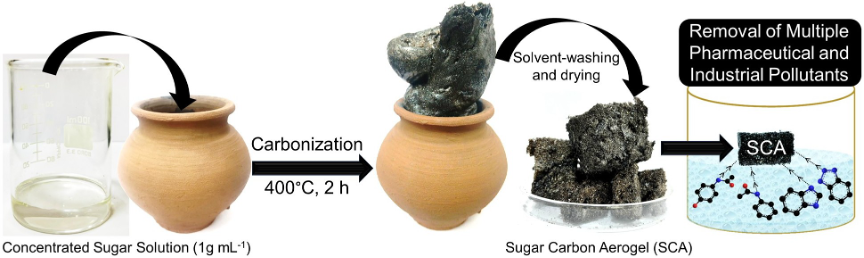
The process is surprisingly simple. First, sugar is dissolved in a small amount of water to make a concentrated syrup-like solution. This solution is then heated in a traditional clay pot at high temperature, where the sugar transforms into a lightweight black carbon framework. After cooling, the material is washed to remove any unwanted residues and then dried. The final product is a porous carbon aerogel made from a very common starting material, without the need for complicated drying methods or costly equipment.
What types of pollutants were you able to remove using this material, and why are these pollutants harmful to the environment or human health?
We tested the material against four representative organic pollutants: benzimidazole, benzotriazole, paracetamol, and acetanilide. These were chosen to represent both industrial and pharmaceutical contaminants. Such compounds are important because they can enter water bodies from domestic use, healthcare systems, and industrial activities. Once present in water, they may persist, disturb aquatic ecosystems, and contribute to broader environmental and public-health concerns, especially when contamination becomes continuous or widespread.
How does this aerogel actually capture or remove pollutants from water? What is happening at the scientific level?
At the scientific level, the aerogel works through its porous structure and surface chemistry. Its large surface area provides many active sites where pollutant molecules can be retained. Our adsorption studies showed that the process is mainly governed by electrostatic attraction and surface interactions such as pi-pi interactions between the pollutant molecules and the carbon surface. The kinetic and isotherm analyses further indicated that adsorption largely follows a pseudo-second-order model and the Langmuir isotherm, which suggests a strong surface-driven process with predominant monolayer adsorption.
One important question people may have is about reuse. Can this material be used multiple times, and how efficient is it after repeated use?
Yes, reusability was one of the encouraging outcomes of this study. We found that the aerogel could be regenerated and reused for up to five adsorption-desorption cycles, with only a gradual decline in performance. In our experiments, the adsorbed pollutants were removed using a mild acidic treatment, after which the material was washed, dried, and reused. This kind of recyclability is important because it improves the practical value of the material and makes it more attractive for real treatment applications.
Finally, how could this research help society in the future? Do you see this technology being used for real water treatment or environmental cleanup?
I believe this research has strong societal relevance because it shows that a useful water-treatment material can be produced from inexpensive and accessible resources. The simplicity of the synthesis makes it attractive not only from a scientific perspective but also from a practical one. With further optimization, such materials could be used in wastewater polishing, treatment of pharmaceutical and industrial effluents, and decentralized water-cleaning systems. Since the material also performed well in spiked and real wastewater samples, the study provides a promising proof-of-concept for future environmental cleanup technologies.