What inspired you to investigate microalgae as potential degraders of plastic waste in freshwater ecosystems?
Our inspiration emerged from observing the increasing accumulation of plastic waste in freshwater environments. An increase in anthropogenic activities results in the discharge of plastic waste into lakes and reservoirs, which results in plastic pollution. People use HDPE, LDPE, PET, PP, and PVC plastics for their daily activities, but these materials create environmental problems because they do not decompose naturally in aquatic ecosystems. Prior and ongoing research has examined how bacteria and fungi break down plastic materials, yet there has been insufficient investigation of how epiplastic microalgae degrade plastic through biochemical and extracellular mechanisms. Our research team investigated how microalgae, which grow naturally in freshwater environments, adapt their behaviour to plastic materials. We also wanted to study microalgae to determine whether they use plastics as their growth substrate or use biological processes to break down the materials. The basis of our research originated from our desire to investigate this topic.
How did your study begin, and what was the main objective of the research?
The preliminary observations were carried out, and field studies were conducted in lentic freshwater bodies in Chennai, Tamil Nadu, India, which were severely polluted with domestic plastic waste. We found that microalgae established dense growth on plastic materials, which led us to investigate how they adapted to synthetic polymer surfaces. Our research objective involved identifying indigenous epiplastic microalgae that possess the ability to break down various types of domestic plastics while we studied the biochemical processes and extracellular mechanisms that drive this process. We sought to investigate how different factors, including cellular metabolism, oxidative stress, extracellular polymeric substances and enzyme-like activities, interact to cause polymer degradation instead of simply measuring degradation percentages.
What were the most important findings from your study?
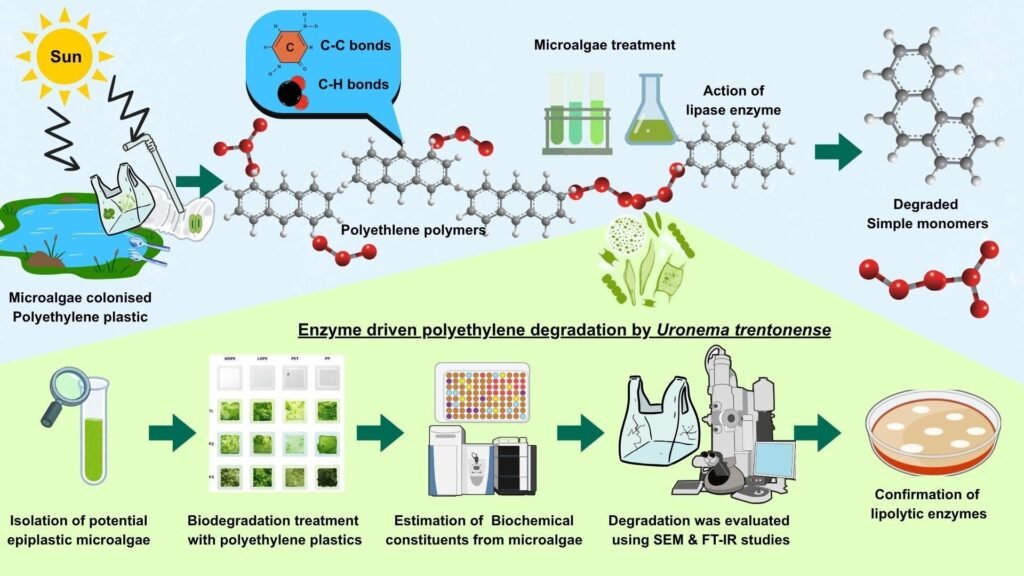
One of the most significant findings was the identification of Uronema trentonense as a highly efficient plastic-degrading microalga. Interestingly, this study represents the first report of Uronema trentonense (PX724094) from India through molecular characterisation using 18S rRNA–ITS sequencing. Among all the isolates screened, Uronema trentonense exhibited the highest degradation efficiency against HDPE and LDPE plastics, achieving up to 27 ± 2% and 21 ± 2% degradation, respectively. The cells underwent significant biochemical transformations that we detected during their exposure to plastic materials. The microalgae showed increased lipid, pigment and extracellular polysaccharide, protein production, which demonstrated their ability to adapt to metabolic stress. The cyanobacterial isolates Nostoc sp. and Oscillatoria sp. produced large amounts of EPS, which helped them create stable biofilms on hydrophobic plastic surfaces. The research results show that microalgae actively participate in the degradation process instead of just passively colonising their environment.
Can you explain how microalgae actually contribute to plastic degradation?
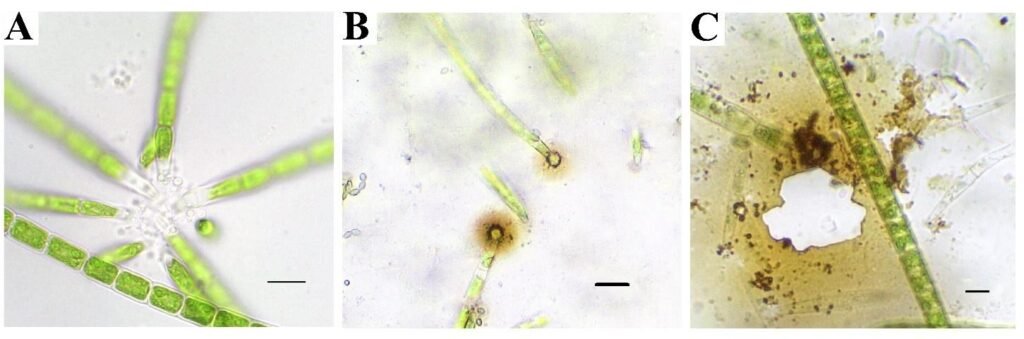
The degradation mechanism shows evidence that it operates through three interconnected mechanisms, which include biochemical, oxidative and extracellular methods of degradation. Microalgae that grow on plastic surfaces encounter environmental stress because their cells must cope with synthetic polymers. The cells respond through increased production of pigments and lipids, together with extracellular metabolites. The metabolic changes lead to the production of reactive oxygen species (ROS), which cause oxidative damage to the plastic surface. The extracellular polymeric substances work together to create stronger attachments, which result in biofilm development that enables cells to maintain contact with plastic materials for extended periods. Our analyses determined that lipase-like enzymatic activity was present in the study. The combination of oxidative stress and the extracellular environment triggers polymer chain cleavage, which results in the conversion of long-chain plastics into smaller intermediate substances. The FT-IR and GC–MS analyses showed that oxidised functional groups and fatty acid methyl esters had formed, which served as evidence for both polymer degradation and metabolic transformation.
What analytical techniques helped confirm the degradation process?
We conducted a full validation of the degradation process through their use of biochemical, molecular, spectroscopic and microscopic methods. We used Scanning Electron Microscopy (SEM) and Atomic Force Microscopy (AFM) to demonstrate structural degradation, which showed cracks, pits and erosion, which increased surface roughness in treated plastics. AFM analysis showed that the surface roughness increased from 31.9 nm in untreated plastics to 207 nm after treatment, indicating substantial nanoscale deterioration. The FT-IR spectroscopy results showed that oxidative degradation produced hydroxyl and unsaturated carbon groups, while GC–MS analysis identified multiple degradation intermediates, which included hexadecanoic acid methyl esters and oxygenated hydrocarbons. To understand the cellular metabolism, confocal microscopy and image flow cytometry to observe intracellular lipid accumulation and extracellular polysaccharide production during plastic exposure. The two analyses produced strong evidence that demonstrated that microalgae actively degraded the material through their metabolic processes.
Why is this research important for environmental sustainability?
The research demonstrates that microalgae possess ecological value as they function as sustainable biodegradable agents that do not harm the environment. Microalgae establish themselves as a unique category of degraders because they use photosynthesis to produce energy while avoiding the toxic endotoxin emissions found in most bacterial and fungal degraders. The organisms possess the ability to use sunlight and carbon dioxide for survival, while they also interact with plastic waste materials. The research reveals new information about the “plastisphere” by showing that freshwater microalgae use their metabolic systems to break down polymers. The mechanisms found in nature will eventually lead to the development of sustainable bioremediation methods to treat plastic waste in water bodies. The study shows that plastic degradation depends on both enzymatic actions and a biological process, which includes metabolic changes and the release of substances from cells to their environment and how they interact with surfaces.
What are the future directions of this work?
The present study demonstrates the significant potential of epiplastic microalgae in the biodegradation of plastic waste; Future research will primarily focus on elucidating the enzymatic and metabolic mechanisms involved in algal-mediated plastic degradation. We planned to determine how enzymes operate through their catalytic efficiency, substrate specificity and degradation pathways, which lead to plastic breakdown. The upcoming research work will use cutting-edge transcriptomic methods and molecular techniques to study stress-response pathways that become active when organisms come into contact with plastic materials. The optimisation studies will enable us to create biodegradation systems which can be used in both environmental and controlled conditions. The research will extend its scope to evaluate how epiplastic microalgae can restore freshwater ecosystems that have been polluted by both macroplastics and microplastics. The research team will conduct long-term ecological studies to determine how plastic pollutants affect microbial community structure and biodiversity and ecosystem functioning during various exposure times. The ecological effects of plastic waste accumulation will be better understood through studying these interactions, which also show how algal communities help restore ecological balance. The research aims to create environmentally safe methods for managing plastic waste through its future research efforts. The research will establish biologically based methods to reduce plastic pollution and enhance aquatic ecosystem health by combining enzymatic studies, molecular analyses, ecological assessments, and environmental optimisation techniques.