Long before life emerged, Earth was likely filled with water and a variety of chemicals, what Darwin called the ”chemical soup.” This primordial soup contained various chemicals that reacted, forming countless new combinations. All it takes is a tiny droplet of this aqueous solution trapped in an oily medium, or an oily droplet within water, combined with the right chemistry inside and outside, to create a system capable of movement that can sense its environment, detect chemicals (aka food), and respond to heat, cold, or electric and magnetic fields. Still, they are not alive because they do not self-replicate. Their chemistry is much simpler than that of the simplest single-celled organisms, yet these droplets share an uncanny resemblance to them.
This type of non-living matter that can move autonomously is called active matter. A simple active matter can be created by placing camphor balls in water, as they will move on their own. Self-propelling droplets represent an intriguing class of active matter that can be engineered to perform a variety of fascinating tasks. The composition of such droplets can be tuned to produce a wide range of individual and collective behaviours. For example, the droplet could move randomly, as if agitated, or along a straight path. They can run and suddenly turn around, as in the run and tumble movement of a bacterium. When we place a large number of such droplets in a confined area, their collective dynamics could take several different forms. They could form swarms, like a school of fish. Two such droplets come together for a time being and move together, or one could go around the other. They could form moving or rotating clusters. Because of these possibilities, there has been a surge of interest in the autonomous movement and collective behaviour of active droplets.
The propulsion of these liquid droplets is powered by the Marangoni effect. In this process, localized chemical gradients induce variations in surface tension across the droplet’s interface, ultimately driving it forward.
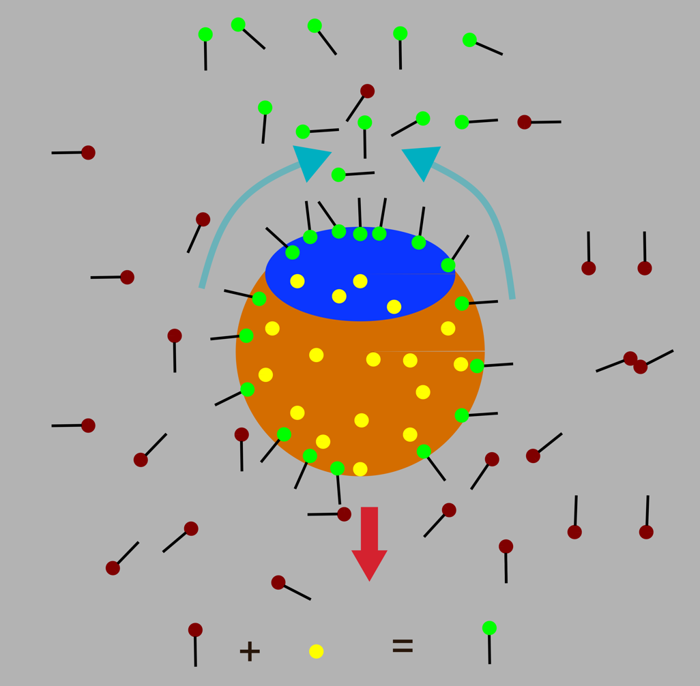
A popular active droplet is made from a liquid that contains or can generate bromine and is placed in an oily medium (squalane) saturated with a surfactant (monolinolein). The bromine (Br) can react with the monoolein (MO) and form bromomonooein (BrMO) near the surface of the droplet. This reaction changes the physical properties of the surfactant molecule and can create a localised dip in surface tension at the interface between two liquids. The surface tension asymmetry creates fluid flow near the surface. To conserve momentum, the entire droplet must move in the opposite direction. When we use simple bromine water inside the droplet, it can move steadily, with speeds varying from 1 to 100 µ m/s. We can speed up the bromination reaction by adding sulphuric acid to the droplet. At a higher reaction rate, the droplet not only moves faster but its motion can also become random.
We can make active droplets more interesting by incorporating the BelousovZhabotinsky (BZ) reaction. The BZ reaction is a nonlinear chemical reaction characterized by cyclic chemical oscillations. It consists of chemicals such as sodium bromate, sulphuric acid, malonic acid, and a metal catalyst, Ferroin, as an indicator. One of the intermediate products of the reaction is bromine (Br2 ). The cyclic reaction can change the colour of the solution from blue (indicating the oxidised state of Ferroin) to red (indicating the reduced state). This colour change can propagate as a chemical wave, with bromine produced just ahead of it. This chemical wave generated within the droplet can further enhance the asymmetric distribution of bromine, which, in turn, can create a larger gradient in surface tension. As a result, when the chemical wave reaches the interface, the droplet’s speed can increase by as much as 10 times.
Another interesting mechanism of generating a surface tension gradient is micellar solubilization. A surfactant molecule, such as monoolein, has a polar end (which can interact with water and hence is hydrophilic or water-loving) and a non-polar end (which does not interact with water and hence is hydrophobic or water-hating). When the surfactant concentration in the oily medium exceeds a critical threshold, surfactants form spherical structures called micelles. In the oily medium, all the hydrophilic parts will come together and form the centre of the sphere, away from the surrounding oil. The hydrophobic part will point outwards and face the oil. These micelles can trap water at their centres, forming swollen micelles. As the droplets move, the micelles carry water out of the droplets, further enhancing the surface tension gradient. Moreover, the droplet leaves behind a trail of such filled micelles, and as they are no longer able to remove water from the droplets, the droplets tend to move away from them. The filled micelles leave the medium with the memory of the droplet’s previous trails. These chemical trails are another way droplets can communicate with each other.
We have observed a variety of interactions between droplets. When several BZ droplets are placed in a Petri dish, some of them come closer to other droplets and move around or move parallel for some time, and then move away. Circular motion of one droplet around its pair is observed when the inter-droplet distance is at a minimum. The droplets can come very close to each other; however, they do not merge. The bromo-monoolein layer that forms around each droplet in the squalene–monoolein medium can prevent droplet merging. We characterized this pairwise interaction by measuring the total time the two droplets remained in proximity. The interaction time of the two BZ droplets decreases as a function of sodium bromate concentration inside the droplet.
We observe similar dynamics when the droplets of different volumes interact. When a big droplet and a small droplet approach from opposite directions or move parallel to each other, they come close for a while, driven by hydrodynamic interaction, and then move apart, driven by the chemical gradient. We see that when a small droplet falls behind a larger one, the larger droplet can quickly move away because it is faster. We observe the maximum interaction time when the larger droplet falls behind the smaller one. Examining their instantaneous speeds, we note that during the interaction, the small droplet’s average speed increases while the large droplet’s decreases. This change indicates that the big droplet is pushing the small droplet. Artificial active matter, like a BZ droplet, helps design a system that can mimic interactions in living systems, such as the run-and-tumble motion of bacteria, the locomotion of amoebas, and their responses to food or temperature gradients. Many groups have found ways to precisely control these artificial swimmers by adding extra nanoparticles and using light to modify the chemical reaction inside. Researchers have also developed interesting applications for these active droplets. They can be used for targeted drug delivery. They can also be used to clean up chemical pollutants by using them as fuel. As we understand more about their dynamics and interactions, we will be able to find new ways of using them to improve our lives and surroundings.