Our interest in working on hydrogen production grew from the need for sustainable energy technologies, and it developed further as we delved into catalytic and electrochemical strategies for efficient water spitting leading to clean fuel generation. To deal with the never ending energy demands and the growing concerns about the climate issues caused by the use of fossil fuels, implication of alternative technologies capable of producing renewable and clean energy is urgently required. The transient nature of existing renewable sources ignited the pursuit for other carbon neutral energy systems and among them hydrogen stand as a promising candidate. Hydrogen generation is a simple reaction involving two electron reduction of two protons. In nature hydrogen is not freely available in their original form, rather they exist in combined form with other elements, such as hydrocarbons or oxides (H2O). Unfortunately, production of hydrogen from its natural sources are unsustainable, as production from hydrocarbons are economical but not carbon neutral and from water is carbon neutral but not economical. This tug of war between the need for clean and economical practices, creates tension in the field of hydrogen evolution technologies. A feasible solution to this is to cut the cost of hydrogen production from its ubiquitous source, water, using efficient and cheap catalyst. Keeping this aim in mind we were in pursuit of iron based electrocatalyst for hydrogen generation from water. Iron being the most abundant 3d transition metal, electrocatalyst based on iron can be an economically viable solution for carbon neutral hydrogen generation.
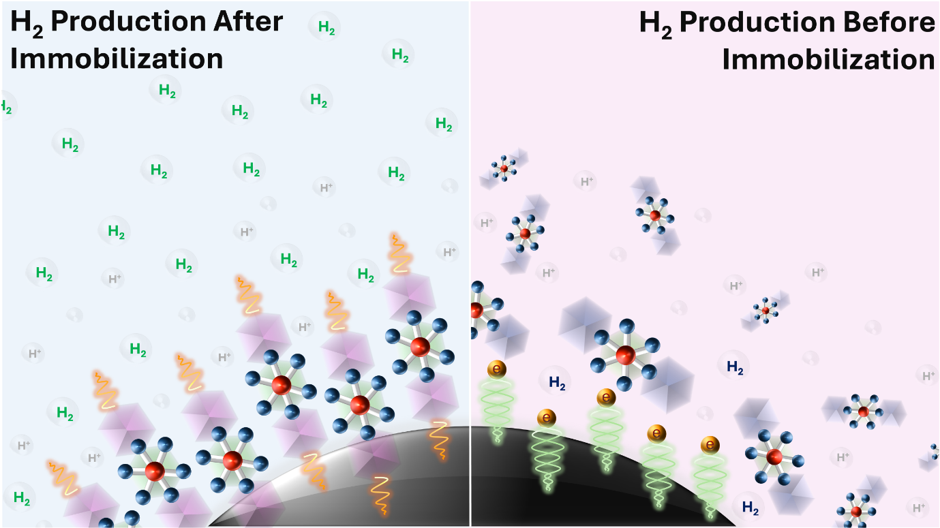
In recent years transition metal complexes have emerged as a significant class of electrocatalyst due to their adaptable structural characteristics, ability to exist in variable oxidation state, atom economy, clear catalytic mechanism and so on. A great deal of molecular catalysts has been developed and investigated, many of which have shown satisfactory stability and catalytic rates for hydrogen generation. To be noted majority of this work is dedicated in employing these catalysts under homogenous condition, which lacked practicality. Very recently, this trend has taken a turn, and they have been immobilized over conducting electrodes via both covalent and non-covalent interactions. This initiative has numerous advantages as they offer the qualities of both homogenous and heterogenous catalysts while also mitigating their shortcomings most of the time. An ideal system to achieve the optimum results require minimal synthetic effort for the development, immobilization of the catalyst and have the capability to directly generate hydrogen under renewable conditions. However, majority of the studies in this area of research fails in terms of practicality due to their lack of stability under experimental conditions and challenges in their synthesis. To address this issue, we studied the direct immobilization of para substituted pyridine-2,6-dicarboxylate based iron complexes via electro-oxidation reactions on conducting carbon surfaces. Major highlight of our study is that the para-chloro substituted pyrdine-2,6-dicarboxylate iron complexes gets covalently attached to the carbon electrode under oxidation potentials via radical pathway. The catalyst immobilized carbon surfaces acted as stable cathode electrode during aqueous alkaline hydrogen evolution reaction. Under electrolysis condition the modified electrode showed minimum stability for 150 hours maintaining stable current densities. In addition to demonstrating a novel method for the direct immobilization of complexes with chloro-substituted aromatic rings through an electrooxidation reaction, this study also demonstrates the adequate stability of pyridine-2,6-dicarboxylate iron complexes under electrolysis conditions during the hydrogen production. This study opens up a new avenue for immobilization of similar catalysts on conducting carbon surfaces for tackling the current energy crisis and it stands as an example for establishing a simple, cost effective synthetic approach to develop stable cathode electrodes for hydrogen production.
Under strong acidic conditions pyridine-2,6-dicarboxylate based iron complexes undergo partial dechelation, resulting the formation of free carboxylic acid arms near the catalytically active iron centre. Hydrogen evolution reaction under acidic condition is thus triggered by the formation of a metal hydride intermediate. But under alkaline condition the complexes exhibit structural rigidity, and this sturdy behavior results in the long term stability of these complexes under aqueous alkaline conditions. Even after immobilization and long term electrolysis studies did not denature the surface anchored catalyst. Besides the novel immobilization approach via electrooxidation reaction, this study introduces a stable molecular iron based cathode electrode for hydrogen evolution reaction. With wide range of similar molecular catalysts and conducting substrates available, this technique ensures that heterogenous hydrogen evolution reaction is viable on variety of their combinations giving limitless possibilities for materials engineering. Further, a major advancement in the field will be studying the activity of these electrodes for direct sea water electrolysis reaction. As the electrode shows stability under aqueous alkaline conditions, its stability in presence of electrode corroding cations and anions should be tested. At present these studies are underway in our lab and we believe the possible outcomes from these studies would mark a place in the evolution of hydrogen evolving catalysts.