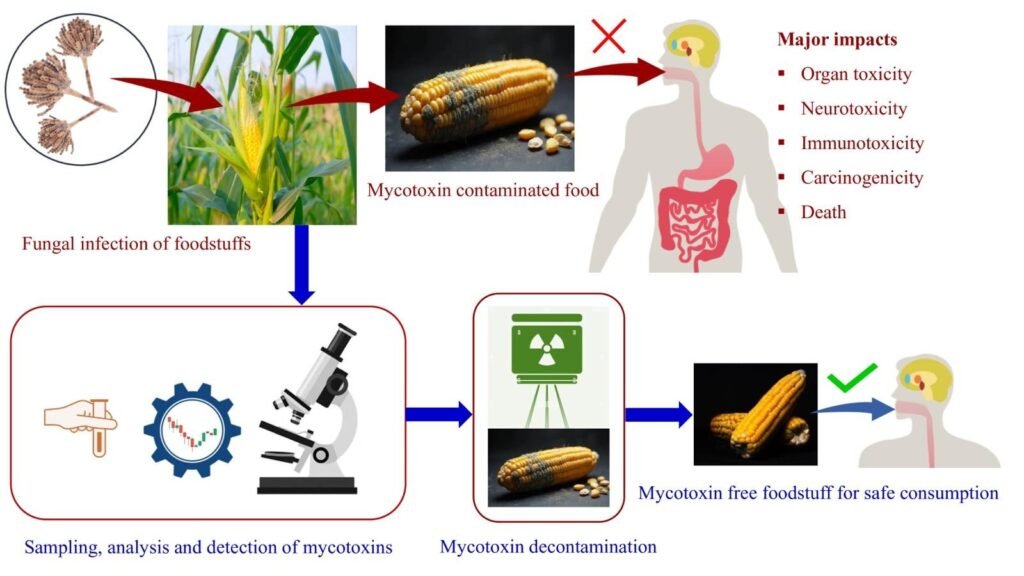
Food is not merely a basic need for physical development and functions but also a driver of the cognitive functions that altogether decides our state of well-being. Hence, ensuring safe and secure access of the society to nutritious and balanced platter of food is the utmost priority of every nation of world. Unfortunately, the food which provides nourishment to our body and mind can sometime also become a carrier of toxic substances produced by nature itself. It is a common knowledge that being easily perishable, foods, either processed or unprocessed are prone to get contaminated by various spoilage causing microorganisms. At least majority of us have seen the greenish patches of that evil looking ‘Bread mould’ sitting over the surface of bread signaling possible harm from consumption. In the world of food spoilage causing microorganisms fungi and moulds are undoubtedly the dominants, overshadowing others. There is a remarkably vast number of varieties of them which can produce a specific type of toxin within the core of food materials once the fungi invade through infection. These toxins, produced by fungi (‘Myco’) are known as mycotoxins and are considered a serious ‘biohazard’ threat to the safely of foodstuffs worldwide due to their short to long term adverse impacts on human health, agronomic practices and livestock raising. Mycotoxins are chemical compounds produced as the secondary metabolites by the mycotoxigenic fungi and excreted in the surrounding of the producer cells. They accumulate within the matrix of infected foods, staying hidden in plain sight and may reach the body of unsuspecting consumers undetected. Mycotoxin induced ‘food poisoning’ may exhibit acute (nausea, fever, vomiting, abdominal pain, diarrhoea etc.) to chronic toxic impacts like hepatotoxicity (liver), nephrotoxicity(kidneys), neurotoxicity (nervous system), immunotoxicity (immune system) on humans or animals. Carcinogenicity is also associated with some mycotoxins which makes them even more concerning for the safety of food and consumers health. Upon consumption above critical levels, which could be ranging between 0.5 to 15 micrograms (μg)/kilogram (kg) death may also occur due to lethal mycotoxicosis.
Although, indications of mycotoxin contamination go back to a longtime in history, severe casualties caused by mycotoxin poisoning are reported in not-so-distant past. In 2004,mycotoxin poisoning caused by consumption of contaminated maize killed 125 people in rural Kenya. Alarmed by such instances of outbreak of mycotoxicosis the global health and food regulatory bodies like World Health Organization (WHO) and Food and Agriculture Organization (FAO) joined hands to form Joint FAO/WHO Expert Committee on Food Additives (JECFA). As the global representative of governments JECFA monitors the risk assessments of mycotoxins in foodstuffs in conjunction with Codex Alimentarius Commission(the intergovernmental standards-setting body for food) to facilitate mycotoxin control in food and management advices for prevention of mycotoxin poisoning. While these practices are implementable in developed countries where sorted, tested, packaged and properly labelled food materials are available in the supermarkets for the customers meeting the safety standards set by the international regulatory bodies, it is a cumbersome task for the developing countries. In countries like Asia and Africa, a direct ‘farm-to-market’ practice is traditionally operated for majority of foodstuffs like the cereals, vegetables, fruits and oilseeds, which often skips the proper check points for possible fungal or mycotoxin contamination. The result can be disastrous as having a tropical/sub-tropical, warm and humid agro-climatic conditions, fungal infestations of crops and other raw foodstuffs is highly plausible in these countries during any stage of food supply chain. This calls for the development of ‘quick-to-run-and-implement’ protocols for accurately detecting, controlling and removing mycotoxins from foods to ensure safe consumption worldwide.
Modern research has identified over 400 structurally different mycotoxins produced by toxigenic fungus like Aspergillus, Penicillium, Alternaria, Fusarium, Claviceps etc. Among them a few stands out as potent contaminants of food and feed due to their frequent occurrence and high levels of toxicity. These include Aflatoxins (AFs), Ochratoxins (OTs), Nivalenol(NIV), Deoxynivalenol (DON), Patulin (PAT), Citrinin (CIT), Fumonisins (FBs) and Zearalenone (ZEN). Mycotoxins can form throughout the cultivation, pre-harvest, harvest and post-harvest storage phases of crop/vegetable/fruit/spices production and during transportation and processing. Early detection of mycotoxins enables prompt action, such as separating contaminated fraction of foods or enhancing storage conditions. In the earlier times, for a visibly damaged or infected lot of foodstuffs simple physical (sorting, sieving, floating, washing, dehulling, steeping, milling, heat treatment etc.) or chemical (citric acid, hydrogen peroxide, propionic acid, sodium hypochlorite, ascorbic acid, aluminium hydroxide etc.)treatments were used to eliminate the toxigenic fungi or mycotoxins. Major limitations of these conventional methods are that they act in a non-specific manner targeting not only sources of mycotoxins but also damaging the nutritional quality and aesthetic attributes of the food stuffs. More importantly these methods are more effective for removing the surface-residing fungi but less effective in penetrating and destroying deeply embedded chemically stable and robust structures of mycotoxins. In recent times various advanced techniques like chromatographic analysis, enzyme linked immunosorbent assay (ELISA), lateral flow assay (LFA) and recently biosensors have been applied due to their high specificity and sensitivity for detecting such well-hidden mycotoxins in foodstuffs. Along with the accurate detection several advanced technologies have been employed for developing unconventional decontamination techniques for targeted destruction and elimination of mycotoxins without leaving behind toxic by-products or secondary residues. These include irradiation, ozonation, cold activated plasma, high hydrostatic pressure, pulsed electric fields, pulsed light, magnetic particles and nanoparticles, natural essential oils and phytochemicals. They are developed based upon different physical, chemical and biological principles and follow different mechanisms for target specific destruction of robust chemical structures of mycotoxins with high degradation efficiency reaching as high as >95% in some specific cases. Additionally, these techniques safeguard preservation of overall nutritional and aesthetic qualities of foods without much damage compared to the conventional mycotoxin decontamination methods. Most recently, combined application of some of these unconventional methods showed the promise of higher mycotoxin degradation in foods. However, the requirements of advanced technical infrastructures equipped with high-end machineries for implementing some of these promising unconventional techniques i.e., cold activated plasma, high hydrostatic pressure, pulsed electric fields, pulsed light, magnetic particles and nanoparticles has restricted their progress within the laboratory-based studies. Complete elimination of fungal contamination of foods throughout all phases of their supply chains is practically impossible due to their almost omnipresent nature.
Thus, standardization of the best practices for mycotoxin decontamination is one yet to achieve goal requiring further research attention. Being directly related to global food safety this is a very important and dynamic field of research. It is swiftly transcending from being a solitary research field towards a highly interdisciplinary domain combining multiple scientific and technical innovations. To achieve high success rates in targeted mycotoxin degradation, principles of analytical chemistry, nutrition and food biochemistry, agro-food processing, process engineering and optimization and computational modelling must be integrated into the focused research endeavours. Inclusion of sustainable development goals (SDGs) has necessitated the mycotoxin decontamination techniques to be completely green, economically feasible and serve societies of the global nations in a satisfactory manner. Beyond optimizing the applicability of the core research findings, successful implementation will require strategic planning by the governmental policymakers to make the mycotoxin decontamination affordable and fully compatible with the latest agro-food-processing operations in practice.