N-Heterocycles and the Rise of Sustainable Synthesis
Nitrogen-containing heterocycles (N-heterocycles) serve as the structural backbone for the majority of modern pharmaceuticals. Recent data indicate that N-heterocycles are present in approximately 82% of small-molecule drugs approved by the FDA since 2013. Among these, pyrazole and its derivatives, such as pyrazolines and pyrazolones, are particularly prominent. The incorporation of the trifluoromethyl (CF3) group into these heterocyclic cores is a strategic design choice in drug discovery. The CF3 moiety enhances metabolic stability, increases lipophilicity, and improves binding affinity and bioavailability. Consequently, developing efficient methods for synthesizing CF3-tethered N-heterocycles is of paramount importance to the pharmaceutical industry.
Traditional synthetic routes to these molecules often involve stoichiometric amounts of toxic oxidants and expensive metal catalysts. Organic electrochemistry offers a compelling green alternative by using electricity as the primary redox reagent. By replacing hazardous chemical reagents with electrons derived from renewable energy, these methods enable transformations under mild conditions, often producing hydrogen gas as the sole byproduct.
“Our research demonstrates how precise control of applied current during constant-current electrolysis can achieve selectivity in product formation, leading to the divergent synthesis of potential molecules.”
Advancing Organic Synthesis through Electrochemistry
Harnessing Radicals with Electricity
A central advancement in this field is the electrochemical generation of reactive radical intermediates. The ability to access C-, O-, and N-centred radicals via direct electrolysis has significantly expanded synthetic capabilities. These radical species are instrumental in triggering cascade reactions, leading to the efficient formation of new C-C and C-heteroatom bonds. Such radical-based strategies enable the construction of highly functionalized molecules that were previously challenging to access through conventional polar pathways.
Metal-Free Routes to Greener Synthesis
A significant trend in recent research is the development of metal-free and external-oxidant-free protocols. These methods align with the core principles of green chemistry by eliminating the need for transition-metal catalysts and hazardous oxidants. These processes typically employ inexpensive electrodes and operate at ambient temperatures, further improving their sustainability profile.
Precision Functionalization of Indoles
Indoles represent a versatile class of building blocks in organic synthesis. Recent electrochemical advances have enabled regioselective functionalization of indoles at various positions (C2, C3, and N1). These strategies utilize electrons to facilitate cross-coupling and cyclization reactions without the need for pre-functionalized starting materials. The ability to target specific sites within the indole ring enables the synthesis of diverse derivatives with potential bioactivity, thereby stimulating further research into indole-based therapeutics.
Combining Light and Electricity for Chemical Synthesis
The integration of photochemistry and electrochemistry, known as electrophotocatalysis, represents an emerging frontier. This hybrid approach leverages the benefits of photons as reagents while using an electric potential to tune the redox state of catalysts. Electrophotocatalysis is particularly effective for transformations such as C-H functionalization and reductive cross-coupling, enabling reaction modes that are inaccessible via single-modality methods.
Controlling Molecular Synthesis with Electricity
Electricity as a Switch for Divergent Synthesis
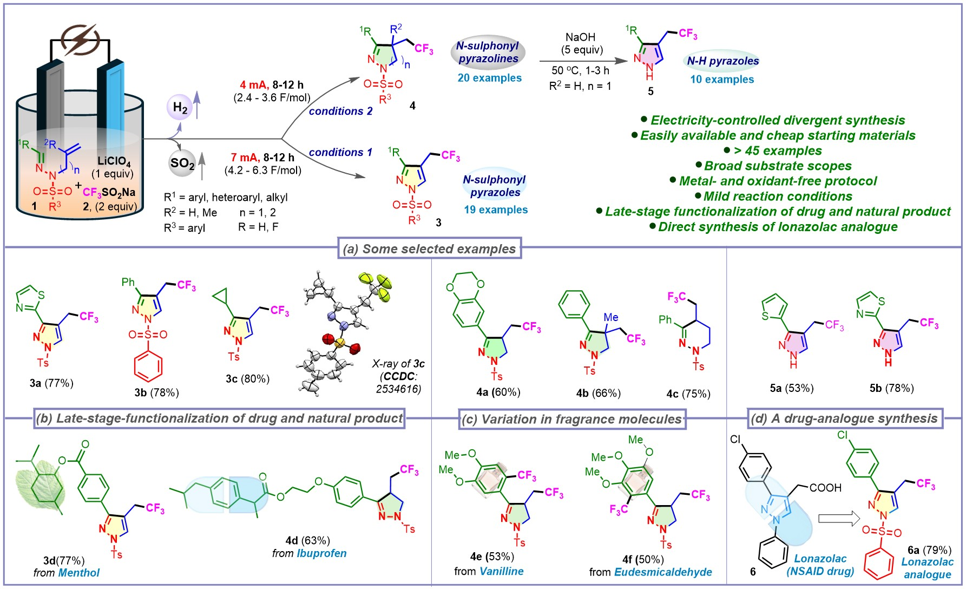
A landmark contribution to the field is the development of electricity-controlled divergent synthesis of biologically active N-heterocycles. Our recent studies have demonstrated that product selectivity can be precisely modulated by adjusting the applied current during constant-current electrolysis. For example, the transformation of N-allyl-N’-benzylidenesulfonohydrazides 1 with CF3SO2Na 2 can yield β-trifluoroethyl-substituted N-sulfonylpyrazoles 3, N-sulfonylpyrazolines 4, or N-H pyrazoles 5 depending solely on the electrical parameters employed.
When a mixture of 1 and 2 was electrolyzed with a constant current of 7 mA for 8-12 h (4.2–6.3 F/mol, conditions 1), 4-trifluoroethyl N-sulfonylpyrazoles 3 were formed, however, a constant-current-electrolysis (CCE) with 4 mA current for 8-12 h (2.4–3.6 F/mol, conditions 2) furnished 4-trifluoroethyl N-sulfonylpyrazolines 4, which after the treatment with NaOH afforded the corresponding N-H pyrazoles 5 (Figure 1).
Thus, by simply tuning the applied electric current during constant-current electrolysis, one can selectively synthesise three different classes of bioactive N-heterocycles. The method exhibits broad substrate applicability and tolerance toward various functional groups, encompassing derivatives from fragrances, pharmaceuticals, and natural products (Figure 1a-1c). Electricity serves as the sole reagent, producing H2 as a harmless byproduct, highlighting the protocol’s significant sustainability. The authors’ 2026 JACS Au paper confirms this electricity-controlled, metal- and external-oxidant-free strategy and its broad functional-group tolerance.
Controlling Trifluoromethylation with Radical Chemistry
The synthesis of CF3-tethered heterocycles often proceeds through a tandem sequence of regioselective radical trifluoromethylation, annulation, and oxidation. Controlling the reactivity of the •CF3 radical generated by sources such as Langlois’ reagent is a major challenge because the radical can attack multiple sites on the substrate. The development of selective radical trifluoromethylative annulation protocols represents a significant advance in overcoming these competitive pathways.
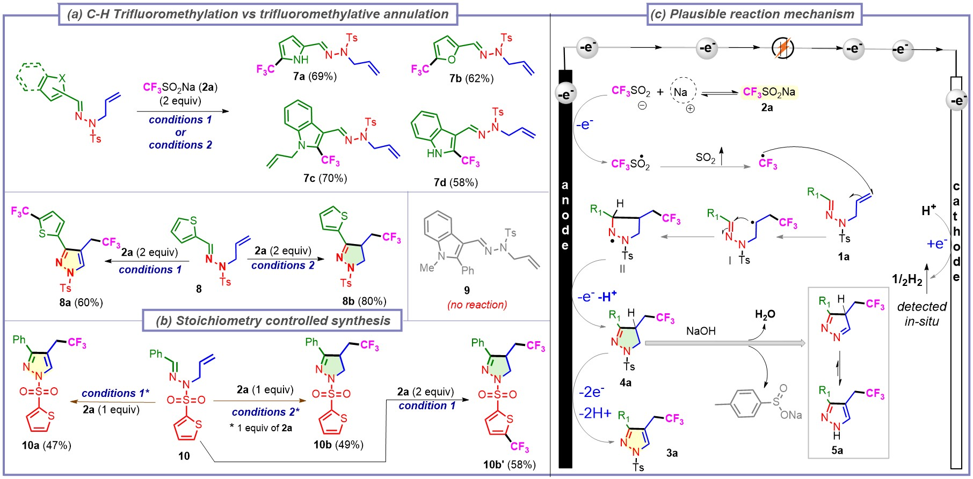
Interestingly, electron-rich heteroaryl such as indole, pyrrole, and furan-substituted substrates underwent chemoselective C−H trifluoromethylation of the heteroaryl component over annulation (Figure 2a). Notably, when the second position of indole was blocked (9), it still did not undergo trifluoromethylative annulation. These findings underscore the distinct reactivity of the •CF3 radical in relation to (hetero) aryl-substituted N-allylsulfonohydrazides. Moreover, thiophene-substituted substrates underwent Langlois’ reagent stoichiometry-controlled trifluoromethylative annulation and C-H trifluoromethylation (Figure 2b).
Extending the Strategy to Drugs and Natural Products
The robustness of this electrochemical protocol is demonstrated by its use in the late-stage functionalization (LSF) of existing drugs and natural products (3d, 4d – 4f), such as ibuprofen and menthol (Figure 1b-1c). Successful CF3 incorporation and heterocyclic construction have been achieved on molecules such as ibuprofen and menthol. Furthermore, this method has enabled the direct synthesis of an analogue of the marketed drug Lonazolac 6, i.e., 6a (Figure 1d), thereby demonstrating its potential utility in pharmaceutical manufacturing.
Understanding How Electricity Controls the Reaction
Several control experiments and mechanistic studies have been conducted to elucidate the origin of the electricity-controlled, chemoselective synthesis of 4-trifluoroethyl N-sulfonylpyrazoles 3, N-sulfonylpyrazolines 4, and N-H pyrazoles 5 from 1 and 2.
These studies revealed that •CF3 radical was generated via a preferential single-electron-oxidation (SET) CF3SO2Na 2 at the anode, followed by the elimination of SO2 gas and subsequent reduction of the sodium ion at the cathode to form a major deposition of sodium metal on the cathode (Figure 2c). The electrophilic •CF3 radical was then added to the terminal position of the allyl functional group of the substrate 1, regioselectively to form the nucleophilic alkyl (2o) radical (I), which, after radical annulation, SET at anode, and deprotonation furnished the 4-trifluoroethyl N-sulfonylpyrazolines 4 under conditions 2 (CCE at 4 mA).
However, under condition 1 (CCE at 7 mA), the in situ-generated 4-trifluoroethyl N-sulfonylpyrazolines underwent two-electron oxidation and two-proton elimination to directly afford 4-trifluoroethyl N-sulfonylpyrazoles 3. When the in situ-generated 4-trifluoroethyl N-sulfonylpyrazolines were treated with NaOH (5 equiv) at 50 °C, 4-trifluoroethyl N-H pyrazoles 5 were formed.
Challenges in Electrochemical Synthesis
Despite significant progress, several challenges remain. Achieving high regioselectivity in multi-site substrates is a persistent hurdle, as the high reactivity of radical intermediates can lead to undesired side reactions. Furthermore, the physical organic principles governing electrochemical transformations are highly complex, with outcomes that are sensitive to electrode materials, electrolytes, and applied electric fields.
A deeper mechanistic understanding, supported by computational modelling and spectroscopic monitoring, is necessary to optimise these reactions for broader application. Moreover, while many protocols are successful at the laboratory scale, transitioning to industrial-scale production requires further development in flow electrochemistry to ensure efficient mass and heat transfer.
Towards a More Sustainable Future for Drug Synthesis
Electrochemical synthesis of CF3-tethered N-heterocycles has transitioned from a niche methodology to a central pillar of sustainable organic chemistry. By harnessing radical reactivity and electricity-controlled selectivity, researchers have developed efficient, metal-free protocols that address long-standing limitations in the controlled, divergent synthesis of biologically active molecules and in drug discovery. As the field continues to integrate, enabling technologies like electrophotocatalysis and flow chemistry, the precise and sustainable use of electrons will undoubtedly play a vital role in the synthesis of next-generation pharmaceuticals.