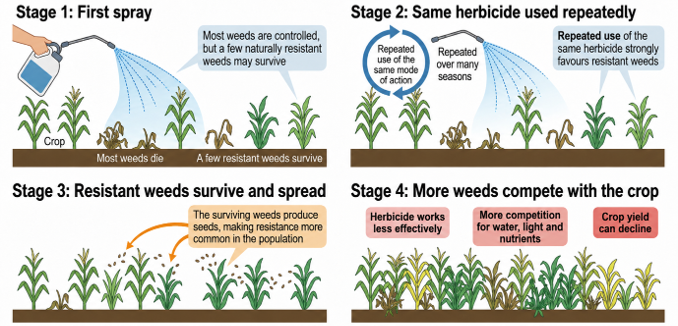
Plants cannot walk away from danger. When exposed to drought, pathogens, extreme temperatures or agricultural chemicals, they must rapidly adjust their internal biology to survive. This remarkable flexibility is controlled not only by the genes plants possess, but also by how those genes are switched on and off. This distinction is becoming increasingly important in weed management. Herbicides remain among the most effective tools for protecting crops from weeds, which compete for water, nutrients, light and space. However, repeated use of the same herbicides has driven the evolution of resistant weed populations. Treatments that once worked reliably are becoming less effective, creating a growing challenge for farmers and agricultural researchers worldwide.
For many years, herbicide resistance was viewed mainly as a genetic problem. A mutation might alter the protein targeted by a herbicide, preventing the chemical from binding effectively. Alternatively, a plant might produce more of the target protein or break down the herbicide before it reaches a harmful concentration. These mechanisms remain central to our understanding of resistance, but they do not explain every case. A more dynamic regulatory layer may also be involved: the epigenome.
“The important question is no longer only what genes a plant carries, but how flexibly and precisely those genes can be controlled.“
BEYOND THE DNA SEQUENCE
The epigenome can be thought of as a collection of molecular instructions that control how the information contained in DNA is used. Unlike a mutation, an epigenetic change does not alter the letters of the genetic code. Instead, it can influence whether a gene is active, silent or ready to respond to a particular signal. One of the most important epigenetic modifications in plants is DNA methylation, in which small chemical groups are added to specific regions of DNA. Depending on where it occurs, methylation can control gene activity, influence nearby regulatory elements or help maintain genome stability. This matters because herbicide responses are probably controlled by the action of several genes, whose regulation could influence whether a plant is damaged by a herbicide or able to tolerate it. Scientists are therefore beginning to ask whether herbicide tolerance can arise not only through DNA mutations, but also through changes in the way existing genes are regulated.
SMALL RNAs AS MOLECULAR GUIDES
A particularly fascinating plant pathway is RNA-directed DNA methylation (RdDM). In this natural process, plants produce small RNA molecules that recognize matching regions of the genome. These small RNAs act like molecular address labels, guiding protein complexes to particular DNA sequences. Once the correct location is found, the cellular machinery can cause DNA methylation and influence the activity of that region.
RdDM is already known to play a major role in silencing transposable elements, protecting genome stability and regulating interactions between genes and nearby repetitive DNA. Increasing evidence also links epigenetic regulation with plant responses to environmental stress. The exciting possibility is that this natural system may eventually become programmable. By designing RNA signals that guide methylation to selected genomic regions, researchers could potentially adjust the activity of genes associated with herbicide detoxification, transport, sequestration or stress signalling, without permanently changing the DNA sequence. Thus, RdDM offers a promising biological route for developing herbicide-tolerant crops in the future.
FROM OBSERVING EPIGENETIC CHANGES TO ENGINEERING THEM
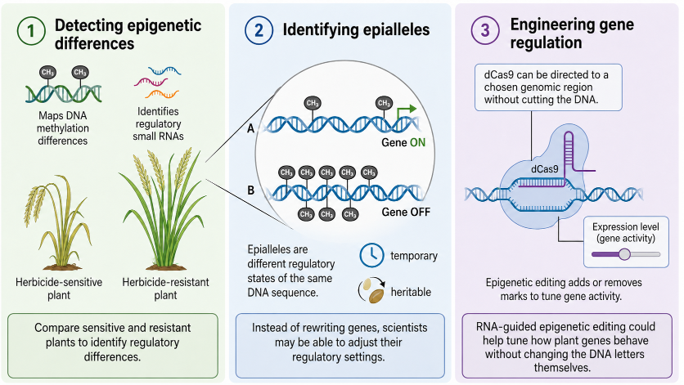
Several technological advances have brought this idea closer to experimental testing. Whole-genome methylation analysis can now reveal where DNA methylation differs between herbicide-sensitive and resistant plants. Small-RNA sequencing can identify the RNA molecules associated with these regions, while transcriptome analysis shows which genes become more or less active. In our recent article published in the Journal of Experimental Botany (https://doi.org/10.1093/jxb/erag094), we proposed combining these approaches to identify regulatory regions linked to herbicide responses and then testing whether targeted changes in their epigenetic state alter herbicide tolerance. Together, these technologies can help researchers identify epialleles, different regulatory states of the same DNA region that are not caused by changes in its underlying sequence. Some epialleles are short-lived, whereas others may persist through plant development or even be transmitted to future generations.
CRISPR technology has also moved beyond conventional DNA editing. A modified Cas protein called dCas9 can be directed to a selected genomic region without cutting the DNA. When joined to proteins that add or remove epigenetic marks, dCas9 may allow researchers to alter gene activity at a chosen location. This represents an important change in thinking. Instead of rewriting a gene, we may be able to adjust its regulatory setting.
THE QUESTIONS WE STILL NEED TO ANSWER
The largest challenge is separating cause from consequence. A methylation change found in a resistant plant might contribute to resistance, but it could also result from herbicide exposure or be linked to nearby genetic differences. Association alone is therefore not enough. Candidate epigenetic changes must be directly manipulated and tested. Stability is another major question. Some epigenetic states disappear when the trigger is removed. Others may persist across cell divisions or generations. Temporary regulation could be valuable when reversible protection is desired, whereas stable epialleles might be useful for breeding. What matters most is that their behavior can be predicted.
Precision must also be carefully examined. Methylation introduced at one location could affect neighboring genes or interact unexpectedly with other regulatory regions. A modification that improves herbicide tolerance might also lead to undesirable traits. Finally, laboratory results must be tested under realistic agricultural conditions. Crop genotype, soil, climate, herbicide dose and developmental stage could all influence the stability and effectiveness of an engineered epigenetic state.
THE ROAD AHEAD
RNA-guided epigenetic crop improvement is a promising but still emerging field. We now possess powerful methods for mapping epigenetic variations and increasingly precise tools for altering gene regulation. What remains to be demonstrated is whether these changes can produce predictable, stable and agronomically useful trait such as herbicide tolerance. Further, these technologies should not be viewed as a reason to increase reliance on herbicides. They must complement crop rotation, mechanical weed control, diversified herbicide use and resistance monitoring. The real promise of RdDM lies in expanding the crop-improvement toolbox. By controlling existing genes rather than permanently rewriting them, RNA-guided epigenetics may offer a more flexible way to develop crops that respond intelligently to agricultural challenges. The field is now moving from asking whether epigenetic changes accompany herbicide responses to asking whether we can deliberately and responsibly control them. Answering that question could open an entirely new chapter in sustainable crop management.