
Nature has spent billions of years refining chemical processes. Within living systems, enzymes carry out complex transformations with remarkable efficiency and selectivity. Crucially, the enzymes execute these transformations under incredibly mild conditions, entirely in water. How do the enzymes achieve such precision? Their performance does not arise solely from the intrinsic properties of their catalytic centers. Equally important is the highly specific, confined microenvironment surrounding these active sites. This allows enzymes to position substrates precisely, protect reactive intermediates, suppress undesired pathways, and control the movement of molecules into and out of their catalytic pockets.
“Unlike closed cages that suffer from product inhibition, the open-ended design of molecular barrels balances robust guest confinement with smooth, continuous chemical exchange.”
One of the central goals of supramolecular chemistry has been to replicate these features in artificial systems. Can synthetic molecular architectures be designed to mimic the functional environments of enzymes while offering robustness, tunability, and structural diversity available through modern chemical synthesis?
Building the Molecular Barrels: Self-assembly at the nanoscale
Over the past several decades, coordination-driven self-assembly has emerged as a powerful tool for the construction of well-defined, discrete three-dimensional metal-organic architectures. Through the spontaneous organization of metal ions and organic ligands, it is possible to generate complex molecular structures in high yield with precise control over shape, size, and functionality. Importantly, the internal cavities of these architectures provide confined reaction spaces that can emulate key features of enzyme active sites by organizing substrates, stabilizing reactive intermediates, and influencing chemical transformations. Historically, many synthetic molecular cages were designed as closed architectures with small openings. While these systems proved highly efficient for guest encapsulation, they often suffered limitations in catalysis. Reactants could enter the cavity and undergo transformation, but the resulting products sometimes remained trapped inside the host. This leads to product inhibition, reducing catalytic efficiency by preventing continuous turnover.
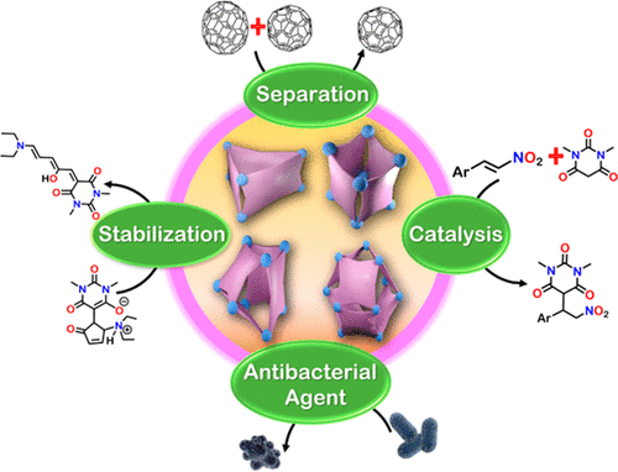
To address this challenge, our group has focused on developing molecular barrels. These self-assembled architectures possess elongated internal cavities enclosed by continuous aromatic walls and large open windows at both ends. Such a design combines two essential features required for efficient host–guest chemistry. The confined cavity provides a protected environment capable of stabilizing reactive species and pre-organizing substrates, while the open ends allow the efficient exchange of reactants and products. As a result, molecular barrels represent attractive platforms for developing artificial enzyme-like reaction vessels.
Fullerene Chemistry and Challenges
Among the many molecular guests that can benefit from supramolecular confinement, fullerenes occupy a special position. The cage-like carbon allotropes C60 and C70 possess exceptional photophysical and electronic properties, making them highly effective photosensitizers. Upon light absorption, they can generate reactive oxygen species that drive a wide range of oxidation reactions. These characteristics have made fullerenes attractive candidates for applications in photocatalysis, energy conversion, and materials science. Despite their promise, the practical use of fullerenes remains challenging. Their extremely poor solubility in water and strong tendency to aggregate significantly limit their performance in aqueous environments. Aggregation suppresses excited-state processes and reduces the efficiency of reactive oxygen species generation. Consequently, many of the desirable photochemical properties of fullerenes become inaccessible under conditions where sustainable chemical transformations are most desirable.
Various approaches have been explored to improve fullerene solubility. Covalent modification by introduction of solubilizing functional groups can increase aqueous compatibility, but these strategies are often synthetically demanding and may alter the intrinsic properties of the fullerene. An alternative approach is to use supramolecular host–guest interactions to control fullerene behaviour without permanently modifying its structure.
Our group has been interested in exploring how molecular barrels could be used for fullerene binding. In our earlier studies, we observed that fullerene binding could induce significant structural reorganization within self-assembled hosts. The introduction of a fullerene guest triggered the transformation of one cage architecture into another, resulting in enhanced singlet oxygen generation and improved photocatalytic activity. Subsequent studies showed that fullerene confinement within molecular barrels could prevent aggregation and enable efficient photocatalysis under visible and even promote catalysis under low-energy red-light irradiation. These advances highlighted the potential of supramolecular confinement for controlling fullerene photochemistry. However, an important challenge remained unresolved. Most fullerene-containing host systems continued to operate primarily in organic solvents. Achieving efficient fullerene photocatalysis in water remains a significant objective. If we truly want to mimic nature and develop sustainable, green chemistry, we have to make such system operational in water.
Unlocking Fullerene Photocatalysis in Water
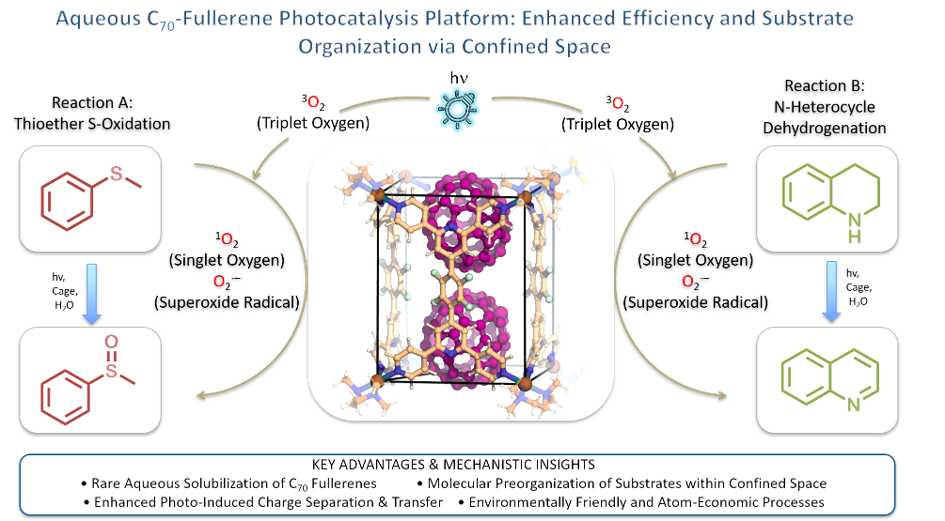
Our recent work addresses this challenge by designing a water-soluble, self-assembled Pd₈ molecular barrel capable of trapping C70 fullerene. The barrel possesses a large rectangular cavity and an overall architecture that combines hydrophobic confinement with excellent aqueous solubility. Upon C70 encapsulation, the barrel undergoes subtle structural adjustments that facilitate the binding of two fullerene molecules, reminiscent of the induced fit model forming a stable host–guest complex. The complex effectively disperses fullerene molecules in an aqueous media while preventing their aggregation. As a result, a homogeneous supramolecular photocatalytic system can be generated directly in water.
The role of the molecular barrel extends far beyond solubilization. Unlike many host systems, the elongated rectangular cavity of barrels not only accommodates the fullerene photosensitizer but also provides sufficient space for substrate molecules to access the confined environment. By bringing substrates into close proximity to the encapsulated fullerene, the barrel creates a localized reaction space where light harvesting, photoinduced processes and substrate activation can occur more efficiently. In this way, the architecture resembles an enzyme-like reaction chamber that combines guest stabilization with substrate organization. Confinement within this well-defined environment also significantly influences the photophysical behaviour of the encapsulated fullerene. Most notably, the host–guest complex exhibits an approximately twelve-fold enhancement in photocurrent response compared with free C70, indicating more efficient charge separation and reduced charge recombination. Together, these effects promote the generation of reactive oxygen species, particularly superoxide radicals, which play a central role in the observed photocatalytic transformations.
Using this system, we demonstrated two important light-driven oxidation reactions in water. The first involves the selective oxidation of sulfides to sulfoxides, an important transformation in synthetic chemistry. The second is the aerobic oxidative dehydrogenation of tetrahydroquinolines to valuable quinolines. These results illustrate how supramolecular confinement can unlock chemical reactivity that would otherwise be difficult to achieve using free fullerene molecules in aqueous media.
“Confinement of fullerenes within the barrel enhances charge separation, empowering complex to drive complex, light-powered sulfide oxidations and aerobic dehydrogenations in pure water.”
Future Perspectives
Supramolecular hosts have officially evolved beyond simple storage vessels. The development of our system demonstrates how molecular confinement can be used not only to solubilize functional molecules but also to enhance and control their behaviour. In this respect, molecular barrels are evolving beyond simple molecular containers into functional nanoreactors capable of regulating photochemical processes. Looking forward, the implications of this work extend far beyond fullerene chemistry. The ability of confined environments to influence charge separation, molecular organization, and catalytic performance suggests new opportunities for the design of advanced supramolecular photocatalysts. Future studies may focus on expanding the range of photoactive guests that can be incorporated within these architectures, developing systems capable of activating more challenging substrates, and improving long-term operational stability under practical reaction conditions.
More broadly, these efforts contribute to a growing vision in which self-assembled molecular architectures perform functions traditionally associated with biological systems. By combining the precision of supramolecular design with the versatility of synthetic chemistry, molecular barrels provide a promising platform for developing sustainable catalytic technologies. While artificial systems are unlikely to match the complexity of enzymes in the near future, advances in molecular confinement are bringing us closer to constructing functional synthetic reactors that emulate some of Nature’s most effective strategies for controlling chemical reactivity.