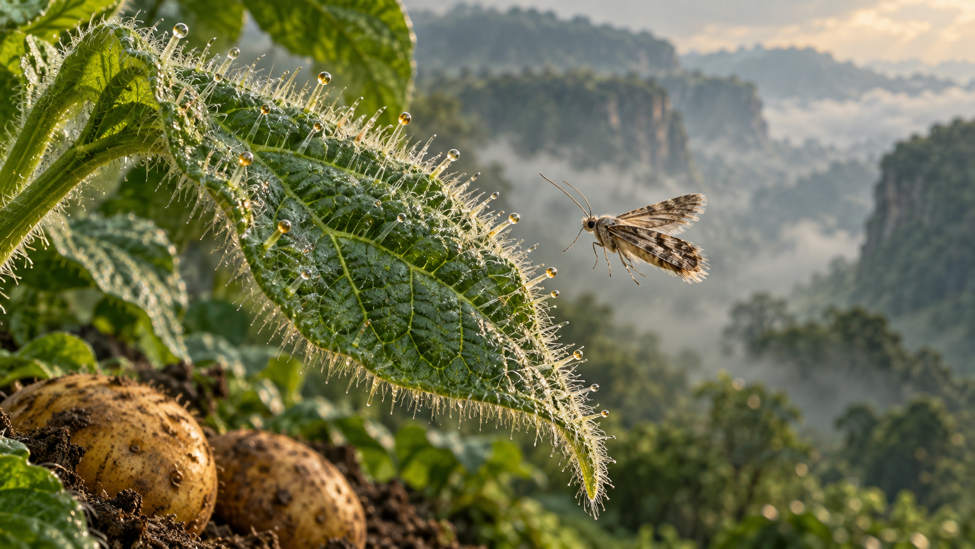
Potato tuber moth is a destructive insect pest of potato crops. What makes this pest particularly challenging for potato growers, both in the field and during storage?
The potato tuber moth is especially destructive because it is a field-cum-storage pest. It can damage potato crops before harvest and continue causing losses during storage. Its larvae remain concealed inside plant tissues and tubers, making the pest difficult to detect and control.
Adult moths lay eggs on leaves, stems, and exposed tubers. The larvae burrow into leaves and stems, forming mines, and may also tunnel directly into tubers. This reduces plant vigor and damages marketable potatoes. Larvae inside the tubers are difficult to detect and are protected from insecticides. Infested tubers may rot and eventually become unmarketable.
The pest can also continue developing in stored potatoes, particularly when tubers are exposed and storage conditions are warm. Therefore, even a small infestation entering the store can multiply rapidly and spread, leading to significant post-harvest losses.
What motivated you to investigate Meghalaya’s traditional potato varieties as potential sources of natural resistance to the potato tuber moth?
The main motivation for investigating Meghalaya’s traditional potato varieties was their unique genetic diversity and long history of cultivation under local environmental conditions. These varieties have been conserved and cultivated by farmers over generations and may possess naturally occurring traits that confer tolerance or resistance to important insect pests, including the potato tuber moth. Such locally adapted genetic resources therefore represent a valuable source of potential pest resistance.
Another important motivation was the growing concern over the dependence on chemical pesticides for managing potato tuber moth. Excessive or repeated pesticide application can increase production costs and may adversely affect beneficial organisms, the environment, and food safety. Identifying naturally resistant potato varieties could therefore provide an alternative, environmentally safer, and more sustainable approach to pest management.
The study was also motivated by the possibility of combining resistance traits from Meghalaya’s traditional varieties with the high-yielding characteristics of commercial cultivars. Although some traditional varieties may have comparatively lower yields, their natural resistance and biochemical defense mechanisms could serve as valuable sources of resistance in future breeding programs. Thus, the investigation aimed not only to identify traditional potato varieties with resistance to potato tuber moth but also to assess their potential as genetic resources for developing high-yielding, pest-resistant potato cultivars with reduced dependence on chemical pesticides.
Phan San Minit and Lah Ksain showed particularly strong resistance in your study. What characteristics distinguished these varieties from the more susceptible commercial potatoes?
The local potato varieties Phan San Minit and Lah Ksain showed comparatively higher densities of both glandular and non-glandular trichomes than the susceptible varieties. These local varieties were found to be comparatively more resistant to potato tuber moth than the commercial varieties Kufri Jyoti and Kufri Megha.
The lower preference of potato tuber moth for Phan San Minit and Lah Ksain was observed in terms of both oviposition and feeding. The expression of resistance was positively associated with higher glandular and non-glandular trichome density on the leaves, greater trichome length, and higher concentrations of defensive biochemical compounds.
Among the biochemical factors, higher levels of the glycoalkaloids α-solanine and α-chaconine, along with phenolic compounds such as chlorogenic acid, caffeic acid, and flavonoids, were associated with greater resistance compared with the susceptible varieties Kufri Jyoti and Kufri Megha.
Thus, the resistance observed in Phan San Minit and Lah Ksain appears to be associated with a combination of physical defenses (trichomes) and biochemical defenses (glycoalkaloids and phenolic compounds), which may reduce potato tuber moth oviposition and feeding.
Your findings highlight glandular and non-glandular trichomes as important physical defenses. How do these structures help reduce egg laying and feeding by the potato tuber moth?
Trichomes are often the first plant structures encountered by arthropods when they land on or move across plant surfaces. Therefore, they play an important role in antixenosis resistance, a type of resistance that deters insect feeding and oviposition. In many crops, particularly solanaceous plants, resistance is associated with the presence, type, density, and morphology of trichomes.
Trichomes are broadly classified into two major types: glandular and non-glandular. Glandular trichomes possess a glandular head and can contribute to plant defense by producing and releasing toxic or deterrent compounds. They may also trap insects through sticky secretions and release defensive chemicals that reduce herbivore activity. In addition, glandular trichomes can interact with herbivores and attract their natural enemies, thereby contributing to indirect plant defense. The size and structure of the glandular head may therefore provide an indication of its potential defensive or toxic activity.
In contrast, non-glandular trichomes generally do not produce defensive chemicals but provide physical protection. Their rigid and often pointed structures can interfere with insect movement, feeding, and oviposition. In Solanum species, non-glandular trichomes are commonly spike-like and can act as physical barriers against herbivores. Differences in their size, density, and structure may influence their effectiveness in protecting plants from insect pests as well as from certain abiotic stresses.
Thus, both glandular and non-glandular trichomes can contribute to insect resistance through chemical and physical mechanisms, respectively. Their density, length, and morphology may therefore be important factors in determining the resistance of potato varieties to potato tuber moth.
Resistant varieties also contained higher levels of glycoalkaloids and phenolic compounds. How do these natural chemicals contribute to defense against the insect pest?
Glycoalkaloids play an important role in the chemical defense of potato plants against insect pests. They have been reported to interfere with the insect nervous system by inhibiting the enzyme acetylcholinesterase (AChE) and by damaging gastrointestinal cell membranes. These effects can disrupt digestion and impair other physiological functions, thereby reducing insect growth and survival. Phenolic compounds, particularly chlorogenic acid, caffeic acid and various flavonoids, also contribute to plant defense. Besides their antioxidant properties, these compounds can exert insecticidal or deterrent effects by interfering with insect metabolism and development. Phenolic compounds can participate in redox reactions and generate reactive compounds that may cause cellular damage in insects.
However, resistance to potato tuber moth cannot be attributed to glycoalkaloids or phenolic compounds alone. Their defensive effects depend on several factors, including compound concentration, tissue distribution, cultivar, insect developmental stage, and interactions with other plant defense mechanisms. Therefore, the resistance of a potato variety is likely to result from the combined effects of multiple physical and biochemical defense traits rather than from a single compound.
What do these findings tell us about the importance of conserving Meghalaya’s traditional potato varieties, especially as high-yielding commercial varieties increasingly replace local germplasm?
The traditional potato varieties of Meghalaya were comparatively richer in nutrients than the commercial varieties and contained substantial levels of biochemical compounds associated with resistance to insect pests. These naturally occurring compounds may contribute to plant defense while remaining within levels considered safe for human consumption. However, the traditional varieties generally produced lower yields than the commercial cultivars.
The inherent resistance of these traditional varieties to insect pests suggests that their cultivation may require fewer applications of chemical pesticides for effective pest management. The presence of naturally occurring defensive compounds can reduce plant and tuber susceptibility to insect infestation, particularly by potato tuber moth. Consequently, the use of resistant traditional varieties could help reduce dependence on chemical pesticides, lower production costs, and minimize the environmental and food-safety risks associated with excessive pesticide use.
Therefore, these traditional potato varieties represent valuable genetic resources for future potato breeding programs. Their resistance traits could be incorporated into high-yielding commercial cultivars through suitable breeding approaches. Combining the natural pest resistance and nutritional characteristics of traditional varieties with the high-yielding potential of commercial cultivars could contribute to the development of high-yielding, nutritionally improved, and potato tuber moth-resistant varieties, thereby promoting more sustainable potato production.
Looking ahead, how could these resistant traditional varieties and their defensive traits be incorporated into breeding programs to develop high-yielding, pest-resistant potatoes with reduced reliance on chemical pesticides?
Looking ahead, the resistant traditional potato varieties of Meghalaya could serve as valuable genetic resources for the development of high-yielding and potato tuber moth-resistant cultivars. Their inherent resistance and naturally occurring defensive biochemical compounds could be incorporated into breeding programs through hybridization with high-yielding commercial varieties. The resulting progenies can then be evaluated and selected for desirable combinations of pest resistance, nutritional quality, agronomic performance, and yield.
Further characterization of the morphological and biochemical traits associated with resistance would help in understanding the specific mechanisms responsible for tolerance to potato tuber moth. Once validated, these traits could be used as selection criteria in breeding programs. Where appropriate molecular markers are identified, marker-assisted selection could further accelerate the development of resistant cultivars.
Combining the resistance traits of traditional Meghalaya varieties with the high-yielding and agronomically desirable characteristics of commercial cultivars could result in improved potato varieties that maintain high productivity while showing greater resistance to potato tuber moth.
The development and adoption of such resistant cultivars could also reduce dependence on chemical pesticides. Since resistance is inherently expressed by the plant, fewer pesticide applications may be required to manage pest populations, potentially reducing production costs, pesticide residues, and adverse effects on beneficial organisms and the environment. Resistant cultivars can further be integrated with other components of integrated pest management (IPM) to develop more sustainable and environmentally friendly potato production systems.
Thus, Meghalaya’s traditional potato varieties represent an important reservoir of genetic diversity and resistance traits. Their effective utilization in future breeding programs could contribute to the development of potato cultivars that combine high yield, improved nutritional quality, and resistance to potato tuber moth, while reducing reliance on chemical pesticides and promoting sustainable potato production.