A finger injury may seem minor, but damage to its tendons can seriously affect hand movement. What role do tendons play in finger function, and why are these injuries sometimes difficult to repair?
Tendons connect muscles to bones and transmit the force needed to move our fingers. The flexor tendons allow us to bend our fingers, grip objects, write, and perform everyday activities. Even a small injury can significantly affect hand function.
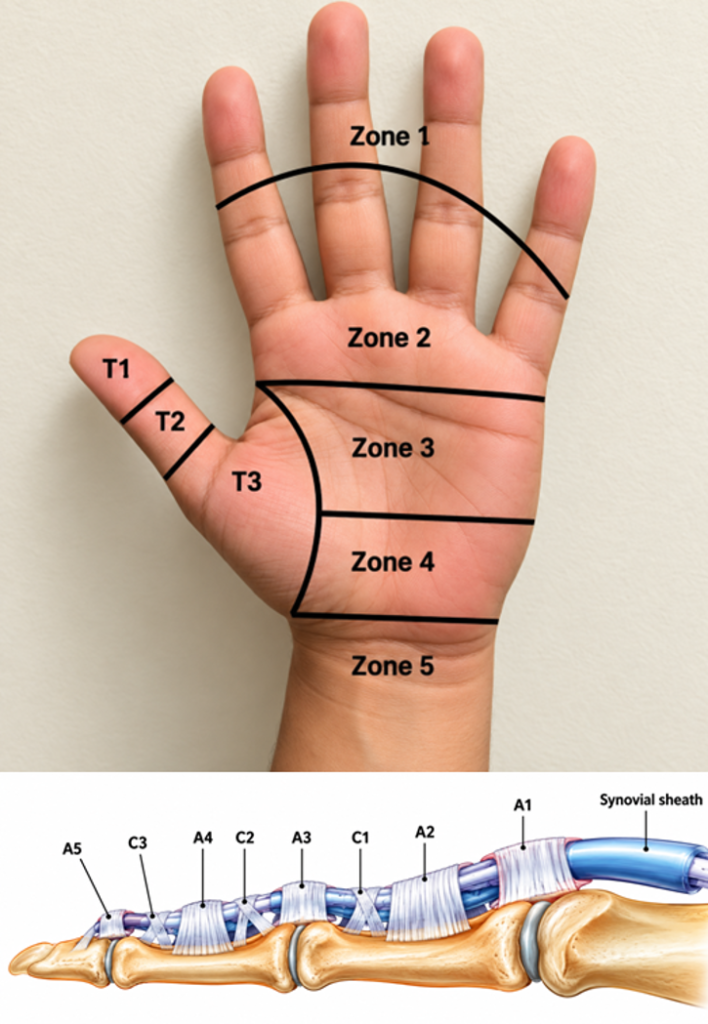
Repairing these tendons is particularly challenging in Zone II of the finger, often called the “no man’s land” of tendon surgery. Here, the tendons travel through a narrow tunnel surrounded by pulleys that guide their movement.
The challenge is not simply to join the cut ends. The repair must be strong enough to withstand controlled movement while remaining smooth enough to glide through this confined space. A bulky repair or excessive scar tissue can restrict movement, while an inadequate repair may separate or rupture.
Successful treatment therefore requires both restoration of tendon continuity and preservation of smooth tendon gliding.
Traditionally, many hand surgeries have been performed under general or regional anaesthesia. What challenges do surgeons face with these approaches, and what makes awake hand surgery different?
General and regional anaesthesia remain important options for hand surgery. However, depending on the anaesthetic technique, patients may be unable to actively move their fingers during the operation. This limits the surgeon’s ability to assess tendon function under active movement before closing the wound.
A repair may appear satisfactory on visual inspection but develop gapping or mechanical obstruction when the patient moves the finger.
Wide-awake hand surgery offers an alternative for appropriately selected patients. By using local anaesthesia while preserving the patient’s ability to cooperate and move the fingers, surgeons can assess the repair dynamically.
The key difference is the opportunity to evaluate not only how the repair looks, but also how it functions. This allows certain problems to be identified and corrected during the same operation rather than discovered later.
Your research uses a technique called WALANT, which allows patients to remain awake during surgery. How does this technique work, and how can patients move their fingers without experiencing pain?
WALANT stands for Wide-Awake Local Anaesthesia No Tourniquet. It uses a local anaesthetic, commonly lignocaine, together with adrenaline (epinephrine). Lignocaine blocks pain signals, while adrenaline constricts small blood vessels and reduces bleeding, providing a chemical alternative to a tourniquet.1
Once adequate anaesthesia has been established, the patient remains awake and can actively move the fingers when instructed. Because the technique does not require the motor blockade associated with some regional anaesthetic approaches, active movement can be assessed during surgery.
Patients should not experience pain from the procedure when anaesthesia is adequate, although they may still perceive pressure or movement.
WALANT is more than an anaesthetic choice in tendon surgery. It creates an opportunity to assess the repaired tendon under active movement and explain the importance of rehabilitation directly to the patient.
One of the key aspects of your work is assessing finger movement during surgery using a technique called iTAMe. How does this help surgeons identify and correct problems that might otherwise go unnoticed?
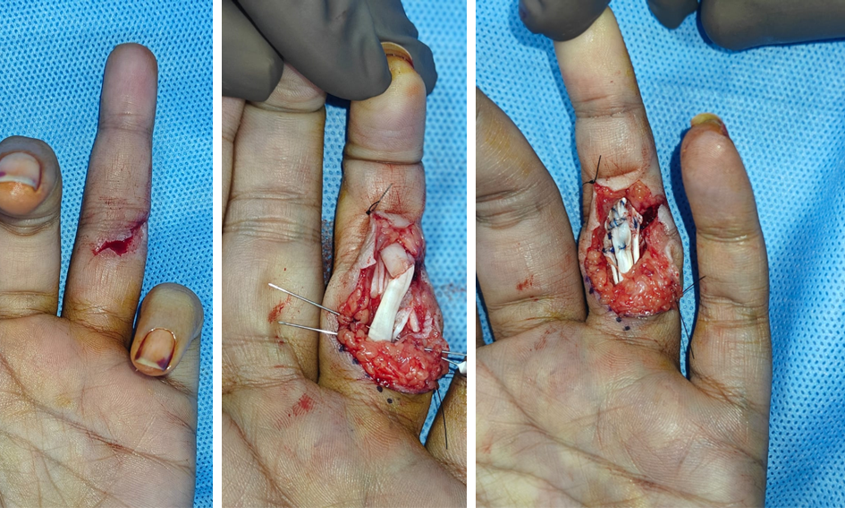
Intraoperative Total Active Movement examination, or iTAMe, is a structured assessment of tendon function during surgery. In our technique, the patient actively moves the finger while the surgeon evaluates repair integrity and tendon gliding.
The assessment includes checking for gapping at the repair site, observing smooth movement through the pulley system, and evaluating resistance during passive movement.
Gapping occurs when the repaired tendon ends separate under tension. Snapping or catching may indicate that the tendon is obstructed as it glides through the pulley system. Excessive resistance may also suggest tendon bunching or problems related to the repair.
Our protocol provides a systematic way to respond to these findings. Gapping can prompt additional suturing or re-repair, while pulley obstruction may require carefully judged partial pulley venting. Adjustments to the sutures may be needed if the repair is bulky.
The advantage is that the surgeon can identify and address these problems before wound closure, when correction is still possible.
Ultimately, the goal of hand surgery is functional restoration, not simply anatomical repair. In our work comparing functional outcomes in two-digit hands,2 we used objective measures of strength and hand function to evaluate the performance of different reconstructive configurations. This reflects a broader principle in hand surgery: surgical success should be judged by how well the reconstructed hand functions, alongside anatomical considerations.
In your study, you describe your clinical experience involving 22 patients and 72 repaired tendons. What were the most important observations, and what do they suggest about the potential benefits of this approach?
Our published technical note describes preliminary experience with 22 patients undergoing Zone II flexor tendon repair using WALANT and iTAMe. A total of 72 tendons were repaired.
Intraoperative testing identified repair-site gapping in six tendons (8.3%) and pulley obstruction in 12 tendons (16.7%). These problems were addressed using the described troubleshooting approach.
During three months of follow-up, no tendon ruptures were recorded. Twenty of the 22 patients achieved full active finger motion. One surgical-site infection was documented, and one patient was lost to follow-up.
These observations demonstrate the feasibility of combining wide-awake surgery with systematic functional assessment. They also illustrate how testing movement can reveal correctable problems that might not be apparent during static inspection.
However, this was a technique-focused report involving a small group of patients, and the findings were not statistically analysed. The results are encouraging but do not establish superiority over other approaches. Larger, controlled studies are needed to determine the long-term benefits and risks.
Beyond improving surgical precision, what benefits could awake hand surgery offer patients? Could their active participation during surgery also help them better understand the recovery and rehabilitation process?
One important advantage is the opportunity for intraoperative patient education, which we refer to as iPE.3
Flexor tendon repair is only the beginning of recovery. Rehabilitation must balance controlled movement, which helps minimise stiffness and adhesions, against protecting the repair from excessive force that could cause rupture.
During awake surgery, the surgeon can explain the injury, demonstrate the repaired finger’s movement, and discuss why the postoperative rehabilitation programme must be followed carefully. This can help patients understand that successful recovery depends on both the surgical repair and their participation afterwards.
When appropriate, involving a hand therapist can further reinforce rehabilitation instructions.
Nevertheless, being able to move the finger during surgery does not mean that unrestricted movement is safe after surgery. Patients must follow an individualised rehabilitation programme under the guidance of their surgical and therapy teams.
Looking ahead, what challenges remain in making awake hand surgery more widely available, and what further research or technological advances could improve the treatment of finger tendon injuries?
Wider adoption requires appropriate training, careful patient selection, familiarity with WALANT techniques, and coordination between surgeons and rehabilitation teams. Patients also need clear explanations and reassurance about remaining awake during surgery.
WALANT should be viewed as an additional option rather than a universal replacement for general or regional anaesthesia. Its suitability depends on the patient, injury, procedure, and clinical circumstances.
Future research should include larger multicentre studies comparing outcomes across different anaesthetic and surgical approaches. Important measures include tendon rupture, adhesions, range of motion, complications, patient-reported function, and return to daily activities.
Our technical note also identifies ultrasound-assisted detection of tendon gaps and simulation-based training for iTAMe as promising areas for further development. These approaches could help improve assessment and standardise training, although their clinical value requires validation.
Ultimately, the goal is not merely to repair a tendon, but to restore useful movement and help patients return to their everyday activities. Combining sound surgical technique, real-time functional assessment, and informed patient participation offers a promising way to work towards that goal.