This article is currently maintained under temporary RFCSR publication support until 13 June 2026.
The notion of vehicles talking to each other sounded futuristic a few years ago. Connected vehicles are already a part of everyday life today. Cars can communicate other nearby cars when they are braking hard, link to traffic lights to reduce congestion, connect to the cloud for navigation updates and even help autonomous driving systems. All of these capabilities depend on one invisible, but critical technology: the antenna.
Cars today are more than machines. They are becoming intelligent communication platforms. Every second, enormous amounts of data are moving between vehicles, road infrastructure, satellites, sensors and mobile networks. To keep this ecosystem running smoothly, wireless connectivity must stay stable even in difficult conditions such as crowded highways, urban traffic, tunnels, rain, or high-speed mobility. While losing a connection in a smartphone can be an inconvenience, a loss of communication in a smart vehicle could directly impact safety.
The growing need for dependable vehicular communication is accelerating the pace of innovation in the field of antenna technology. In recent years, research on vehicular antennas has made significant advances from the conventional single-band designs. Antennas today must work across multiple frequency bands, support high data rates, provide stable connectivity in all directions, and fit inside increasingly compact vehicle structures. One of the biggest engineering challenges in modern transportation systems is to achieve all of this simultaneously.
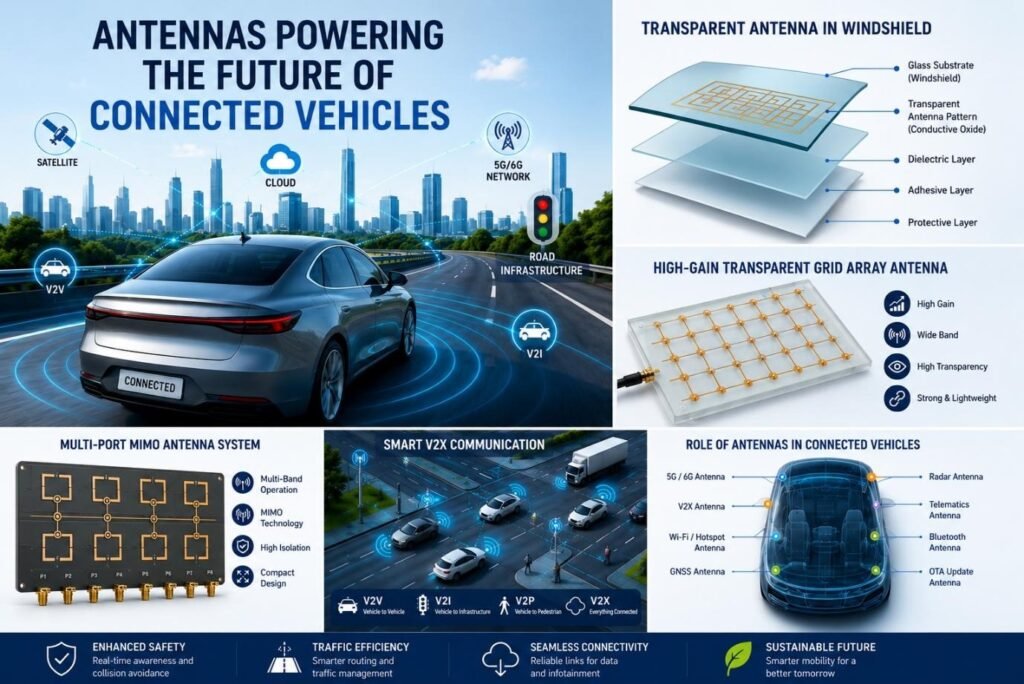
We have been working on solving some of these challenges through advanced multi-band and multiple-input-multiple-output (MIMO) antenna systems for connected vehicles. In our work, a cubic metasurface-based RFID reader antenna was developed for providing 360-degree coverage in internet of vehicles applications. The antenna provided a high gain and a wide directional coverage, which enabled vehicle detection and communication reliably, at road intersections and smart traffic junctions. This design illustrates how three-dimensional antenna arrays can dramatically enhance communication reliability in vehicle-to-infrastructure networks, unlike conventional systems that often face limitations in coverage areas.
A significant trend in our work has been the development of massive MIMO systems for intelligent vehicular communication. Today’s connected vehicles need to be able to communicate with a variety of devices and networks simultaneously, including GPS, Wi-Fi, vehicle-to-everything (V2X) and cloud infrastructure. To address this growing complexity, we designed a sixty-port MIMO antenna system that operates in multiple bands and maintains low correlation and high diversity performance. The basic concept of these systems is simple: rather than depending on a single communication path, multiple antenna elements work together to increase signal strength, reduce interference, and ensure reliable connectivity even in rapidly changing environments.
At the same time, the physical appearance and the integration of MIMO antennas in vehicles become more and more important. Transparent and embedded structures that are integrated into the vehicle surfaces such as windshields or panoramic glass roofs are increasingly replacing the classic protruding antennas. We explored this concept in our work on optically transparent automotive antennas, where we designed transparent multi-service antennas with conductive oxide materials on glass substrates. These antennas accommodate a wide range of communication standards, while preserving vehicle aesthetics and minimizing aerodynamic impact. Such designs are an important step towards future smart vehicles where the communication hardware is nearly invisible.
One of the biggest unresolved challenges is balancing compact size with high performance. There are already many electronic systems built into vehicles include radar sensors, cameras, LiDAR units, GPS modules, infotainment systems and wireless communication devices. It is very difficult to place multiple antennas without creating any electromagnetic interference. With each additional communication band, antenna structures become more congested and intricate. A second critical problem lies with mutual coupling in massive MIMO systems. Mutual interference arises when multiple antenna elements are positioned in close proximity, resulting in reduced efficiency and weakened signal quality. Although techniques such as metasurfaces, defected ground structures, orthogonal placement, and polarization diversity can mitigate coupling, achieving robust isolation within compact vehicular platforms remains a significant challenge. Ensuring reliability in real-world environments is also a critical concern. While antennas may exhibit optimal performance in laboratory settings, actual vehicular conditions are considerably more variable. High-speed movement, reflections from surrounding structures, fluctuating weather, dense traffic, and changes in vehicle orientation all affect wireless performance. Overcoming the challenge of maintaining stable communication links under these dynamic conditions constitutes a key technological gap in connected transportation systems.
However, there are several important unanswered questions about future integration. How to satisfy the need for enormous bandwidths of autonomous vehicles without increasing the power consumption of antennas? How can vehicles seamlessly switch between 5G, Wi-Fi, satellite and roadside communication systems? Is the efficiency of transparent antennas comparable to conventional metallic structures? And perhaps most importantly, how can all these technologies be kept affordable enough for widespread deployment in everyday vehicles, and not just in premium models?
The emergence of 5G and the initial evolution of 6G technologies are predicted to make this field even more transformative. Future communication networks will demand ultra-low latency, massive device connectivity and real time data exchange between millions of moving systems. Antennas will no longer be simply communication devices, they will become intelligent sensing and networking platforms embedded in the whole transportation ecosystem. Massive MIMO systems have a great potential to enhance channel capacity, reliability and data throughput by exploiting multiple parallel communication paths. This translates into faster communications, quicker safety response times and more robust autonomous driving capabilities for connected vehicles. However, the scalability of MIMO systems with small, energy-efficient and low-cost antennas is still an open research problem.
Artificial intelligence could also transform antenna technology in the near future. In future smart antennas may be able to dynamically change their radiation patterns, frequencies and polarization states according to traffic density, environmental conditions or communication requirements. Antennas can evolve from static hardware systems into adaptive and self-optimizing components of intelligent transportation systems. Another exciting frontier is the convergence of communication and sensing technologies. In the future, vehicle antennas may incorporate a single integrated platform that simultaneously supports radar sensing, wireless communications, environmental monitoring and positioning systems. This can drastically cut down hardware complexity and enhance vehicle intelligence.
The exciting part of this field is that the story is yet to be written. Every step forward in antenna design moves connected transportation closer to safer roads, smarter cities, less congestion and more efficient mobility systems. Passengers may not see the antennas tucked away in the cars of tomorrow, but they will silently power the intelligent transportation networks that will define the future of mobility.