This article is currently maintained under temporary RFCSR publication support until 13 June 2026.
In the race to solve the crises of global energy demand and environmental pollution, the light from our own sun can be far more effective than we often realize. Imagine a material that we could put in a container of polluted water, catch a few rays of sunlight, and instantly begin breaking down toxic chemicals into harmless substances. Likewise, a material that uses sunlight to split water molecules into clean hydrogen fuel. This isn’t science fiction, it’s the power of photocatalysis. Photocatalysis is about using light to start a chemical reaction. Among the many materials studied for this task, Zinc Oxide (ZnO) stands out as a champion. It is abundant, cheap, and safe. However, in its natural state, ZnO has a bit of a native issues such as it only responds to high energy ultraviolet (UV) light, which makes up less than 5% of the sunlight reaching our planet (Earth). To make it a real world hero, we have to upgrade it further. To push ZnO to its full potential, our research focuses on two main modifications: doping and heterostructure design.
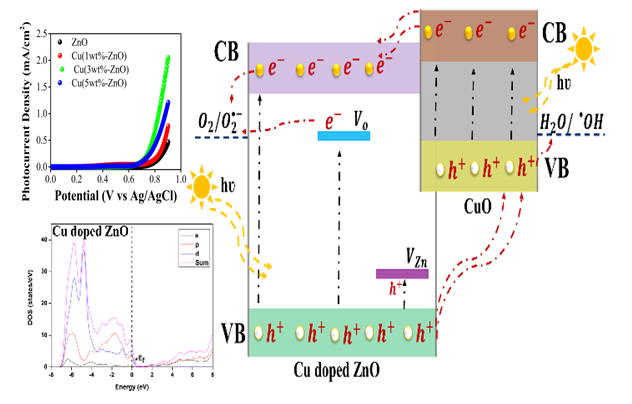
Think of doping like adding a pinch of seasoning to a dish to change its character. By introducing small amounts of copper atoms into the crystal lattice of ZnO, we fundamentally change how it interacts with light. Copper narrows the bandgap, the energy required for electrons to become active in the reaction. This also allows the material to and absorb visible light (45% of the solar spectrum), not just UV (5% of the solar spectrum). But absorbing light is only half the battle. For the chemistry to happen, these electrons and holes need to stay apart and move to the surface of the material. In pure ZnO, they tend to find each other and recombine almost instantly, wasting the energy as heat. To solve this, we design heterostructures. By pairing ZnO with another material (like another semiconductor). One material pulls the electrons, the other pulls the holes. This spatial separation ensures that the charges live long enough to reach the surface and perform the reaction of breaking down pollutants.
Our findings have been eye-opening. When we compare standard ZnO to our copper-doped heterostructures, the efficiency gains are impressive. By precisely controlling the amount of copper, we have observed a significant increase in the degradation rates of organic dyes in water. The results reveal a special role of charge separation induced by the copper doping in ZnO structure. On the other hand, it also turns out that more is not always better. Excess amount of copper can actually act as a trap that stops the electrons from moving. However, when balanced correctly within a heterostructure, the synergy is undeniable. We aren’t just making the material more sensitive to light, we are making it more productive. We have seen charge carrier lifetimes extend significantly, which translates directly to a faster, more thorough catalytic process in water treatment tests.
Now the question arises: If the lab results are so promising, why don’t we have these materials in every water treatment plant? But the transition from a small beaker in a lab to a real world application is troubled with challenges. Currently, the biggest limitation is stability and recovery. In a lab, we use pure, distilled water. In the real world dirty water contains salts, bacteria, and various minerals that can impact the catalyst surface, making it less effective over time. Furthermore, most high-performance photocatalysts are synthesized as tiny nanoparticles. While they have a huge surface area for reactions, they are incredibly difficult to recover from the water once the job is done. There is also the issue of photocorrosion. Some of the best performing materials actually begin to dissolve or degrade under prolonged exposure to light and water. Creating a material that is both highly reactive and incredibly rough.
Despite our progress, several fundamental questions still remains:
- We know the general process, but mapping the exact active sites on a complex heterostructure surface in real time is still difficult.
- Can we design a material that is equally effective against pesticides, plastics, and pathogens?
- Plants perform photosynthesis with near-perfect efficiency using very common elements. We are still struggling to match the elegant charge-transfer mechanisms found in a simple leaf.
The Road Ahead: Looking forward, the future of photocatalysis lies in scalability and integration. We are trying to upgrade from dispersed powders in dye solution to immobilized systems growing our copper-doped heterostructures onto large, flexible substrates. This allows water to flow through the system while the catalyst stays fixed, ready to be used again and again. We are also exploring green approach: using bio-waste materials to create these catalysts. If we can harvest zinc from green waste or copper from bio-source to build our energy-saving materials, the environmental payoff is doubled. We are moving closer to a world where polluted water purification is possible allowing remote communities to clean their water using nothing but a plastic bottle coated with a specialized film and the midday sun. Thus our aim is to build the tools for a cleaner, self-sustaining planet.