This article is currently maintained under temporary RFCSR publication support until 13 June 2026.
Chemistry has traditionally been rooted in the design and understanding of static molecules, entities defined by fixed structures, predictable reactivity, and well-established mechanistic pathways. While this approach has enabled remarkable advances in synthesis, catalysis, and materials science, it falls short of capturing the dynamic complexity inherent in living systems. In contrast, biological matter operates through highly interconnected molecular networks that continuously sense, process, and respond to environmental cues. These systems exhibit properties such as adaptability, self-regulation, and functional autonomy, features that collectively define what could be described as ‘molecular intelligence’. Bridging the conceptual gap between static chemical systems and dynamic living matter has thus become a central challenge and opportunity in modern chemistry.
The emergence of systems chemistry and supramolecular design has begun to reshape how chemists think about function at the molecular level. Seminal reports by Koshland, Lehn, Pederson and Cram have made a paradigm shift. Rather than focusing solely on individual molecules, attention is increasingly directed toward ensembles of interacting components capable of collective behaviour. In such systems, non-covalent interactions, reversible bonding, and energy flow enable continuous reorganization and responsiveness. This shift from isolated molecules to dynamic networks is critical for developing chemical systems that can mimic life-like processes, including signal transduction, feedback regulation, and adaptive function.
In a recent study, we have demonstrated that chemical systems can also be intelligent and smart enough to understand the external stimuli to process themselves accordingly. Our exploration led to the development of electroactive, reconfigurable organic receptors capable of performing multiple functions simultaneously, marking a shift from single-purpose molecules to integrated chemical systems. One of the most notable breakthroughs lies in the demonstration of chemically induced flexibility in inherently rigid molecular scaffolds (Scheme 1). Traditionally, structural adaptability in supramolecular chemistry has relied on metal–ligand reassembly or dynamic covalent exchange. However, we have shown that even a rigid, planar ligand framework can undergo dramatic and reversible conformational transformations through simple chemical modification. Specifically, N-alkylation of a planar tripyridyltriazine (TPT) core induces an unprecedented transition to a bowl-shaped geometry, revealing that structural plasticity can be embedded directly into molecular design without altering the core connectivity.
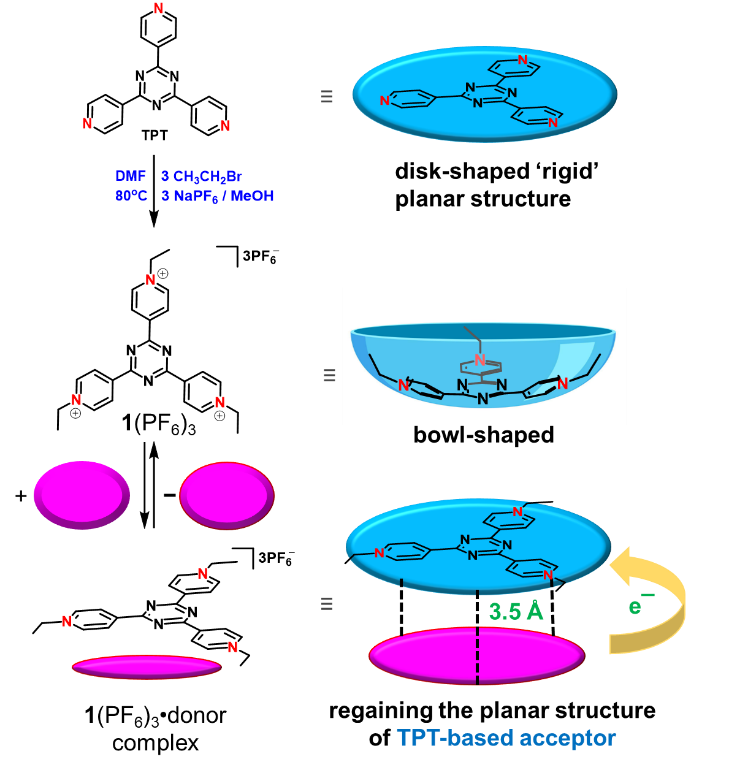
Upon interaction with electron-rich guest molecules, the distorted “bowl” conformation reverts to its original planar structure. This dynamic switching not only enables adaptive host–guest recognition but also demonstrates how molecular systems can reorganize in response to environmental inputs to maximize functional output. Such behaviour closely parallels biological receptors, which alter their conformation to achieve selective binding and signal transduction.
Another major advancement is the integration of information encoding and processing at the molecular level. The tunable electronic structure of these adaptive systems, modulated through conformational and redox changes, enables donor–acceptor interactions that can be harnessed for molecular-level encryption and decryption (Figure 1). This represents a significant step toward chemical data processing and secure information technologies that operate beyond traditional electronic platforms.
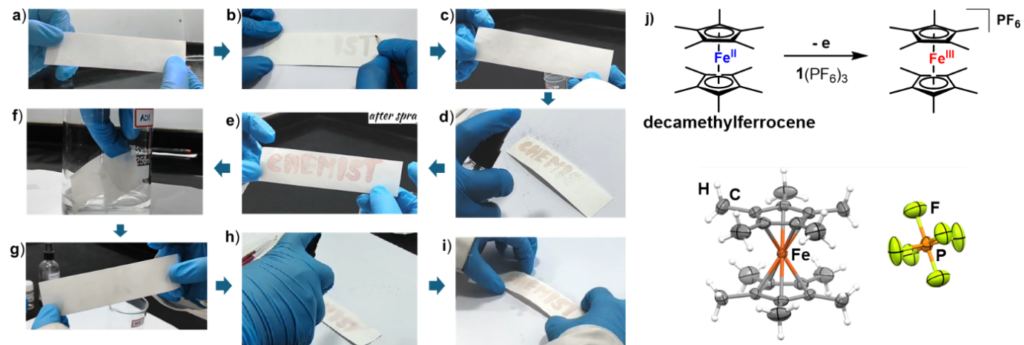
In parallel, these systems demonstrate functional reactivity coupled to adaptive behaviour, particularly in the context of metal-free redox chemistry. The enhanced electron deficiency of the tricationic receptor enables it to act as an efficient organic oxidant, capable of transforming electron-rich substrates such as decamethylferrocene under mild conditions (Figure 1j). This dual role, combining adaptive recognition with catalytic or redox function, highlights the emergence of multifunctional molecular platforms that can sense, respond, and act within a single system. Adaptive molecular systems capable of sensing, processing, and responding to stimuli open new avenues for designing autonomous functional matter. Such systems could revolutionize catalysis by enabling self-regulating catalysts that adjust activity and selectivity in real time.
Despite these promising prospects, several fundamental challenges remain. One major limitation is the control of complexity, as systems become more multifunctional and interconnected, predicting and directing their behaviour becomes increasingly difficult. Achieving precise spatiotemporal control over molecular responses, especially under non-equilibrium conditions, is another critical hurdle. Additionally, energy management remains a key challenge, as sustaining adaptive and life-like behaviour requires continuous and efficient energy input. Furthermore, integrating multiple functions, such as sensing, processing, and actuation, within a single system without cross-interference demands careful molecular design. Finally, translating proof-of-concept systems into scalable, real-world applications requires improvements in stability, reproducibility, and synthetic accessibility. Addressing these challenges will be essential for advancing molecular intelligence from conceptual frameworks to practical technologies. Currently, we are focusing to solve these problems.