Why Do We Need New Ways to Make Antibiotics?
Antibiotics are among modern medicine’s greatest achievements, yet the way we manufacture many of them has barely changed in decades. Penicillins and cephalosporins, the β-lactam family that still accounts for a large share of the antibiotics prescribed worldwide, are made by growing filamentous fungi such as Penicillium in large fermenters. These fungi are capable producers, but they grow slowly, are difficult to engineer genetically, and leave little room to redesign the molecules they make. Drug-resistant infections already contribute to well over a million deaths each year, and the pipeline of genuinely new antibiotics has thinned. As resistance rises and the demand for new and modified antibiotics grows, the question of where and how we produce these compounds has become as important as the biochemistry itself.
β-lactam antibiotics belong to a class of natural products called non-ribosomal peptides. Most proteins are made by ribosomes, which read the cell’s genetic code to string amino acids together in a set order. Non-ribosomal peptides are built differently: giant, multi-part enzymes called non-ribosomal peptide synthetases assemble them piece by piece, working like molecular assembly lines. Each section of the enzyme selects, activates, and stitches together a specific building block, including unusual amino acids the ribosome never handles. This machinery gives the resulting molecules extraordinary chemical diversity; antibiotics, immunosuppressants and anticancer agents all emerge from it. That same complexity also makes them exceptionally difficult to produce outside the organisms that evolved to make them.
The first committed step toward every β-lactam antibiotic is a small three-part molecule with complex nomenclature: δ-(L-α-aminoadipyl)-L-cysteinyl-D-valine, shortened to ACV. A single, very large enzyme called ACV synthetase assembles it from three amino acids and then flips one of them into a mirror-image form. ACV is the rate-limiting precursor of the entire pathway, but in its natural hosts it is consumed almost as quickly as it is made, which makes it nearly impossible to isolate and study on its own. This reflects a broader theme in drug discovery: many valuable molecules come from organisms that are hard to grow or genetically manipulate.
“Relocating antibiotic production into a fast, safe, well-understood yeast could make drug discovery more flexible and better prepared for rising resistance.”
Building Antibiotics in a Better Host
For years, metabolic engineers have pursued an appealing alternative: moving complex biosynthetic pathways into ‘chassis’ microbes that are fast-growing, safe, and easy to engineer. Then came the synthetic biologists that started doing this in a modular plug and play manner and made sure the genetic codon usage matched. The same logic underlies engineering yeast to make the antimalarial artemisinin and bacteria to produce human insulin. A landmark 2017 study showed that baker’s yeast could be engineered to produce penicillin, proving that these assembly-line enzymes can function in yeast at all. The natural next question is whether the same can be done in a host actually built for industrial-scale production.
Engineering Yeast to Produce the First Building Block
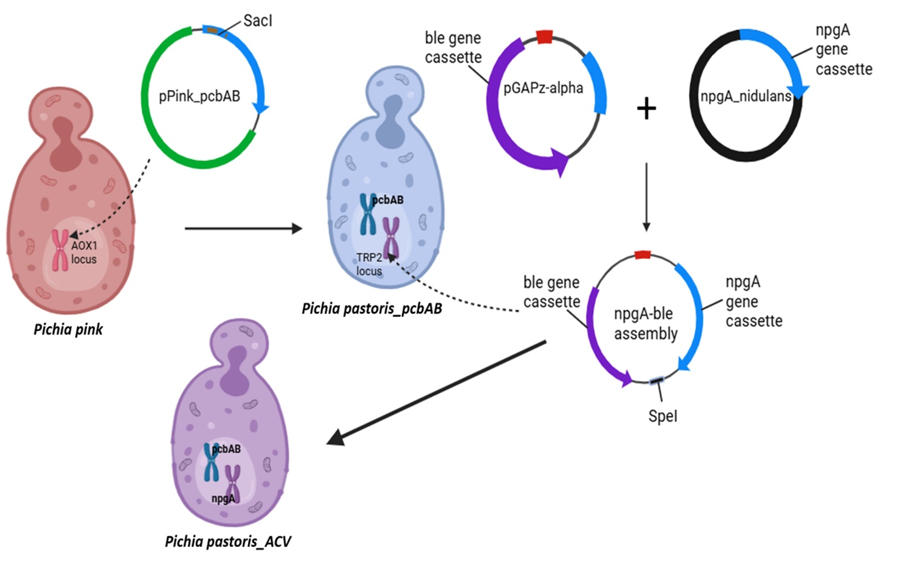
That is the question our team set out to answer using Pichia pastoris (also known as Komagataella phaffii), a methylotrophic yeast widely used in biomanufacturing. It is recognized as safe, grows to very high cell densities on inexpensive defined media, and allows new genes to be integrated permanently into its genome, so the engineered strain stays stable without constant chemical selection. We rebuilt the minimal ACV pathway from the ground up. Two genes were computationally redesigned and optimized for the yeast: pcbAB, which encodes the large ACV synthetase from Penicillium chrysogenum, and npgA, a small activating enzyme from Aspergillus nidulans that switches the synthetase on. Both were integrated directly into the genome under a methanol-controlled switch, and mass spectrometry confirmed that the engineered yeast produced genuine ACV, the first time this pathway has been reconstructed in P. pastoris.
Improving Production Through Evolution
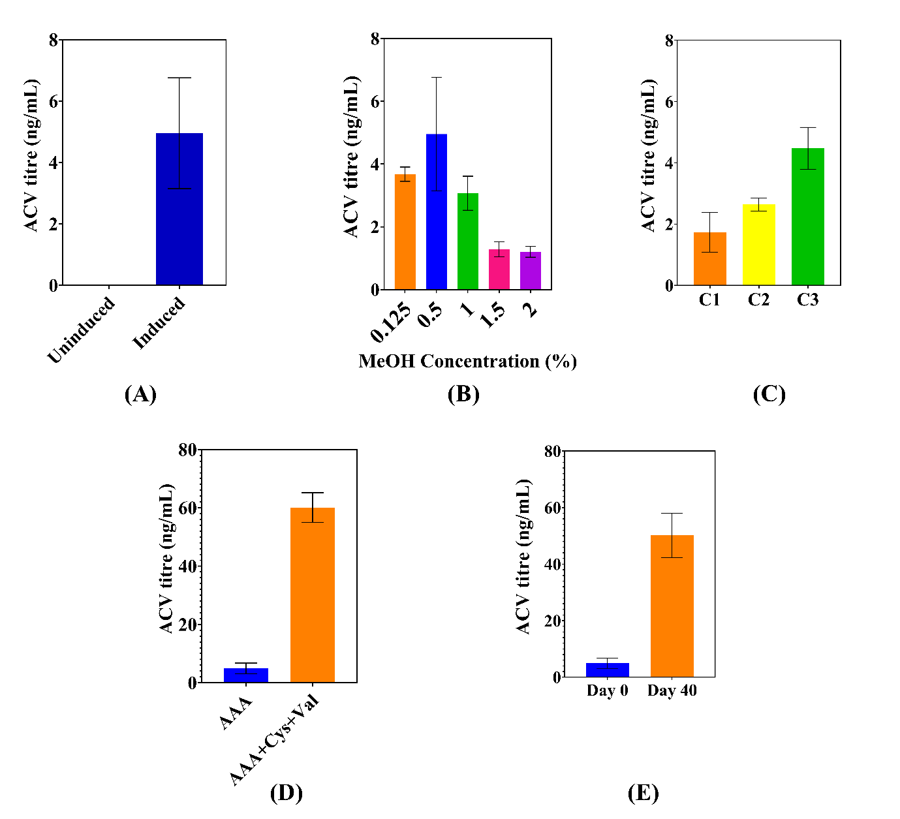
Our first strain made only trace amounts, around 5 nanograms per milliliter. Two complementary strategies raised output roughly ten- to twelve-fold. Simply feeding the cells the three amino-acid building blocks lifted production to about 60 nanograms per milliliter. Separately, adaptive laboratory evolution, growing the strain for 40 days (roughly 300 generations) under a controlled gradient nutrient pressure, yielded a variant producing about 50 nanograms per milliliter. Sequencing that evolved strain5 was revealing: the cells had spontaneously rewired their own protein-making machinery, acquiring mutations in the systems that process transfer RNA and in a ribosomal protein, apparently to cope with the burden of building such a large enzyme. A genome-wide look at gene activity reinforced the picture, showing hundreds of genes shifting to boost energy supply and replenish the pathway’s raw materials.
Two honest caveats matter. The amounts produced are still modest, nanograms per milliliter, far below what industrial manufacturing would require. And we also observed an intriguing disconnect: the evolved strain made more ACV even though the introduced genes were less active (in terms of expression levels) than before. It is a useful reminder that in living cells, turning up a gene does not automatically turn up the product; the behavior of the entire biomolecular network and the crosstalk between diverse biomolecules and pathways is what counts.
Toward the Next Generation of Antibiotics
There is a further, longer-term prospect. Because non-ribosomal peptide synthetases are modular, researchers are beginning to swap and rearrange their sections (the synthetic biology paradigm) to make entirely new peptides that nature never produced. A host that reliably expresses these enzymes is the essential platform on which such ‘designer’ antibiotics could one day be built, a way to stay ahead of resistant bacteria rather than merely reacting to them. Establishing that a robust industrial yeast can host even one such assembly line is a prerequisite for that longer-term goal, and a reason the result matters beyond the specific molecule we chose to make.
The significance of this work lies less in the quantity produced than in the demonstration itself. It establishes P. pastoris as a workable, general-purpose chassis for non-ribosomal peptides, one of the most challenging classes of natural products, and lays out a repeatable blueprint: design synthetic genes, feed key precursors, apply evolution, and read the cell’s response at the systems level to guide the next round. The road to industrially useful titres is still long, and the central challenges are clear: supplying enough of the right precursors, easing the metabolic burden of a giant foreign enzyme, and closing the wide gap in yield. But given how many antibiotics, and other medicines, originate in organisms we can barely cultivate, the ability to relocate their production into a fast, safe, well-understood yeast could make antibiotic discovery and manufacturing more flexible, more sustainable, and better prepared to keep pace as resistance evolves.