This article is currently maintained under temporary RFCSR publication support until 13 June 2026.
The increasing need for energy to sustain daily activities has led to an overwhelming dependence on fossil fuels. This excessive dependence has resulted in severe environmental degradation, including disturbances to the ecological balance and depletion of fossil fuel reserves. Therefore, the transition to renewable energy sources is an urgent necessity. A wide variety of renewable energy sources, including hydropower, wind, solar, nuclear, and geothermal, are currently in use. However, these alternatives are associated with severe limitations. Wind energy is highly dependent on regional conditions, whereas solar energy is not available during the night or under adverse weather conditions. Nuclear and geothermal energy sources are expensive and pose potential technical and safety risks.
“By using computational screening, we identified nonheme single-atom catalysts that can match platinum in performance while relying on more abundant and potentially less expensive materials.”
Therefore, in addition to developing renewable energy, it is crucial to develop efficient storage methods enabling on-demand utilization. We can store intermittent energy in chemical bonds via controlled reactions, producing high-energy-density small molecules. These energy-rich molecules can subsequently be utilized as fuels, releasing stored energy in a controlled manner.
Fuel cells and metal-air batteries have attracted significant interest. In these electrochemical devices, the oxygen reduction reaction (ORR) plays a key role as the cathodic half-reaction, controlling overall performance. The discharge cycle involves the reduction of molecular oxygen to water via a four-electron electrochemical pathway, as shown in equation 1.
O2 + 4H+ + e– 🡪 2H2O (eq 1)
So far, platinum-group metals (PGMs) are known to be the most efficient electrocatalysts for driving ORR. However, the high cost and limited availability of these catalysts pose significant challenges for industrial-scale use. Therefore, earth-abundant electrocatalysts with high activity and long-term stability are needed for ORR applications.
Single-atom catalysts (SACs) have been identified as the most effective electrocatalysts for ORR. The individual metal atoms are dispersed on a suitable heterogeneous support. The well-separated active sites allow tunable control over the binding affinity of the intermediates and enable modulation of catalytic activity and selectivity. The Heme-inspired SACs comprise transition-metal atoms coordinated to macrocyclic ligands such as porphyrins or phthalocyanines, or to defective nitrogen-doped graphene surfaces. These catalysts show promising ORR activity, particularly due to π-conjugation in the support network. However, a major challenge has been their poor stability under the operating electrochemical conditions. This limits their application in proton exchange membrane fuel cells. Beyond the potential windows of 0.7 V vs SHE, most heme-based SACs exhibit demetallation and dissolution, leading to catalyst degradation.
In contrast, nonheme-based support frameworks, such as corrole and salen, have recently been shown to be promising alternatives. These macrocyclic ligands allow strong metal-binding ability and structural tunability. Corrole introduces both asymmetry and rigidity, whereas salen enables a mixed nitrogen–oxygen coordination environment. Although some experimental studies report encouraging activity, a detailed understanding of their catalytic activity and electrochemical stability across varying pH and potentials remains limited.
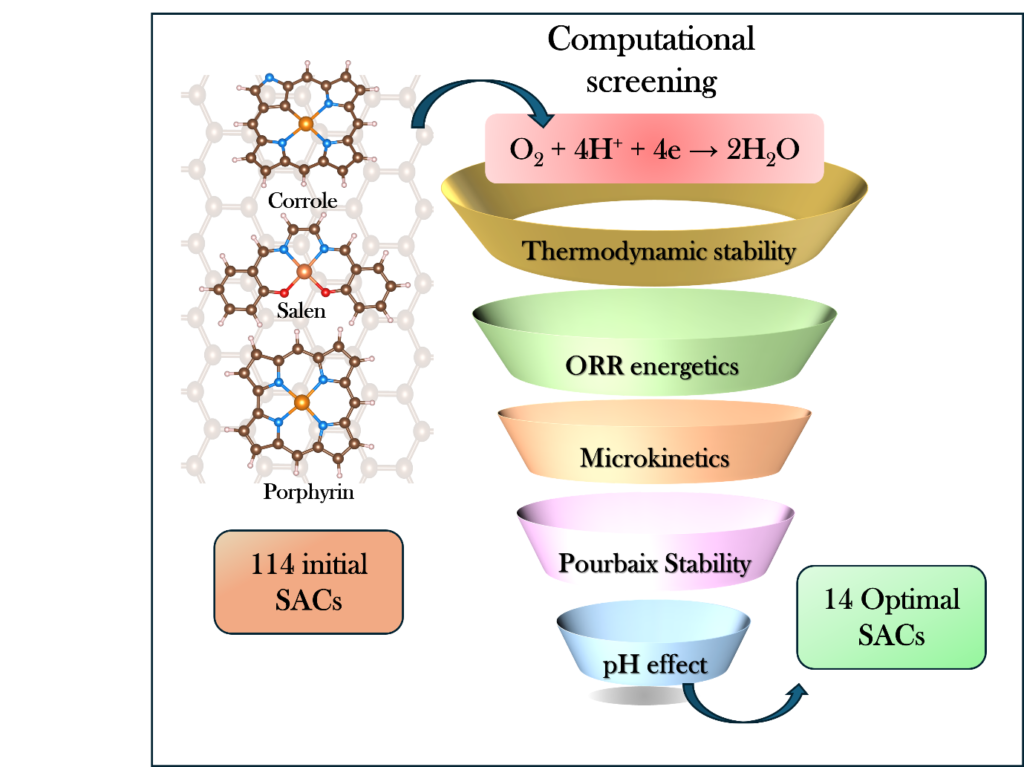
In a recent study, we present a comprehensive five-step high-throughput computational screening strategy to identify efficient nonheme SACs supported on extended graphene substrates for ORR. The macrocyclic frameworks, including confused porphyrin, corrole, and salen, are systematically investigated for their coordination to a wide range of transition metals to explore their catalytic potential.
In this work, we use density functional theory (DFT)-based calculations. Instead of tracking every electron individually (which is extremely complex), DFT simplifies the problem by focusing on the distribution of electrons in space. For materials like solids and surfaces, we use periodic DFT. In these models, a small piece of the material is repeated in all directions in a repeating pattern. This approach mimics real materials and shows regularly repeating atomic structures. We first model the surfaces using an atomistic approach and allow them to arrange into the most stable configurations. The catalytic reactions are studied on these surfaces. We then examine the binding affinity of the intermediates on these surfaces. By analyzing the reaction energetics, the surface activity is determined.
The screening begins with an evaluation of thermodynamic stability through formation energy analysis. From an initial pool of 112 SACs, only two candidates were excluded at this stage due to unfavorable (endothermic) formation energies, confirming the inherent stability of most nonheme configurations. In the second step, adsorption energies of key ORR intermediates are computed to assess catalytic behavior. These energetics are subsequently incorporated into a mean-field microkinetic model to map trends in catalytic activity.
A microkinetic model is a detailed way of understanding how a chemical reaction proceeds by breaking it down into a series of individual steps. By analyzing all these steps together, the model identifies the slowest steps and gives an expression for the overall reaction rate. We find that the adsorption energetics on nonheme SACs follow linear scaling relationships analogous to the metal (111) surfaces. The scaling relations are assumed to originate from the binding structure of the intermediates on the catalyst surface. Using the Brønsted–Evans–Polanyi (BEP) relations, we derive an expression that relates the reaction energy barrier to the reaction thermodynamics. Microkinetic simulations show that non-heme SACs based on Mn, Fe, Rh, and Ir occupy the apex region of the ORR volcano plot. These SACs exhibit turnover frequencies within 30% of the benchmark Pt(111) surface. From this analysis, we have identified 19 SACs as highly active and selective for the four-electron ORR pathway.
To further refine our screening approach, electrochemical stability is evaluated using Pourbaix analysis in the fourth step. A Pourbaix diagram maps the aqueous stability of a material under different pH and applied potential. Corrole- and salen-based SACs show a remarkable stability with late transition metals such as Fe, Rh, and Ir across a wide range of pH and electrochemical potentials. This enhanced stability arises from the distinctive nonheme coordination environment. The non-nitrogen-coordinating groups to the metal center in Salen and the structural variability in Corrole suppress demetalation and dissolution processes observed in porphyrin-based SACs. Fe@corrole, Rh@salen, and Ir@cor (confused porphyrin) exhibit exceptional stability over a broad pH range.
In the final step, pH-field corrections were incorporated to account for interfacial electrostatic effects, providing deeper insight into environment-dependent catalytic performance. These results indicate that most of the stable SACs exhibit enhanced ORR activity under alkaline conditions, highlighting the importance of the electrolyte environment as a tunable parameter.
“Our study shows that carefully designed molecular frameworks can create catalysts that are both highly active and remarkably stable for clean energy technologies such as fuel cells and metal–air batteries.”
Combining all screening criteria, 14 SACs emerge as optimal candidates that simultaneously satisfy activity, selectivity, and stability requirements. Fe-, Rh-, and Ir-based nonheme SACs exhibit catalytic activities comparable to those of Pt, particularly under alkaline conditions. Nonheme macrocyclic frameworks such as confused porphyrin, corrole, and salen provide superior resistance to metal dissolution compared to traditional heme-based systems, while maintaining excellent ORR activity.
Overall, this study uncovers the largely unexplored potential of nonheme SACs as robust and efficient ORR electrocatalysts. By integrating activity and stability descriptors within a high-throughput framework, this work establishes a rational design strategy for next-generation catalysts and provides a pathway toward cost-effective alternatives to platinum in fuel cells and metal–air batteries.