This article is currently maintained under temporary RFCSR publication support until 13 June 2026.
Microbes are opportunistic and notorious! They somehow find the way to grow as and when they find the suitable conditions. One may notice their presence virtually everywhere, irrespective of living and non-living. While they are fundamental to life, once they grow within living organisms including plants, animals, and humans, and that too in a harmful way, they are recognized as ‘pathogens’ which cause infections. This demands immediate care and attention to prevent them from causing further harm and to avoid worsening the situation. In such scenarios, antibiotics are the first and probably the most sought-after treatment to prevent further worsening of bacterial infections and, same is true with the antifungal and antiviral drugs. However, once the microbes become familiar with the antimicrobial drugs being used against them repeatedly, they gradually evolve resistance mechanisms to attenuate or nullify the effects of these drugs. This phenomenon, known as antimicrobial resistance (AMR), poses global challenges to the use of traditional antimicrobial drugs and demands for the novel/unconventional alternate therapies to treat infections. It is in this context that our team (including Mr. Sairam Abbireddy: an enthusiastic young postgraduate, Dr. Joveeta Joseph: a microbiologist, Dr. Bhupesh Bagga, a clinician ophthalmologist with specializations in treating ocular infections, and myself, Dr. Sachin Shukla: a Scientist with focus on the applications of Mesenchymal Stem/Stromal Cells (MSCs)) at L V Prasad Eye Institute, Hyderabad, India, started exploring MSC-based alternatives for eye infections.
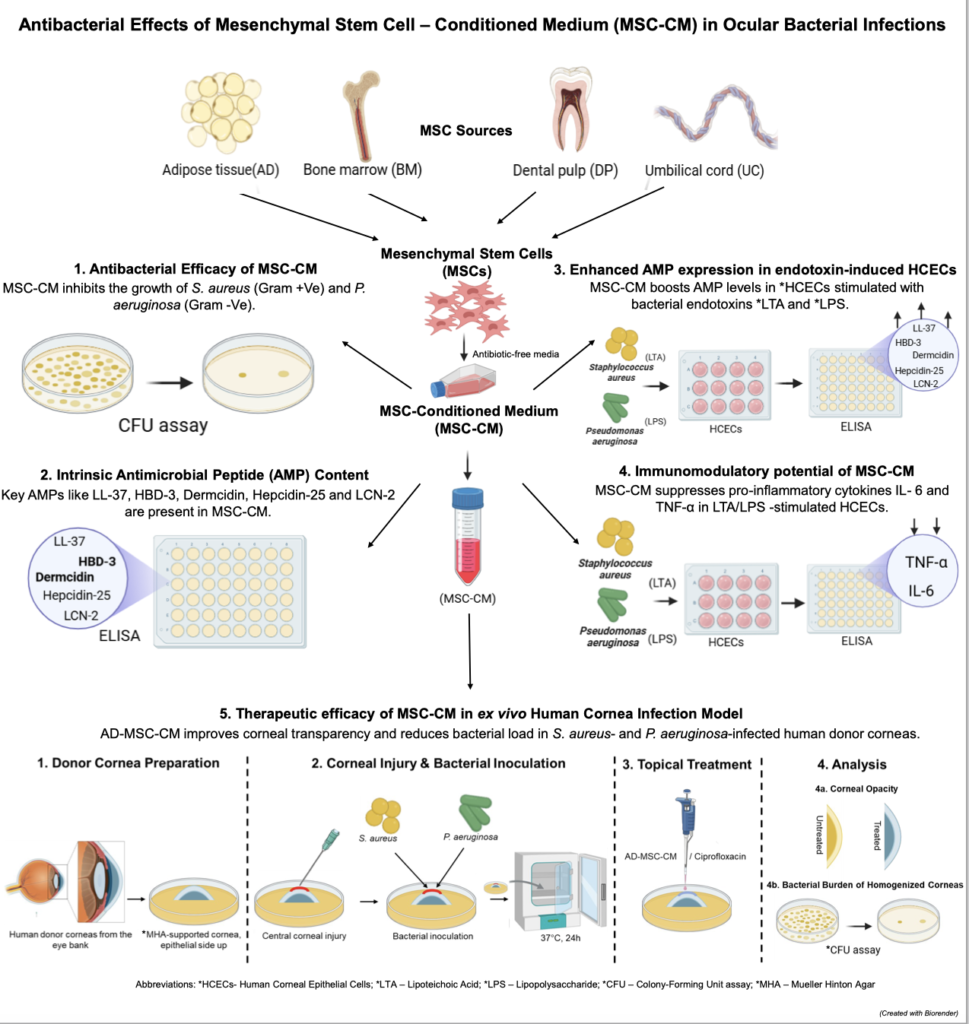
“Mesenchymal stem/stromal cell (MSC)-derived conditioned medium (MSC-CM) derived from human adipose-tissue, bone marrow, dental pulp, and umbilical cord, demonstrates novel antibacterial effects against ocular bacterial infections in laboratory-based studies.”
Eyes, being in direct contact with the external environment, like skin, are prone to microbial infections. When the immune homeostasis at the ocular surface is compromised due to injury, infection, or allergic conditions, it may lead to ocular infections causing blindness and vision impairment in their most severe forms. Bacterial keratitis, affecting cornea, is the most common and serious form of ocular infections which may be caused by unhygienic and long-term use of contact lens, corneal injury, and corneal transplantation. Pseudomonas aeruginosa and Staphylococcus aureus, the Gram-negative and -positive bacteria, respectively, are among the most predominant causal microorganisms causing bacterial keratitis; and at the same time they are increasingly developing resistance to a wide spectrum of antibiotics, including quinolones (e.g., ciprofloxacin and moxifloxacin) and aminoglycosides (e.g., gentamicin, streptomycin). Moreover, these pathogens are classified within the ESKAPE (Enterococcus faecium, S. aureus, Klebsiella pneumoniae, Acinetobacter baumannii, P. aeruginosa, and Enterobacter species) group of World Health Organization (WHO) as significant multidrug-resistant bacteria for which effective therapies are urgently needed.
Stem Cells, being multipotent, are popularly known for their tissue repair and regenerative potential. Additionally, tissue-specific adult MSCs, among the different types of stem cells (e.g., embryonic stem cells, induced pluripotent stem cells, MSCs), are largely known for their immunoregulatory properties. Rather, hematopoietic stem cell transplantation is the only U.S. Food and Drug Administration approved stem cell-based therapy in the world till date. Consequently, MSCs have been widely used in clinical trials, particularly for immune-mediated disorders (e.g., Rheumatoid arthritis, Graft versus Host Disease). However, their abilities to fight ocular infections have not been sufficiently explored with no such report available, to the best of our knowledge, until our recent publication entitled ‘Mesenchymal stem cell-derived conditioned medium demonstrates novel antibacterial effects in ocular bacterial infections’ (https://pubmed.ncbi.nlm.nih.gov/42060691/).
Our hypothesis that MSC-based therapies would be effective for treating eye infections and underlying inflammation was based upon the previous observations by different investigators across the globe (including ours) that MSCs derived from different tissue sources including adipose tissue, bone marrow, dental pulp, and umbilical cord produce antimicrobial peptides (AMPs: e.g., LL-37, Hepcidin, Dermcidin, and Lipcalin-2) which effectively disrupt bacterial cell membranes and inhibit biofilm formation and thus exhibit antibacterial effects against pathogens like S. aureus, P. aeruginosa, and E. coli. The MSCs have been reported to be therapeutically effective in preclinical models of sepsis, chronic wound infections, and cystic fibrosis and more recently in urinary tract infections by different investigators. Further, their tissue repair and immunomodulatory properties have been investigated in Rheumatoid arthritis, Alzheimer’s disease, and myocardial infarction. Instead, their role in ocular infections remains largely unexplored.
MSCs exhibit antibacterial effects in ocular bacterial infections. To study their antibacterial properties, we procured the human MSCs derived from different tissue sources, namely, adipose tissue, dental pulp, bone marrow, and umbilical cord; cultured them under laboratory conditions, and collected their secretions under defined conditions (called as ‘conditioned medium’, hereafter referred as ‘MSC-CM’). To check the effect of MSC-CM on bacterial growth, the standard ATCC strains and clinical isolates (isolated from the infected eyes of patients) of a Gram-positive (S. aureus) and a Gram-negative bacteria (P. aeruginosa) were cultured, further incubated with MSC-CM and plated on Mueller-Hinton agar plates. Number of bacterial colonies were counted through colony-forming unit assay. Treatment with MSC-CM further induced structural deformations in bacteria as observed through scanning electron microscopy.
MSC-secreted Antimicrobial peptides (AMPs) help in execution of antibacterial properties. Having observed the antibacterial effects of MSC-CM on the growth and morphology of S. aureus and P. aeruginosa, the next step before us was to find out what in MSC-CM contributes to their antibacterial effects. We checked the presence of AMPs and quantified their levels of expression through Enzyme-linked immunosorbent assay (ELISA). Our results show the presence of cathelicidin (LL-37), hepcidin-25, dermcidin, human beta defensin-3, and lipocalin-2 in MSC-CM. To see how these AMPs are modulated upon bacterial infection and inflammation, we treated the laboratory cultured human corneal epithelial cells with the bacterial cell wall components: Lipopolysaccharide (LPS, in Gram-negative bacteria) and Lipoteichoic acid (LTA, Gram-positive bacteria) and observed changes in expression of AMPs and pro-inflammatory cytokines (IL-6 and TNF-alpha). While the expression of AMPs was increased, that of pro-inflammatory cytokines was decreased. This suggests that MSC-CM plays dual role: resolution of infection and suppression of inflammation. This combined effect of MSC-CM can be more useful in clinical settings to treat ocular infection and underlying inflammation. Further animal studies and clinical trials are required to validate our findings for clinical applications. Therapeutic Efficacy of MSC-CM: Following the confirmation of antibacterial properties of MSC-derived conditioned medium, the next step was to test the efficacy. For this purpose, we chose the cadaveric corneas as an ex-vivo model system. The cadaveric corneas, with no reported history of infection at the time of death, were infected with the clinical isolates of bacteria (P. aeruginosa and S. aureus) for 24 hours and were then subjected to treatment with adipose tissue-derived MSC-CM as eye drops for next 24 hours. We observed that the treatment resulted in reduced bacterial load and improved corneal transparency ex vivo. To validate our results and compare our outcomes with an established antibiotic, we used ciprofloxacin in all experiments as control and observed comparable results.