
Intravenous immunoglobulin (IVIG) has been a cornerstone in the management of autoimmune and inflammatory diseases for over five decades. Originally developed as a replacement therapy for primary immunodeficiencies, IVIG is now widely used in the therapy of diverse autoimmune conditions, including immune thrombocytopenia, Kawasaki disease, Guillain–Barré syndrome, chronic inflammatory demyelinating polyneuropathy, and other systemic autoimmune disorders. Despite its long-standing clinical usage, IVIG remains a complex and incompletely understood immunotherapeutic, exerting pleiotropic effects through diverse cellular and molecular mechanisms. With the rapid evolution of antibody engineering, an important question arises: can engineered antibodies can replace or restrict clinical usage IVIG?
“IVIG is not a single drug with a single target, it is a complex orchestra of antibodies that restores immune balance through many pathways at once.”
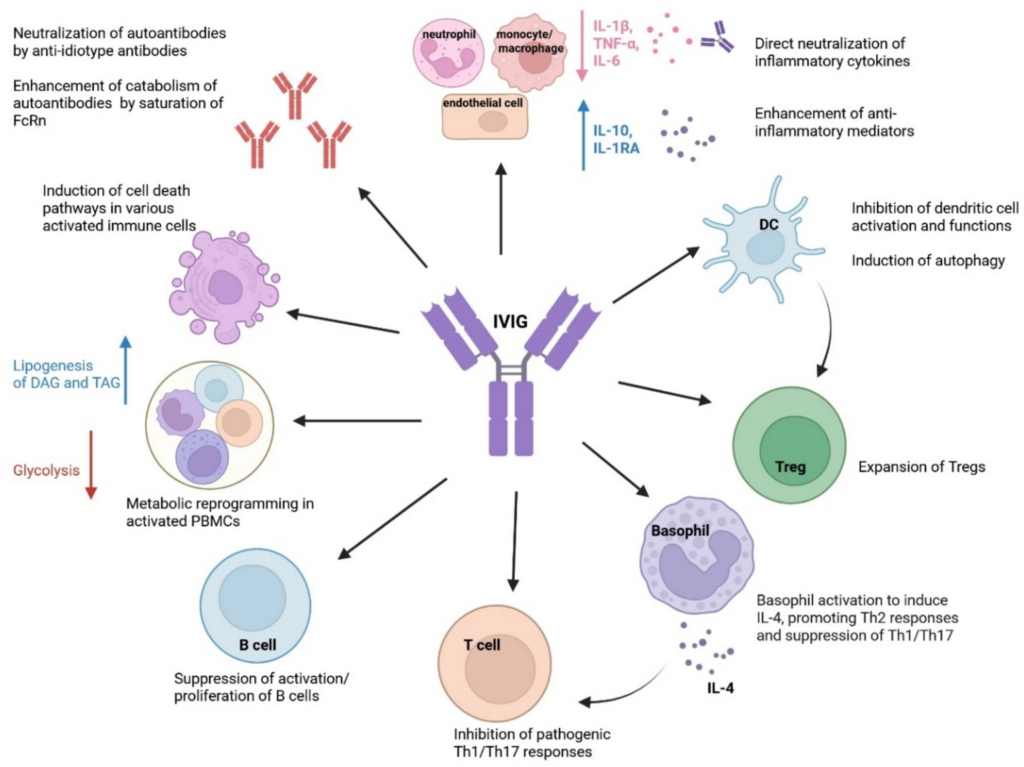
Diverse Cellular and Molecular Mechanisms of IVIG
The therapeutic efficacy of IVIG is rooted in its polyclonal nature, derived from pooled immunoglobulin G (IgG) from thousands of healthy donors. This diversity allows IVIG to target multiple immune pathways, both cellular and molecular, simultaneously, which is particularly advantageous in multifactorial autoimmune diseases (Figure 1).
At the cellular level, IVIG modulates both innate and adaptive immune responses. One of the best-characterized mechanisms involves Fc gamma receptors (FcγRs). IVIG can saturate activating FcγRs on macrophages, thereby inhibiting phagocytosis of opsonized cells, as seen in immune thrombocytopenia. Concurrently, IVIG upregulates the inhibitory receptor FcγRIIB, contributing to a shift toward an anti-inflammatory phenotype. However, Fc-mediated functions do not explain entirely the therapeutic benefits of IVIG and various F(ab’)2-dependent mechanisms have been reported.
IVIG also profoundly affects dendritic cells (DCs), promoting a tolerogenic phenotype characterized by reduced expression of co-stimulatory molecules and increased secretion of anti-inflammatory cytokines such as IL-10. These tolerogenic DCs, in turn, facilitate the expansion of regulatory T cells (Tregs), which are central to maintaining immune tolerance.
At the molecular level, several mechanisms have been proposed. Anti-idiotypic antibodies within IVIG can neutralize pathogenic autoantibodies. IVIG can saturate neonatal Fc receptors and hence promote the degradation of pathogenic autoantibodies. IVIG also interferes with complement activation by binding to C3b and C4b, thereby preventing the formation of membrane attack complexes. Additionally, sialylated Fc fragments of IgG have been implicated in anti-inflammatory effects via interactions with lectin receptors such as DC-SIGN.
Emerging evidence highlights the role of IVIG in modulating cytokine networks and intracellular signaling pathways. For instance, IVIG can inhibit pro-inflammatory cytokines such as IL-17 and IFN-γ while enhancing IL-10 production. By signaling through basophil bound IgE and Syk-pathway, IVIG promotes type 2 cytokines in IL-3-primed basophils. It also influences signaling pathways like NF-κB and MAPK, thereby altering gene expression profiles in immune cells. Recent data demonstrates that IVIG triggers distinct autophagy pathways in innate immune cells and modulates metabolism of immune cells by promoting the synthesis of anti-inflammatory lipid synthesis.
Limitations of IVIG Therapy
While IVIG is highly effective, it has several limitations. The requirement for high doses (typically 1–2 g/kg) imposes significant costs and logistical challenges. Supply constraints, given its reliance on human plasma, further complicate accessibility. Adverse effects, although generally mild, can include infusion reactions, thromboembolic events, and renal dysfunction.
Moreover, the non-specific nature of IVIG, while advantageous in some contexts, can also be a drawback. It may lead to variability in therapeutic outcomes and unintended modulation of immune responses.
Can Engineered Antibodies Replace IVIG?
Advances in antibody engineering have opened new avenues for designing targeted therapies that could potentially replicate or even improve upon the effects of IVIG. These include monoclonal antibodies, Fc-engineered antibodies, bispecific antibodies, and antibody fragments.
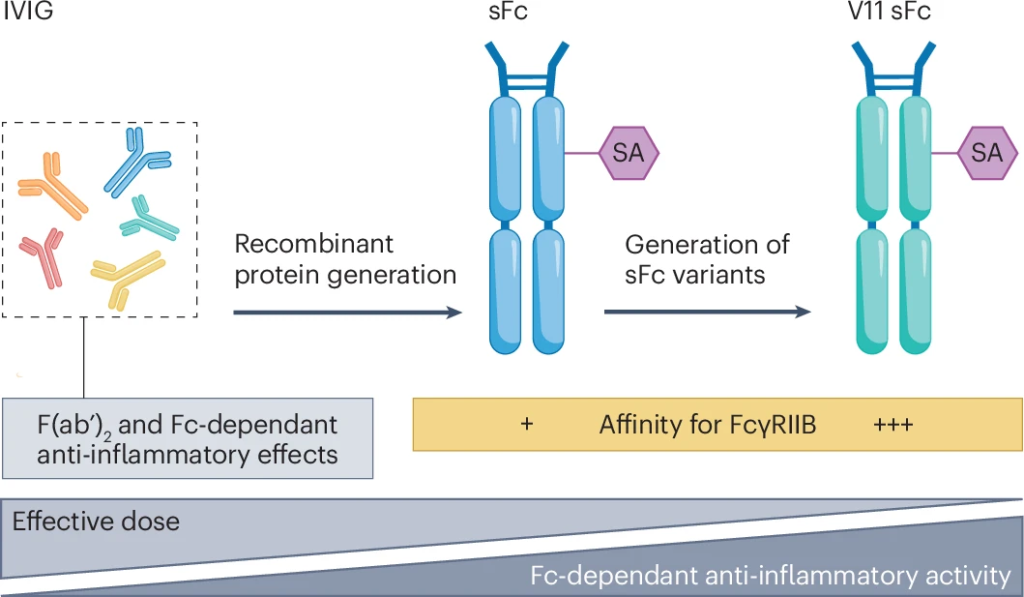
Fc engineering, in particular, holds promise for mimicking key immunomodulatory functions of IVIG. By modifying Fc regions to enhance binding to inhibitory FcγRIIB or reduce affinity for activating FcγRs, engineered antibodies can achieve more precise immunomodulation. Similarly, glycoengineering approaches aim to increase Fc sialylation, thereby enhancing anti-inflammatory activity. In fact, recombinant sialylated IgG1 Fc fragments (sFc) were recently evaluated in FcγR-humanized mice to delineate the roles of Fc sialylation and type I FcγR engagement in mediating the anti-inflammatory effects of IVIG (Figure 2). Prophylactic administration of sFc conferred protection in a serum transfer–induced arthritis model at a 25-fold lower dose than IVIG, whereas non-sialylated Fc or an IgG1 Fc mutant incapable of engaging type I FcγRs failed to protect against arthritis. This work provides compelling preclinical evidence that increasing the affinity of sFc for the inhibitory receptor FcγRIIB markedly enhances its anti-inflammatory efficacy, highlighting its potential as a candidate for clinical development in autoimmune diseases.
Monoclonal antibodies targeting specific cytokines or immune checkpoints have already transformed the treatment landscape for several autoimmune diseases. For example, anti-TNF, anti-IL-6 receptor, and anti-CD20 therapies provide targeted suppression of pathogenic pathways. However, these therapies lack the broad-spectrum immunomodulatory capacity of IVIG.
Another promising approach involves recombinant polyclonal or oligoclonal antibody preparations designed to mimic the diversity of IVIG. These engineered mixtures could theoretically retain the multifunctionality of IVIG while offering improved consistency and scalability.
Despite these advances, several challenges remain. Replicating the full spectrum of IVIG’s mechanisms in a single engineered product is exceedingly complex. IVIG’s efficacy arises from the synergistic action of numerous antibodies with diverse specificities and functions, a feature that is difficult to reproduce synthetically.
Furthermore, the safety and long-term effects of engineered antibodies require careful evaluation. While targeted therapies may reduce off-target effects, they may also lack the regulatory balance provided by IVIG’s polyclonal nature.
Future Perspectives
Rather than a complete replacement, a more realistic scenario may involve complementarity between IVIG and engineered antibody therapies. Engineered antibodies could be used to target specific pathways in well-defined patient subsets, guided by biomarker-driven precision medicine. IVIG, with its broad immunomodulatory effects, may remain indispensable in complex or refractory cases.
Innovations such as recombinant Fc multimers and advanced glycoengineering could bridge the gap between IVIG and engineered antibodies. Additionally, improved understanding of IVIG’s mechanisms will unravel the rational design of next-generation immunomodulators.
“Engineered antibodies may sharpen precision, but IVIG remains unmatched when broad, system-wide immune regulation is needed.”
Conclusion
IVIG remains a unique and versatile therapeutic in autoimmune diseases, owing to its multifaceted mechanisms and broad immunomodulatory capacity. While engineered antibodies offer exciting opportunities for targeted and potentially more efficient therapies, they are unlikely to fully replace IVIG in the near future. Instead, the integration of IVIG with advanced antibody engineering, guided by robust biomarkers, represents the most promising path forward in the evolving landscape of autoimmune therapy.