Taking inspiration from the nature’s own remedial mechanism to counter bacterial infection: the tale of Peppermint Oil Nanoemulsion.
The use of antibiotics for the management of bacterial infection has long been relied; however, the widespread and uncontrolled use of these drugs have resulted to an alarming rise in the antibiotic-resistant bacteria. It has been observed that even the common bacteria have also become resistant towards these drugs, making the once manageable disease increasingly difficult to control. It is in this context that the search for newer alternatives has led the scientists to focus on nature’s own arsenal: plant-derived essential oils. Amongst the many essential oil studied, peppermint essential oil (PEO) has shown impressive antibacterial, antioxidant and anti-inflammatory properties. The PEO is generally being isolated from the hybrid plant Mentha piperita and has been found to be rich in several bioactive compounds including menthone, menthol and methyl acetate. Though its biological effects are promising, several challenges restrict the practical use of PEO in day to day life. The major bottlenecks arises from their strong aroma, high volatility, poor water solubility and also due to their low stability when exposed to heat, light or through aerial oxidation which all effect PEO’s biological efficacy. Hence scientific interventions are required to not only maintain the biological potency of PEO but also to deliver it in a form that helps to overcome these drawbacks.
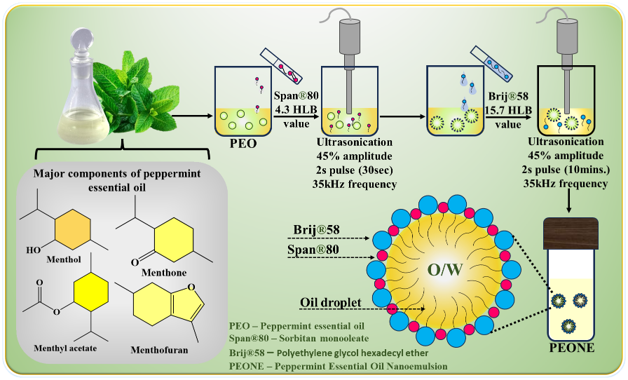
“Peppermint essential oil nanoemulsion (PEONE) was synthesized via ultrasonication method.”
After studying several delivery systems, it was found that nanoemulsification process could successfully be used to enhance PEO’s stability and bioefficacy. The process of nanoemusion formation involves simultaneous use of water and oil in the presence of appropriate surfactant which allow formation of tiny droplets that encapsulates the active ingredients. Our proposed idea was to use such tiny droplets to prevent the degradation of PEO from the external stimuli and maintain its biological activity. To achieve this, our research team developed an optimized ultra-sonication assisted PEO nanoemulsification process comprising of a blend of two non-ionic surfactants viz., Brij®58 and Span®80. The choice of such surfactants was made to maintain adequate hydrophilic –lipophilic balance during the synthesis. Such careful control of the process led us to obtain ultra-small droplets (averaging about 40 nm) PEO nanoemulsion (PEONE). The developed oil-in-water PEONE demonstrated marked colloidal and physical stability for a prolonged period of time, resisting separation of two different immiscible phases with an extremely low creaming index. Next, we studied the anti-bacterial efficacy of the developed PEONE. When tested against common bacterial pathogens viz., Staphylococcus aureus and Escherichia coli, which are the common cause of hospital-acquired infections, skin infection, urinary tract infection etc. PEONE demonstrated ~ 2.4 – to 3.3 fold increased anti-bacterial activity compared to unformulated PEO. Further, PEONE was also able to inhibit the matured biofilms of both the bacteria, indicating its much stronger applications. The potency of the PEONE was quantitatively measured and it was found that it’s Minimum Inhibitory Concentration (MIC) and Minimum Biofilm Inhibitory Concentration (MBIC) values were significantly lower compared to bare PEO. The mechanistic studies suggested that PEONE, due to its small size, penetrates the bacterial cell membrane more effectively compared to unformulated PEO and eventually leads to the oozing out of the cytoplasmic content of the bacteria. We predicted that the small droplet size of PEONE allowed the PEO to penetrate more deeply and also allowed slow and sustained release of PEO, hence maintain its anti-bacterial activity for longer period of time. We expect that such nanoemulsification process will allow deeper penetration of PEO in layers of skin or within bacterial membrane and hence the practical utility of this process may find its applications in cosmeceuticals or other healthcare applications. In practical terms, PEONE could easily be incorporated into topical creams, gels, or hydrogels for use as antibacterial agents.
However, before its practical use, several key questions related to PEONE formulation needs to be addressed. The design and development of an ideal surfactant system that allow stable and ultra-small droplet formation of essential oils is challenging task. Additionally, even though in vitro results are encouraging, the efficiency of any developed formulation is better tested under in vivo condition, which allow a proper mimic of biological milieu. The stability of the developed formulation should also be tested under complex biological environment including living samples. Further, studies on antibiotic resistant strains should also be carried out to confirm the effectiveness of the formulations.
“Mechanistic studies show PEONE disrupts bacterial membranes, highlighting therapeutic potential.”
In conclusion, the development of peppermint essential oil nanoemulsion marks an important step towards the progress of “green antibiotics” using natural antibacterial therapies. The nanotechnological intervention provided an alternative to the inherent limitations of essential oils and initial results suggested this approach to be effective one.