
Adam had managed her diabetes for almost twenty years. She counted her carbs, took her insulin, and checked her sugar every morning without fail. What she never expected was that the disease quietly reshaping her blood sugar might also be reshaping something else entirely, the tiny machinery inside her brain cells that keeps memories intact. “Doctor, my sugar is under control,” she told her physician one afternoon. “So why do I keep forgetting where I put things?” It’s a question more families are asking every year. And it turns out, the answer may be hiding somewhere no one thought to look: inside a cell’s tiniest recycling bin.
“Diabetes didn’t just touch Adam’s blood sugar, it may have reached his memory”
THE CELL’S GARBAGE DISPOSAL AND WHY IT MATTERS
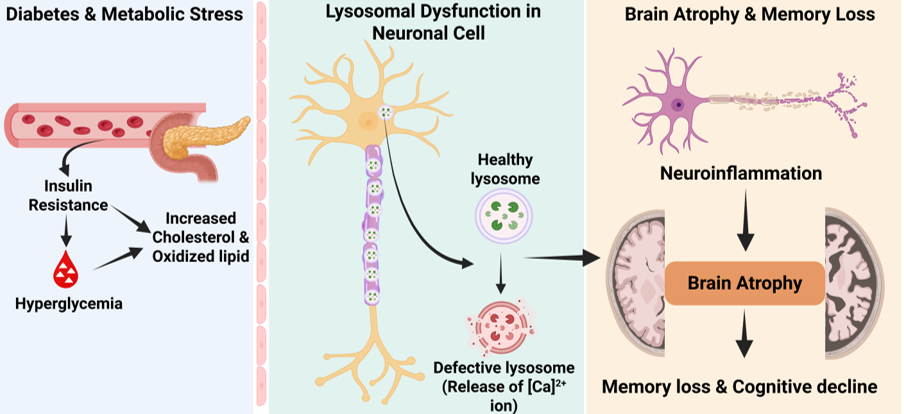
Every cell in the body has a built-in cleanup crew called the lysosome. Think of it as a combination of a recycling center and a garbage disposal, breaking down old proteins, damaged parts, and cellular debris so the cell can stay healthy. For decades, scientists paid little attention to this humble organelle. It seemed like a background player, quietly doing its job while flashier molecules took the spotlight. But our research told a different story. Working with a specially designed fluorescent probe, a molecule we built to light up and change color depending on how “thick” or viscous its surroundings are, we found something unexpected. When blood sugar levels rise, as they do in diabetes, the fluid inside lysosomes doesn’t stay the same. It thickens. It becomes syrupy, almost sluggish, like honey left in a cold refrigerator instead of flowing like water. This thickening is called an increase in lysosomal viscosity, and it turns out to be far more than a mere curiosity. It’s a warning sign.
WHEN THE GARBAGE DISPOSAL GETS CLOGGED
Lysosomes don’t just break down waste. They also store calcium, a mineral your cells depend on to send signals, regulate energy, and keep countless internal processes running on time. When lysosomes swell and thicken under high-sugar conditions, this delicate calcium balance breaks down. Calcium that should stay locked inside the lysosome leaks out into the surrounding cell fluid, throwing the cell’s internal signaling into disarray. To watch this unfold, we studied liver and cervical cancer cells exposed to high glucose, and used a technique called super-resolution imaging, essentially a way of zooming in far closer than a normal microscope allows, to catch lysosomes in the act of swelling in real time. We then turned to a small but powerful ally in biology, Caenorhabditis elegans, a millimeter-long roundworm that, despite its size, shares a surprising number of biological pathways with humans, including ones involved in aging and neurodegeneration.
We fed one group of worms a high-glucose diet, mimicking the hyperglycemia seen in diabetes, and compared them to worms engineered to model Alzheimer’s disease. The result was striking: the same rise in lysosomal viscosity and calcium imbalance we saw under high sugar also appeared alongside the clumping of amyloid-beta, the sticky protein fragment long associated with the plaques found in Alzheimer’s brains.
In other words, the same cellular traffic jam that diabetes creates looks remarkably similar to what happens in a brain sliding toward memory loss.
A COMMON THREAD, NOT A COINCIDENCE
For years, doctors have noticed that people with type 2 diabetes face a higher risk of developing Alzheimer’s disease, so much so that some researchers have nicknamed Alzheimer’s “type 3 diabetes.” But noticing a pattern and understanding its cause are two very different things. Our findings offer a possible thread connecting them: a breakdown in the cell’s own cleanup system, triggered by chronically high blood sugar, that leaves calcium signaling in disarray and creates conditions in which harmful protein aggregates can take hold. This doesn’t mean every person with diabetes will develop Alzheimer’s, nor does it mean memory loss always has a metabolic cause. But it does suggest that keeping blood sugar steady may do more than protect your heart, kidneys, and eyes; it may also protect the quiet, unglamorous machinery inside your brain cells that keeps them clean, balanced, and functioning.
WHY A GLOWING MOLECULE MATTERS
The probe we developed, a zinc-based fluorescent complex, is not a treatment. It’s a window. Because it lights up specifically within lysosomes and changes its glow with viscosity, it lets researchers watch, for the first time in living cells and animals, exactly when and where this cellular traffic jam begins. Tools like this one could eventually help scientists test whether new drugs can restore healthy lysosomal function before memory loss ever sets in, turning an invisible warning sign into something we can actually see, measure, and, one day, treat. Adam’s forgetfulness may never be fully explained by any single study. But research like ours adds one more piece to a puzzle that touches millions of families: the idea that diabetes and memory loss may not be two separate battles, but two symptoms of the same quiet struggle happening inside our cells.