
Chemistry has traditionally advanced through the discovery of new molecules, reactions, and materials. Despite centuries of investigation, water continues to surprise us. We still do not fully understand its behavior under confinement, at interfaces, in extraterrestrial environments, or within complex biological systems. Water exists in interstellar clouds, on distant moons, and within living cells, linking environments separated by vast differences in scale and complexity. Water may have participated in the chemistry that preceded life, and continues to sustain biology and may help define chemistry of the future. As humanity enters a new era shaped by planetary exploration, artificial intelligence, and sustainable technologies, water and its frozen forms remain at the center of scientific investigations.
“Understanding how molecules behave within ice may help answer one of science’s oldest questions: How did life begin?”
Among the many mysteries connected to water, perhaps the most profound is the origin of life itself. In 1953, Stanley Miller and Harold Urey demonstrated that exposing simple molecules such as CH4, NH3, H2, and H2O vapor to energy sources resembling lightning could produce amino acids, suggesting that biological building blocks might arise through abiotic chemical processes. However, as our understanding of the Solar System expanded, scientists began to ask a broader question: What if some of the molecular ingredients required for life were not produced solely on Earth?
Modern astronomical observations strongly support this possibility. More than 300 molecular species have been identified in interstellar and circumstellar environments, including H2O, CO, CO2, CH4, NH3, alcohols, aldehydes, and a growing inventory of complex organic molecules. Many of these species accrete onto microscopic dust grains, forming ice-rich mantles in which water is typically the dominant component. Although temperatures in these regions can be as low as 10 K, they are far from chemically inactive. Ultraviolet radiation, cosmic rays, and energetic particles continuously process these icy materials, driving reactions that increase molecular complexity over astronomical timescales. In this sense, space itself functions as a vast chemical laboratory, where water plays a significant role. The resulting molecules may have been incorporated into comets and meteorites, delivering some of the chemical ingredients of life to the early Earth (Figure 1).
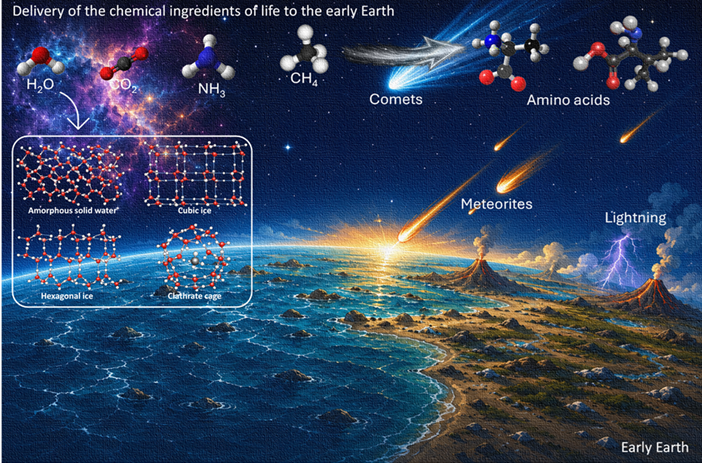
Laboratory simulations inspired by these discoveries have shown that irradiation of simple molecules trapped in water-rich ice can produce amino acids and other prebiotic compounds. Yet major questions remain unresolved. These experiments generally produce racemic mixtures containing equal amounts of left- and right-handed molecules, whereas life on Earth exhibits a remarkable preference for a single chirality. Understanding how this chiral enrichment or homochirality emerged remains one of the central challenges in origin of life research. One intriguing possibility is that confinement within ice matrices or porous molecular structures may influence molecular organization and symmetry breaking. Besides, such confinements could act as reaction vessels for photon/ion/electron-induced chemistry in space.
“Water-based materials may contribute to future technologies for carbon capture, clean energy storage, and sustainable resource management.”
Water is uniquely suited for exploring this question because it exists in multiple solid forms. Under astrophysical conditions, water predominantly exists as amorphous solid water, a highly disordered phase that forms at extremely low temperatures. Upon heating, it can transform into crystalline cubic and hexagonal ice. Water can also organize into clathrate hydrates, cage-like crystalline structures capable of trapping small molecules such as CH4 andCO2 within their cavities. These different phases provide distinct chemical environments that influence how species are stored, transported, concentrated, and transformed. Understanding their formation, evolution, and reactivity is therefore crucial for deciphering chemical processes in space and assessing the role of ice in the emergence of prebiotic molecules and, ultimately, the origins of life.
Motivated by this broader vision, we designed a unique custom-built ultrahigh vacuum (UHV) instrument to mimic key aspects of interstellar chemical events targeting ice. Equipped with infrared spectroscopy, multiple mass spectrometric techniques, and an ultraviolet irradiation source, the setup operates at pressures approaching 10-10 mbar and temperatures as low as 10 K, enabling the study of molecular processes under conditions similar to those found in molecular clouds, comets, and icy planetary bodies. Over more than a decade, this instrument has become a center of attraction for systematically investigating the behavior of molecular solids, including water ice and clathrate hydrates, under such extreme (10 K, 10-10 mbar) conditions.
The first major breakthrough from this lab came in 2019 with the experimental observation of CH4 and CO2 clathrate hydrates under these conditions studied by infrared spectroscopy (Ghosh et al., Proc. Natl. Acad. Sci. U. S. A., 2019). Although the existence of such hydrates in the interstellar medium had been proposed for decades, direct experimental evidence was lacking. The study demonstrated that water molecules could self-assemble into cage-like structures capable of trapping guest molecules even under extremely low-temperature and low-pressure conditions. This observation opened a new direction in laboratory astrochemistry. Subsequently, we have also demonstrated the growth of the clathrate hydrates under similar conditions using electron diffraction (Bijesh et al., J. Phys. Chem. Lett. 2024).
Building on this discovery, subsequent studies demonstrated that a plethora of molecules, such as tetrahydrofuran, acetaldehyde, acetone, formaldehyde, ethane, dimethyl ether, trimethylene oxide, and nitrous oxide, can be trapped in the form of hydrates under UHV conditions. We further demonstrated the formation of several binary and ternary hydrates and revealed dynamic guest migration processes within hydrate frameworks, providing new insights into molecular redistribution in multicomponent icy environments. These investigations also established that thermal annealing and guest desorption transformed hydrates into different forms of crystalline ice. Hydrate dissociation forms hexagonal and cubic ices depending upon the guest molecules. Even non-hydrate-forming volatile species such as acetonitrile present in mixed ices can affect this process and ultimately govern the emergence of specific crystalline ice phases.
Additional intriguing chemistry emerged when these hydrates were exposed to ultraviolet (UV) radiation. CO2, acetaldehyde, and dimethyl ether hydrates demonstrated cage-controlled photochemistry, where confinement altered reaction pathways and product selectivity in the presence of UV irradiation. For instance, acetaldehyde hydrate retains significantly larger fractions of photoproducts, primarily CO and CH3CH2OH, whereas mixed acetaldehyde-H2O ice favors CO and CH4 formation during UV photolysis (Gaurav et al., J. Phys. Chem. Lett. 2026). Complementary photolysis studies of simple astrophysical molecules such as CO, CO2, methyl chloride, and N2O generated a variety of complex organic products of prebiotic relevance.
These studies provide compelling experimental evidence that water, existing as amorphous ice, crystalline ice, and clathrate hydrates, can influence molecular storage, transport, reactivity, and photochemistry under interstellar conditions. Although the puzzle of the origin of life remains unresolved, significant progress has been made toward understanding how molecular complexity emerges in icy environments. Future advances will come from integrating laboratory astrochemistry, space missions, astronomical observations, artificial intelligence, and molecular simulations. As these fields converge, water is increasingly recognized as a key driver of chemical evolution, linking the chemistry of interstellar space to the emergence of life and potentially to habitable worlds beyond Earth.
“Water microdroplets can break minerals!”
Beyond ice and hydrate chemistry, terrestrial water also presents new phenomena of relevance to the origin of life. We showed that charged water microdroplets break natural minerals spontaneously into nanoparticles within milliseconds. Usually, weathering of rocks and minerals occurs over millennia. The active surfaces of minerals formed in water droplets can contribute to chemistry of relevance to life. In a different but equally important context, clathrate hydrates are also being explored as sustainable materials for the capture of CO2 and the storage of gases such as CH4 and H2, offering potential routes for carbon management and clean energy. Looking ahead, advances in these areas may enable new approaches to cooling, energy storage, and resource utilization.