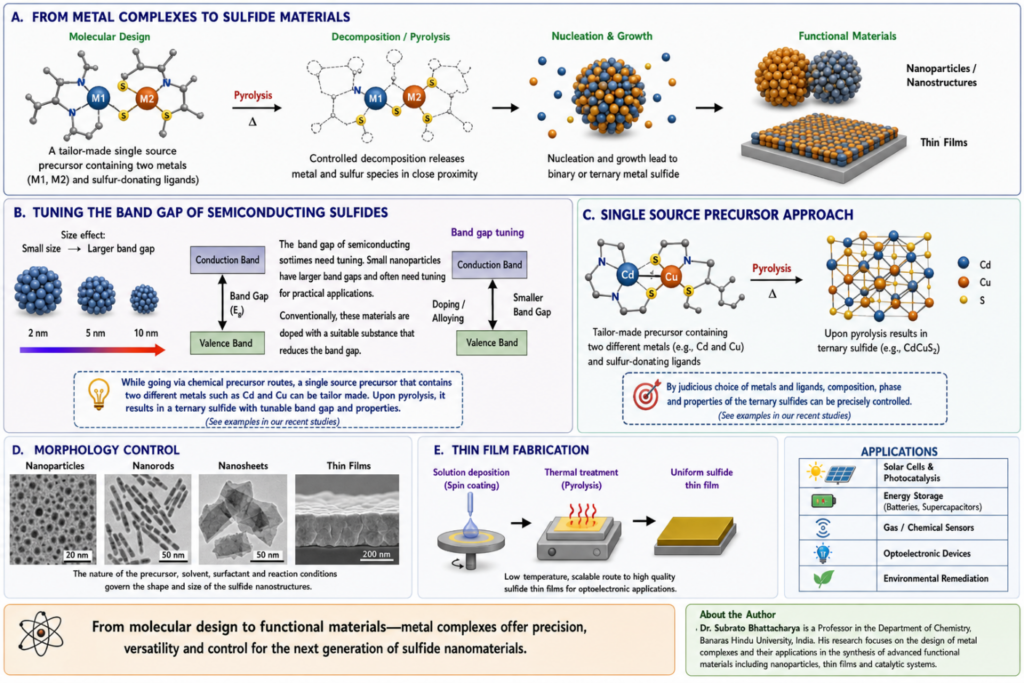
The synthesis of functional materials has traditionally relied on methods that are often energy-intensive and empirically driven. High temperatures, prolonged heating cycles, and repeated optimization steps are common in conventional solid-state routes. Although such approaches have produced technologically important materials for decades, they frequently offer limited control over composition and morphology, particularly in multicomponent systems.
Over the last several years, however, a different philosophy of materials synthesis has begun to attract increasing attention. Instead of assembling materials under harsh conditions from simple inorganic salts or oxides, researchers are now designing molecular precursors in which many of the essential structural and compositional features are already encoded at the molecular level. Among the various approaches explored in this direction, the use of metal complexes as precursors for metal sulfide materials (a class of compounds that underpin technologies ranging from energy conversion to electronics) has emerged as especially promising.
This strategy is appealing not merely because it simplifies synthesis, but because it offers an unusual degree of chemical control. The precursor is no longer just a reagent; in many cases, it behaves like a molecular template that predetermines how the final material will evolve during decomposition.
“In single-source precursors, the blueprint for the final material is built directly into the molecule, allowing chemists to design advanced sulfides with remarkable precision.”
Why Sulfides Matter: Metal sulfides occupy an important position in materials chemistry because of the diversity of their electronic and optical properties. Binary sulfides such as ZnS, CdS, CuS, and NiS have long been investigated for semiconducting, catalytic, and photochemical applications. More recently, ternary and quaternary sulfides have attracted considerable attention owing to their tunable band structures and improved functional performance in areas such as photovoltaics, photocatalysis, sensing, and electrochemical energy conversion.
At the same time, sulfide materials are not always easy to prepare reproducibly. Small variations in temperature, precursor ratio, sintering time, or reaction environment can produce substantial differences in phase purity and particle morphology. The problem becomes even more complicated in multimetallic systems where maintaining homogeneous elemental distribution is often difficult. Therefore, conventional synthetic approaches are considered somewhat unpredictable, particularly when targeting nanoscale materials. This is one reason why molecular precursor routes have become increasingly attractive.
Metal Complexes as Single-Source Precursors: The use of metal complexes introduces a fundamentally different way of thinking about materials synthesis. In coordination chemistry, ligands are selected to stabilize metals in well-defined chemical environments. When metal complexes having sulfur donor ligands are thermally decomposed, the metal and sulfur components are released in close proximity to one another, thus facilitating the direct formation of metal sulfide phases without requiring separate sulfidizing agents. Since all the components are being obtained from the same molecule, the word single-source precursor (SSP) is commonly usedy used for such molecules
This idea of molecular-level mixing is one of the major strengths of the precursor approach. Since the constituent elements are already associated within a single molecular framework, diffusion-related problems that are common in conventional solid-state methods are significantly minimized when a single-source molecular precursor is used. Particularly important in this context are sulfur-containing ligands such as thiocarboxylates, dithiocarbamates, xanthates, and related donor systems. These ligands serve not only as stabilizing groups for the metal center but also as internal sulfur reservoirs during decomposition. As a result, the synthesis can often proceed under comparatively milder conditions while still yielding crystalline sulfide materials.
In many cases, the decomposition behavior of the precursor itself strongly influences the morphology of the final nanostructure. Slight modifications in ligand architecture, coordination geometry, or metal-to-ligand ratio can alter nucleation and growth pathways quite dramatically. This sensitivity, although challenging at times, also provides opportunities for rational materials design.
Toward Multicomponent Sulfide Systems:The advantages of molecular precursor methods become even more evident in ternary compounds and related multicomponent systems. Achieving precise stoichiometric control using conventional approaches is frequently difficult because different metal ions may react or diffuse at different rates. Molecular precursors partly overcome this issue by incorporating multiple metal centers within the same molecule. This aspect is especially relevant for tuning the electronic properties of semiconducting sulfides. At the nanoscale, quantum confinement effects often lead to widening of the band gap as particle dimensions decrease. While this phenomenon can be scientifically interesting, it is not always desirable for practical device applications. Traditionally, band-gap tuning has relied heavily on post-synthetic doping strategies. However, molecularly designed precursors provide a more integrated alternative. By incorporating two or more metals directly into a single-source precursor, it becomes possible to generate ternary sulfides with modified electronic structures in a more controlled manner. Systems containing combinations such as Cu–Cd, Cu–Zn, Ag-Zn, or Ag-Cd have shown how precursor design can influence morphology and property simultaneously. An important consequence of this approach is that compositional tuning occurs during material formation itself rather than through a secondary modification step. This often improves reproducibility and reduces synthetic complexity.
From Nanoparticles to Thin Films: One of the most exciting aspects of the molecular precursor approach is its versatility in shaping materials at different scales. By varying reaction conditions such as temperature, solvent, and deposition method, chemists can direct the formation of nanoparticles, nanostructures, or thin films. Nanoparticles derived from metal complexes often exhibit narrow size distributions and well-defined shapes. Their high surface area and unique electronic properties make them ideal for catalysis and sensing applications. Moreover, because their formation is guided by molecular precursors, it is possible to achieve a level of reproducibility that is difficult with conventional methods.
On the other hand, thin films are central to many technologies, including photovoltaics and microelectronics. Using techniques such as solution deposition or spray coating, metal complexes can be transformed into uniform sulfide films on various substrates. In addition, volatile metal complexes have also been extensively explored as precursors in metal–organic chemical vapor deposition (MOCVD), where controlled decomposition in the vapor phase enables the growth of high-quality sulfide thin films with excellent compositional uniformity. These films can be engineered to have specific thicknesses, crystallinity, and surface characteristics, enabling their integration into functional devices.
“By using metal complexes as molecular templates, scientists can create high-performance nanomaterials and thin films under milder, more efficient, and more controllable conditions.”
Advantages Beyond Control : While reproducibility is a major advantage, the benefits of using metal complexes extend further. Thermal decomposition of single-source precursors operates under relatively mild conditions compared to traditional high-temperature sintering routes. Additionally, the ability to design complexes at the molecular level allows for greater flexibility and creativity. Chemists can introduce functional groups, tailor decomposition pathways, and even incorporate additional elements to create hybrid or doped materials, thus providing solutions to the demands of modern technology.
The Road Ahead :Despite the considerable promise of molecular precursor routes, several challenges remain. The design of suitable metal complexes requires careful control over the coordination environment and decomposition pathways. However, advances in spectral and imaging characterization and computational modeling are steadily improving our understanding of these transformations and enabling more rational precursor design.
Nevertheless, the single-source precursor approach has already emerged as a versatile strategy for the synthesis of compositionally controlled sulfide nanomaterials under comparatively mild conditions. As interest in sustainable and tunable functional materials continues to grow, further developments in coordination chemistry and precursor engineering are likely to expand the role of this methodology in areas ranging from catalysis and energy conversion to electronic and optoelectronic applications.