
Tuberculosis (TB) remains one of the world’s leading infectious diseases and continues to be a major public health challenge in India. Although significant progress has been made in diagnosis, treatment, and programme implementation, India still accounts for the largest share of the global TB burden. Eliminating TB requires more than providing quality treatment. It also requires timely notification of every diagnosed patient to the public health system. TB notification is much more than a reporting requirement. It forms the foundation of disease surveillance. It helps health authorities understand where TB is occurring, monitor treatment, trace contacts, and allocate resources effectively. Without complete notification, patients become invisible to the programme, making it difficult to achieve the goal of TB elimination.
The private healthcare sector plays a critical role in India’s health system. A large proportion of patients with symptoms suggestive of TB first seek care from private practitioners, hospitals, diagnostic laboratories, or pharmacies. These providers diagnose and treat thousands of TB patients every year. Their active participation is therefore essential for strengthening surveillance and improving programme performance. Recognizing this, the Government of India has introduced several initiatives to improve private-sector engagement. Mandatory TB notification, the Ni-kshay digital platform, Public–Private Mix (PPM) activities, and provider incentives have all strengthened reporting. Nationally, these efforts have increased private-sector notifications. However, progress has not been uniform across districts. Many areas continue to face operational challenges that limit private-sector participation.
Our experience from the Akot Tuberculosis Unit highlighted an important reality. The biggest barriers were rarely related to policy. Instead, they were practical problems encountered during routine clinical practice. Busy outpatient clinics, limited familiarity with digital reporting, technical difficulties, and infrequent communication with programme staff affected notification practices. These challenges could not be solved by regulations alone. They required continuous support and collaboration.
From Policy to Practice
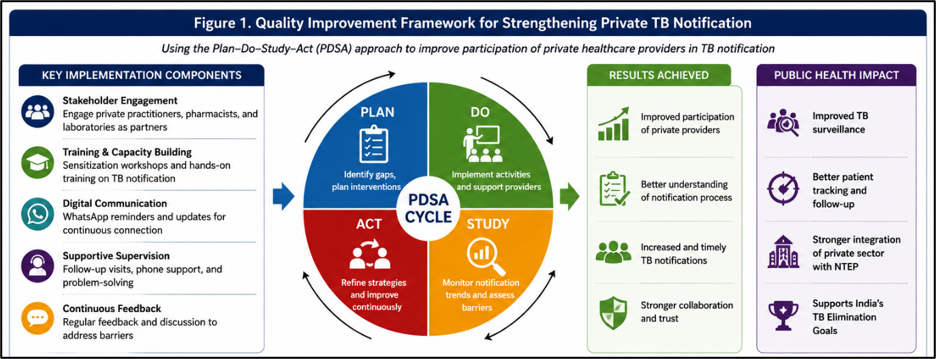
To address these challenges, we adopted a quality improvement approach. The objective was not to introduce a new programme but to strengthen the existing one. We worked closely with private practitioners, pharmacists, laboratory personnel, and district TB programme staff. Rather than assuming the causes of poor notification, we first tried to understand them. The solutions were intentionally simple. Sensitization meetings improved awareness of TB notification. Regular WhatsApp communication kept providers informed and connected. Technical support helped resolve problems related to the Ni-kshay platform. Follow-up visits created opportunities to answer questions and address operational difficulties. Every intervention was designed to fit within routine programme activities. One important observation was that healthcare providers were willing to participate when the reporting process became easier and support was readily available. Most providers did not oppose notification. They simply needed practical guidance and confidence in the system. This finding reinforces an important principle of implementation research: improving systems often depends more on reducing operational barriers than introducing new technology.
Our quality improvement initiative demonstrated that district-level TB notification can be strengthened without introducing new reporting systems or major financial investments. By combining stakeholder engagement, digital communication, supportive supervision, and continuous feedback within the existing NTEP framework, the initiative provided a practical model that can be replicated in similar programme settings. The experience reinforces the growing importance of implementation research in translating public health policies into routine practice.
The Value of Partnership
Perhaps the greatest achievement of this initiative was not the increase in notification alone. It was the stronger partnership that developed between the public health programme and private healthcare providers. Regular interaction created trust. Private practitioners became more comfortable discussing their concerns. Programme staff gained a better understanding of the realities of private clinical practice. Communication became more open, and problems were solved more quickly. This partnership changed the way notification was perceived. It was no longer viewed as an administrative obligation. Instead, it became a shared responsibility for improving patient care and strengthening public health. These experiences demonstrate that successful programmes depend as much on relationships as they do on technology. Digital platforms can simplify reporting, but they cannot replace regular communication, mutual respect, and supportive supervision.
Remaining Challenges and Knowledge Gaps
Although India has made substantial progress in strengthening private TB notification, important challenges remain. The success of quality improvement initiatives depends on sustained engagement with healthcare providers and continued support from programme teams. Maintaining these efforts over time can be difficult, especially in resource-constrained settings. Evidence on the long-term sustainability of quality improvement interventions is still limited. More implementation research is needed to identify strategies that work across different districts, urban and rural settings, and diverse private healthcare systems. Future studies should also evaluate the cost-effectiveness of these interventions, the role of digital technologies, and innovative approaches to strengthen long-term engagement of private healthcare providers. Addressing these knowledge gaps will help develop scalable and sustainable models that can support TB elimination not only in India but also in other high-burden countries.
Lessons Beyond Tuberculosis
The lessons from this work extend well beyond TB control. Many public health programmes depend on collaboration between public agencies and private healthcare providers. Immunization, maternal and child health, non-communicable disease screening, antimicrobial resistance surveillance, and outbreak preparedness all require timely reporting and coordinated action. Quality improvement offers a practical framework for strengthening these programmes. It encourages teams to identify local barriers, test simple solutions, evaluate outcomes, and refine interventions over time. This approach allows programmes to adapt to local needs without requiring major structural changes or additional resources. One important lesson is that small improvements can have a large cumulative impact. A phone call, a follow-up visit, a WhatsApp message, or timely technical assistance may appear simple, but together they create a system that is easier to use and more responsive to healthcare providers.
Looking Ahead
India has made remarkable progress in engaging the private sector for TB control. The next phase should focus on improving the quality of engagement rather than simply expanding reporting mechanisms. Digital innovations, including user-friendly reporting systems, artificial intelligence-assisted decision support, and mobile health technologies, may further strengthen programme performance. However, technology should complement, not replace, strong partnerships between healthcare providers and public health teams. Future implementation research should focus on identifying strategies that are sustainable, scalable, and adaptable across different healthcare settings. More evidence is needed on long-term provider engagement, integration of digital tools into routine practice, and cost-effective models that can be implemented across districts with different resource levels. Sharing successful district-level experiences will help accelerate learning across programmes and strengthen national TB elimination efforts. Making private TB care visible ultimately means making every patient visible to the health system. When healthcare providers, programme managers, researchers, and policymakers work together, notification becomes more than a reporting exercise. It becomes a vital step towards better surveillance, better patient care, and ultimately, a TB-free India.