The Growing Challenge of Antimicrobial Resistance
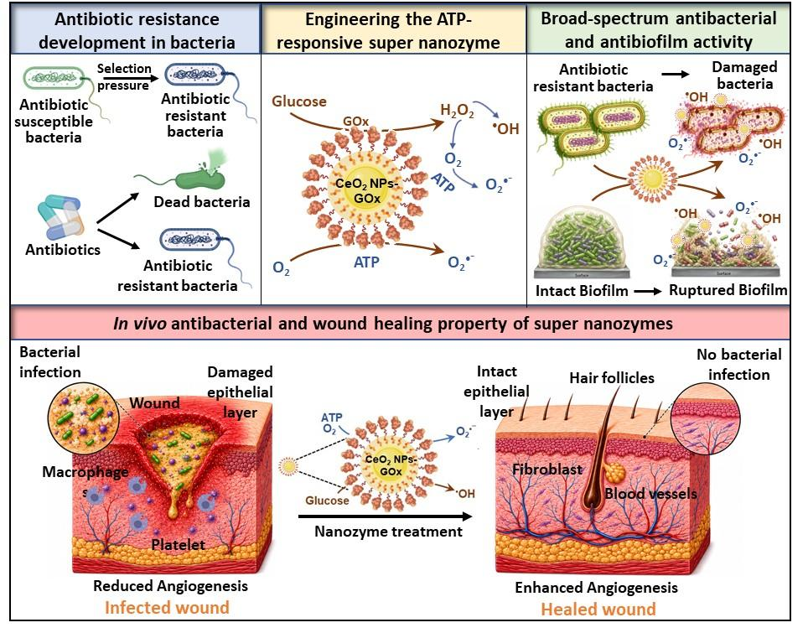
Antimicrobial resistance (AMR) is rapidly becoming one of the greatest threats to the global healthcare including humans and animals. As conventional antibiotics continue to lose their effectiveness, global researchers endeavor to explore novel therapeutic approaches that are less likely to cause resistance in the pathogens. Among the most promising innovations of recent times, nanozymes (engineered nanomaterials exhibiting the catalytic functions of natural enzymes) have emerged as an excellent alternative to the conventional antibiotics. Being nanomaterial, nanozymes too display unusual intrinsic properties due to the extremely tiny size, high surface to volume ratio and high surface area that makes the basis of extremely high catalytic activity. Pro-oxidant nanozymes have demonstrated remarkable potential for producing reactive oxygen species rendering them suitable for eliminating antibiotic-sensitive as well as resistant bacterial species, and disrupt biofilms. Although a lot has been reported in this context, the field remains in its infancy and therefore, several exciting questions are yet to be answered. One of the biggest concerns is the behavior (stability and activity) of nanozymes within the complex biological systems. It also remains to be studied that what are the possible effects of the interaction of nanozymes with multiple components of complex biological milieu. It is also discovering that how soon these nanozymes are recognized by the reticuloendothelial system and levels of opsonization. Although nanozymes are found accumulated in spleen and liver that indicates that swift clearance by macrophages, presents a major bottleneck for targeted drug delivery and long circulation in blood. These questions are some of the forefront concerns of translational limitations of nanozyme-based technologies from the laboratory to clinical practice. Another major unanswered and challenging area is understanding the precise molecular mechanisms underlying nanozyme-mediated antibacterial activity. Although reactive oxygen species generation is widely recognized as a primary mechanism, growing evidence suggests that nanozymes may also influence bacterial metabolism, gene expression, quorum sensing, and host immune response. Deciphering these complex interactions could enable researchers to design more effective and selective therapeutic platforms.
Scientific and Technological Breakthroughs Needed
Several scientific and technological breakthroughs will be required to unlock the full potential of nanozyme-based medicine. The next generation of nanozymes should include the development of theranostic nanozymes, exhibiting both diagnostic and therapeutic capabilities within a single platform. Such systems would enable real-time monitoring of disease progression along with treatment efficacy leading to personalized medicine. Equally important is the development of selective or target-dependent nanozymes that can specifically recognize and eliminate pathogenic microorganisms while sparing beneficial microbiota and healthy host tissues. Achieving this level of selectivity would significantly improve treatment safety and efficacy. These advances will pave the way for intelligent, precision nanozyme therapeutics with broad clinical applications. Further, the development of advanced analytical and imaging technologies for real-time monitoring of nanozyme behaviourur in complex biological environments is required. High-resolution in vivo imaging, multimodal molecular imaging, single-particle tracking, and real-time spectroscopic techniques will enable researchers to monitor nanozyme biodistribution, catalytic activity, degradation, and therapeutic responses within living systems. Emergence of such discoveries and technologies are required to deepen our understanding of nanozyme–biological interactions, and support the rational design of next-generation nanozyme therapeutics.
Emerging Innovations Driving the Field Forward
Among the most promising emerging trends is the development of microenvironment-responsive nanozymes. Our own research on ATP-enhanced glucose-oxidase conjugated cerium-oxide nanozyme (CeO2 NPs-GOx) system highlights the potential of exploiting biochemical signals naturally present within infected tissues. ATP, glucose, and local physiological changes such as pH can serve as endogenous triggers capable of activating catalytic therapy precisely at the site of infection. Such self-regulated therapeutic systems represent an important step toward personalized and precision medicine by maximizing antibacterial efficacy while minimizing damage to healthy tissues. Another rapidly emerging area is the application of artificial intelligence (AI) and machine learning (ML) in nanozyme research. Rather than relying solely on human intelligence-based time-consuming experimental screening, AI and ML can predict the optimal composition, morphology, surface chemistry, crystal structure, catalytic activity, and biosafety of nanozymes. These computational approaches can reveal structure–activity relationships, accelerate the rational design of highly efficient, disease-specific nanozymes, and substantially reduce both development time and cost. The integration of nanozymes with advanced biomaterials is another exciting innovation that are being discovered currently. Incorporating nanozymes into hydrogels, wound dressings, tissue-engineered scaffolds, microneedle patches, and implant coatings can provide sustained localized therapy while promoting tissue regeneration, reducing inflammation, and preventing bacterial colonization. Such multifunctional platforms hold great promise for treating chronic wounds, diabetic ulcers, burn injuries, and implant-associated infections.
The Next Five to Ten Years
Over the next five to ten years, the field is likely to evolve from proof-of-concept demonstrations toward clinically relevant applications. We anticipate the emergence of highly specialized nanozyme systems tailored for specific diseases and patient populations. Standardized protocols for evaluating catalytic activity, therapeutic performance, and long-term safety will become increasingly important. Regulatory frameworks governing nanozyme-based therapeutics are also expected to mature, facilitating eventual clinical translation. In near future, the nanozyme field is expected to significantly evolve by developing stimuli-responsive nanozymes, AI-assisted nanomaterial design, bioinspired catalytic systems, and multifunctional theranostic platforms, etc. Equally important will be advances in large-scale manufacturing and reproducibility, which are essential prerequisites for commercialization. Nanozyme-based start-ups are also expected to emerge rapidly as the field transitions from laboratory research to commercial translation. These companies are likely to focus on developing clinically validated nanozyme therapeutics, rapid point-of-care diagnostics, precision livestock health products, biosensors, and environmentally sustainable catalytic technologies.
What Lies Ahead?
In future, readers are expected to witness the transformation of the field from first-generation single-enzyme mimics toward next-generation intelligent catalytic nanomedicines that integrate multiple catalytic functions with targeted delivery, disease-responsive catalytic actions, and real-time diagnostics. The multifunctional nanozyme platforms are also expected to transform human and veterinary medicine, environmental remediation, biosensing, AMR eradication, and industrial bio-catalysis. The emergence of clinically validated and commercially available nanozyme-based products is anticipated to be one of the most significant milestones in nanomedicines over the coming decade.