Visceral leishmaniasis (VL), commonly known as kala-azar, is one of the most severe neglected tropical diseases (NTDs) and remains a major public health concern in tropical and subtropical regions. The disease is caused by protozoan parasites of the genus Leishmania, primarily Leishmania donovani in the Indian subcontinent and East Africa, and is transmitted by infected female phlebotomine sand flies. Following transmission, parasites invade host macrophages and multiply intracellularly, leading to systemic infection of the spleen, liver, bone marrow, and lymphoid tissues. If left untreated, VL is almost invariably fatal. Although the World Health Organization has made significant progress toward VL elimination through vector control, early diagnosis, and improved treatment strategies, the disease continues to affect thousands of people annually, particularly among economically disadvantaged populations. Because of its high mortality, socioeconomic impact, and limited therapeutic options, visceral leishmaniasis remains one of the priority neglected tropical diseases requiring continued research and innovation.
From Understanding the Parasite to Improving Patient Care
Over the past several decades, remarkable advances have been made in understanding the biology of Leishmania, parasite–host interactions, immune responses, and disease epidemiology. Molecular and genomic studies have identified numerous parasite virulence factors and mechanisms involved in intracellular survival. Improvements in diagnostic techniques, including rapid diagnostic tests (rK39), molecular diagnostics, and quantitative PCR, have enabled earlier and more accurate detection of infection. Advances in immunology have demonstrated that successful parasite clearance depends largely on a protective Th1 immune response characterized by interferon-γ (IFN-γ), interleukin-12 (IL-12), and macrophage activation, whereas disease progression is associated with elevated IL-10 and TGF-β production that suppress cellular immunity. Furthermore, improvements in experimental infection models, including macrophage assays, BALB/c mice, and hamster models, have greatly facilitated preclinical evaluation of novel therapeutic candidates.
The therapeutic landscape has also changed considerably. Pentavalent antimonials, once considered the major drug of VL treatment, have largely been replaced because of widespread resistance, particularly in the Indian subcontinent. Current treatment options include Amphotericin B, liposomal Amphotericin B, Miltefosine, Paromomycin, and Pentamidine. These drugs have substantially reduced mortality and improved cure rates. However, none of these drugs acts as an ideal therapy because each drug has a limitations, including toxicity, prolonged treatment duration, high treatment costs, parenteral administration, hospitalization requirements, and reduced effectiveness in some endemic regions. Increasing reports of treatment failure and reduced susceptibility to Miltefosine and other anti-leishmanial drugs have raised serious concerns regarding the sustainability of current treatment strategies.
Giving Existing Medicines a New Purpose
One of the most significant advances in the field has been the recognition of drug repurposing as a practical and efficient strategy for anti-leishmanial drug discovery. Drug repurposing involves identifying approved or clinically investigated drugs for new therapeutic indications outside their original use. This strategy offers major advantages over conventional drug discovery because repurposed drugs already possess established safety profiles, pharmacokinetic data, manufacturing processes, and clinical experience, thereby reducing development time, costs, and regulatory barriers. Importantly, several anti-leishmanial drugs currently used in clinical practice are themselves successful examples of drug repurposing. Amphotericin B was originally developed as an antifungal drug, Miltefosine as an anticancer compound, Paromomycin as an aminoglycoside antibiotic, and Pentamidine for African trypanosomiasis before being adopted for visceral leishmaniasis. These successes provide strong evidence that repurposing existing medicines represents a scientifically valid approach for discovering new therapies against neglected tropical diseases.
New Technologies Accelerating Drug Discovery
Recent advances in computational biology, artificial intelligence, high-throughput drug screening, molecular docking, structural biology, metabolomics, transcriptomics, and systems pharmacology have accelerated the identification of repurposable drug candidates against Leishmania. Numerous FDA-approved drugs from diverse therapeutic classes including antimalarials, anticancer agents, antifungals, antibiotics, anti-inflammatory drugs, and metabolic modulators have demonstrated anti-leishmanial activity in experimental studies. In parallel, increasing emphasis has been placed on evaluating not only parasite-killing activity but also the immunomodulatory effects of candidate drugs, recognizing that durable parasite clearance requires restoration of protective host immune responses in addition to direct parasite elimination.
The Remaining Challenges in Defeating Kala-Azar
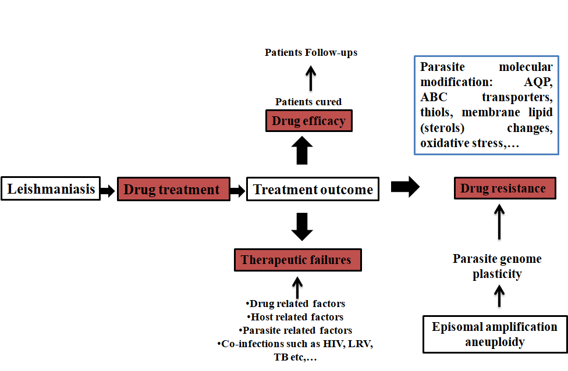
Despite these important advances, several major scientific challenges remain. Drug-resistant Leishmania donovani has emerged as one of the greatest threats to VL control programmes. Parasites acquire resistance through multiple mechanisms, including altered drug uptake, increased drug efflux, gene amplification, chromosomal instability, metabolic adaptation, and enhanced antioxidant defense systems. Furthermore, treatment failure is a multifactorial phenomenon influenced not only by parasite resistance but also by host immune status, HIV co-infection, malnutrition, pharmacokinetic variability, treatment adherence, and environmental factors. Consequently, overcoming drug resistance requires therapeutic approaches that address both parasite biology and host immunity(Figure 1).
There is a limited evaluation of repurposed drugs against clinically resistant or relapse-derived Leishmania donovani isolates. Most published studies continue to rely on maintained laboratory strains that may not accurately represent parasites circulating in endemic regions. Similarly, relatively few investigations comprehensively examine the immunological effects of repurposed drugs alongside their direct anti-parasitic activity. Additional studies evaluating pharmacokinetics, combination therapy, resistance mechanisms, biomarkers of treatment response, and long-term safety are still required before repurposed medicines can be incorporated into routine clinical practice.
Our Contribution: Finding New Uses for Existing Drugs
Against this background, our research contributes to the field by investigating FDA-approved repurposed drugs against clinical isolates of Leishmania donovani exhibiting reduced susceptibility to currently available anti-leishmanial drugs. Unlike many previous studies performed using laboratory-adapted strains, our work evaluates clinically relevant isolates through both in vitro and in vivo experimental models. The study identifies Buparvaquone as the most potent repurposed candidate while also demonstrating promising anti-leishmanial activity for Disulfiram, Chloroquine, and Artemisinin. In addition to parasite inhibition, the research evaluates host-cell toxicity and immunomodulatory responses, demonstrating that selected repurposed drugs can reduce parasite burden while promoting protective Th1 immune responses. These findings provide important preclinical evidence supporting further investigation of repurposed medicines as safer, faster, and more cost-effective therapeutic alternatives for drug-resistant visceral leishmaniasis.
The Road Ahead
Overall, the current state of the field demonstrates substantial progress in understanding Leishmania biology, host immunity, and therapeutic development. Nevertheless, drug resistance, treatment failure, toxicity, prolonged treatment regimens, and the limited pipeline of novel anti-leishmanial drugs continue to threaten disease control and elimination programmes. Drug repurposing has emerged as one of the most promising strategies to address these challenges because it builds upon existing medicines with known safety profiles while substantially reducing the time and cost required for drug development. Continued research integrating molecular biology, immunology, pharmacology, and translational studies is expected to accelerate the discovery of effective repurposed therapies capable of overcoming drug-resistant kala-azar and improving patient outcomes worldwide.