Everyday Motion, Extraordinary Energy
Envisage this: you’re walking down the street, and with every step, your shirt is quietly generating electricity. Sounds futuristic? Not anymore. Welcome to the world of piezoelectric energy harvesting, where simple movements can be transformed into electricity.
What Is Piezoelectricity?
The word might sound intimidating, but the idea is simple: certain materials create an electric charge when you press, bend, or stretch them. Discovered back in 1880 by the Curie brothers, this effect is like squeezing a crystal and watching it spark. These materials don’t just produce electricity, they also change shape when exposed to an electric field. That’s why they’re used in everything from sensors and speakers to cutting-edge energy devices.
Natural vs. Manmade Powerhouses
Piezoelectric materials are of two types: Natural substances: Quartz, topaz, tourmaline, and even everyday substances like bone, wood, silk, and enamel. Engineered materials: Ceramics: Strong output but brittle. Polymers: Flexible and wearable, though less effective. Composites: The best of both worlds, combining strength and flexibility.
Meet the Nanogenerator
The real game-changer is the nanogenerator a tiny device that converts mechanical/thermal energy as produced by small-scale physical change into electricity. Think of it as a microscopic power plant that can keep your smartwatch or fitness tracker running without charging, power medical implants like pacemakers using your heartbeat, and supply electricity to IoT sensors monitoring bridges, cars, or even your home. Rising energy demand has intensified reliance on fossil fuels, yet their continued use results in significant carbon dioxide emissions and environmental degradation. To address this challenge, innovative energy harvesting techniques are being developed, particularly within urban infrastructure such as roads, where vast amounts of kinetic energy are wasted annually. Key market trends include the integration of solar panels, piezoelectric devices, and thermoelectric and electromagnetic harvesters to capture this untapped energy (Table 1).
Among these, piezoelectric nanogenerators (PENGs) stand out at the intersection of materials science, nanotechnology, and energy engineering. Their importance lies in enabling self-powered electronics, reducing dependence on conventional batteries, and paving the way for sustainable, autonomous technologies in healthcare, IoT, and wearable devices. The global energy harvesting system market was valued at $511.6 million in 2020 and is projected to reach $1,057.7 million by 2030. (source: https://www.alliedmarketresearch.com/energy-harvesting-system-market-A13686).
| Technology | Typical output | Best use cases | Pros | Cons |
| Solar panels (roadside/embedded) | mW–kW | Rooftops, road shoulders, parking lots | High maturity; predictable daytime output | Reduced output in shade/rain; maintenance needs |
| Piezoelectric (including nanogenerators) | µW–mW per device | Road vibration, footpaths, wearables, sensors | Works in low-light; ideal for vibration sources; battery-free sensors | Low per-unit power; material durability/cost issues |
| Thermoelectric | µW–mW from small ΔT | Waste heat from pavements, vehicles, Heating, Ventilation, and Air Conditioning | Harvests heat continuously where ΔT exists | Requires temperature gradient; modest efficiency |
| Electromagnetic (captures ambient energy, such as vibrations, movement, or stray radio waves, and converts it into usable electrical power using Faraday’s law of induction) | mW–W (mechanical motion) | Road speed bumps, vehicle suspensions | Higher instantaneous power for large motion | Mechanical complexity; wear and maintenance |
Key Discoveries and Advances in Piezoelectric Energy Harvesting
High-performance materials: Development of PVDF (poly(vinylidene fluoride)) and copolymers and lead-free ceramics with strong piezoelectric coefficients. Nanostructuring breakthroughs: Electrospinning and thin-film deposition techniques that maximize electroactive phase content in PVDF. Hybrid energy harvesters: Combining piezoelectricity with triboelectric or photovoltaic effects for higher efficiency. Bio-integrated devices: Demonstrations of nanogenerators powering pacemakers, sensors, and smart textiles. Scalable fabrication: Progress in large-area printing and flexible substrates for wearable applications.
PVDF and its copolymers exhibit outstanding piezoelectric and ferroelectric properties, enabling the efficient conversion of ambient mechanical stimuli, such as vibrations, pressure variations, and biomechanical motions into usable electrical energy. The inherent polymorphism of fluoropolymers, particularly the tuneable transitions between nonpolar and electroactive crystalline phases, offers a powerful framework for tailoring structure–property relationships through processing strategies including electrospinning, mechanical stretching, and electrical poling. This synergy of intrinsic electroactivity, structural adaptability, and broad device compatibility firmly establishes fluoropolymers as a cornerstone material platform for next-generation self-powered systems.
Current State of the Field
The field has moved beyond proof-of-concept and is entering early commercialization. PENGs are already being tested in wearables, biomedical implants, and IoT sensors, but widespread adoption requires breakthroughs in power density, durability, and scalable manufacturing. The overarching vision is a future where devices are energy autonomous, continuously harvesting ambient mechanical energy without batteries.
In short: Piezoelectric nanogenerators are evolving from niche prototypes into real-world sustainable energy solutions, with the potential to revolutionize how we power small-scale electronics.
Why This Matters
Convenience: Imagine never charging your smartwatch again it powers itself from your daily movements. Sustainability: Reduces reliance on disposable batteries, cutting electronic waste. Healthcare impact: Safer, longer-lasting implants powered by the human body itself. Smart cities: Maintenance-free sensors for infrastructure monitoring.
Top 5 Coolest Piezoelectric Prototypes
Power-Generating Shoes: Walking or running charges tiny electronics, imagine sneakers that juice up your fitness tracker as you move. Smart Jackets: Fabrics woven with piezoelectric fibers can harvest energy from stretching and bending, turning clothing into wearable power stations. Heartbeat-Powered Pacemakers: Implantable devices that draw energy directly from the rhythm of your heart, reducing the need for surgical battery replacements. Self-Healing Rubber Sensors: Flexible composites that repair themselves after damage, while continuously monitoring health signals like blood pressure or motion. Bridge Vibration Monitors: Piezoelectric sensors embedded in infrastructure harvest vibration energy to power themselves, keeping tabs on structural health without ever needing a battery swap.
Scientists are already weaving piezoelectric fibers into fabrics, opening the door to self-powered clothing. Imagine jackets that charge your phone or shoes that power GPS trackers. Add eco-friendly materials and hybrid systems that combine piezoelectricity with solar or triboelectric effects, and the possibilities multiply.
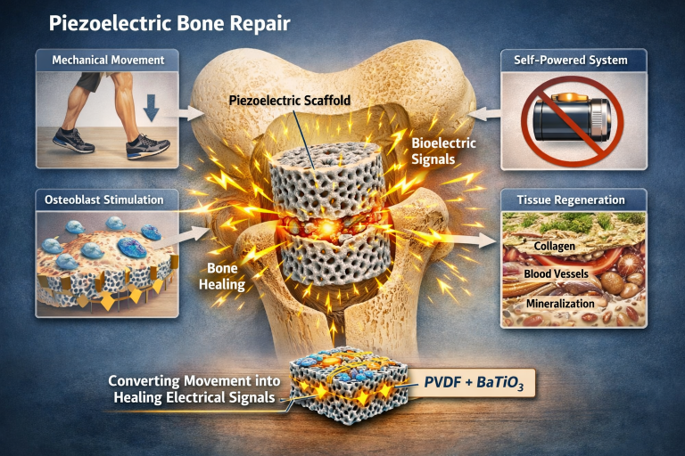
PENGs are emerging as a powerful tool for bone tissue repair, enabling self-powered scaffolds that stimulate bone regeneration by converting mechanical stress (like walking or muscle movement) into bioelectric signals. Engineered scaffolds with piezoelectric ceramics and polymers (such as PVDF and BaTiO3) accelerate bone defect regeneration as they mimic the natural piezoelectricity of bone, promoting faster healing (Figure 1). PENG-based scaffolds could reduce reliance on repeated surgeries and external electrical stimulation devices.
Major Challenges and Knowledge Gaps
Low power density: Current devices often produce microwatt-level outputs, insufficient for larger electronics. Durability: Mechanical fatigue and microcracks may reduce long-term reliability. Scalability: Transitioning from lab-scale prototypes to industrial-scale production remains difficult. Standardization: Lack of unified testing protocols for benchmarking performance. Biocompatibility: Ensuring materials are safe for long-term implantation in humans.
Future Outlook
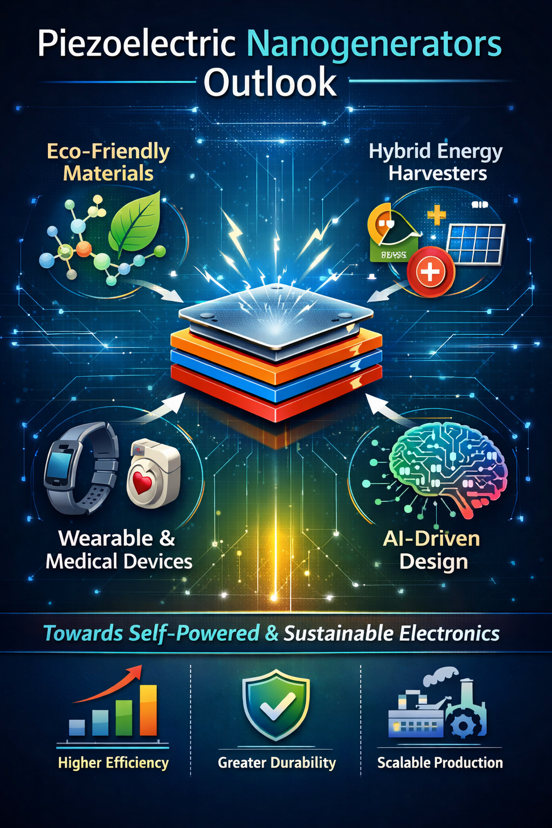
The field of PENGs is poised at a transformative stage, moving from proof-of-concept prototypes toward practical, scalable applications. Several converging trends will shape its trajectory (Figure 2).
Material Innovation
The transition to lead-free, eco-friendly piezoelectric materials is essential for sustainable and biocompatible devices. Advances in polymer–nanoparticle composites and self-healing polymers promise improved durability and performance.
Hybrid Energy Systems
Integrating PENGs with triboelectric, thermoelectric, or photovoltaic harvesters will enable multi-modal energy capture, significantly boosting output power density.
Device Integration
Seamless incorporation into wearables, biomedical implants, and IoT sensors will drive adoption. Flexible substrates and large-area printing techniques are expected to make commercialization more feasible.
Standardization and Benchmarking
Establishing unified testing protocols and performance metrics will be critical to compare devices across labs and accelerate industrial uptake.
AI-Driven Design
Machine learning and computational modelling will optimize nanostructures, predict material behavior, and shorten development cycles.
Final Spark
From quartz crystals to futuristic nanogenerators, piezoelectricity is reshaping how we think about energy. The next time you take a step, stretch, or even breathe, remember: your body’s motion could be the battery of tomorrow.
In summary, PENGs are evolving into a cornerstone technology for self-powered electronics. While challenges in power density, durability, and scalability remain, the combination of material breakthroughs, hybrid architectures, and intelligent design strategies suggests a future where ambient mechanical energy can reliably sustain the next generation of autonomous devices.