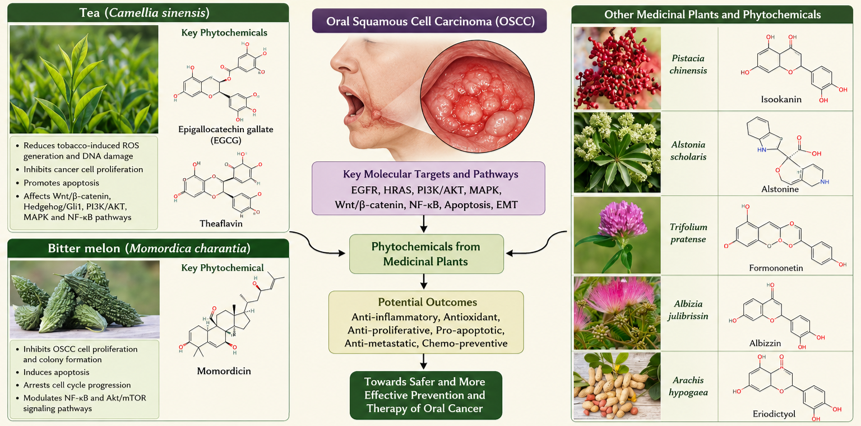
Imagine that some molecules capable of influencing cancer biology are already growing around us, in tea leaves, bitter melon, grapes, broccoli and many other plants. This does not mean that drinking tea or eating vegetables can cure cancer. Rather, it raises an intriguing question: Could nature provide valuable starting points for safer and more effective approaches to prevent and treat oral cancer?
Plants produce thousands of biologically active compounds that can influence inflammation, cell growth, metabolism, immune responses and programmed cell death. Nature has already contributed several important anticancer medicines. The challenge now is to identify promising plant-derived molecules, understand their mechanisms and determine whether they can be developed into reliable preventive or therapeutic strategies.
Oral cancer: a persistent challenge
Oral squamous cell carcinoma (OSCC), which develops from the epithelial lining of the oral cavity, accounts for more than 90% of oral cancers. Despite advances in surgery, radiotherapy, chemotherapy, targeted therapy and immunotherapy, it remains a major clinical challenge.
Globally, cancers of the lip and oral cavity accounted for approximately 452,205 new cases and 194,108 deaths in 2022, with Asia carrying the greatest burden (GLOBOCAN 2022). In the United States, cancers of the oral cavity and pharynx are estimated to cause about 60,480 new cases and 13,150 deaths in 2026 .
The burden is particularly concerning in countries such as India, where tobacco and alcohol use, together with other environmental and lifestyle factors, contributes substantially to disease development. Many patients are diagnosed after invasion of surrounding tissues or lymph-node involvement, while recurrence and second primary tumors remain important concerns.
Modern treatments have made significant progress. Surgery remains central, while radiotherapy and chemotherapy are commonly used for advanced disease. Targeted therapies against molecules such as epidermal growth factor receptor (EGFR) and immune checkpoint inhibitors targeting PD-1/PD-L1 have expanded treatment options. However, tumor heterogeneity, treatment resistance and the complex tumor microenvironment continue to limit therapeutic success .
This complexity has encouraged interest in natural products and phytochemicals as potential complementary approaches.
Nature’s chemical library
Plants have been used in traditional medicine for thousands of years. Modern research has revealed their remarkable chemical diversity, including polyphenols, flavonoids, alkaloids, terpenoids and other bioactive molecules. Nature has already contributed directly to oncology. Vinca alkaloids such as vincristine and vinblastine, the taxane paclitaxel and compounds related to podophyllotoxin originated from natural sources and became important anticancer drugs. Common foods such as cruciferous vegetables, garlic, onion, green tea, citrus fruits, soybeans, tomatoes, berries, turmeric and ginger also contain phytochemicals that have attracted attention for their potential role in cancer prevention. The scientific interest lies in understanding how these molecules influence cancer-associated pathways.
Tea: more than a comforting beverage?
Tea contains numerous biologically active compounds, including the green-tea polyphenol epigallocatechin gallate (EGCG) and theaflavins found in black tea. Our research first investigated whether black tea could influence biological damage associated with tobacco exposure, a major risk factor for oral cancer. In a population-based study involving 308 individuals, regular black-tea consumption was associated with lower tobacco-induced reactive oxygen species (ROS) generation and DNA damage in buccal mucosa compared with individuals without a tea-drinking habit . In addition, both EGCG and theaflavin reduced tobacco-associated multi-organ carcinogenesis in tongue and liver of mice simultaneously, with EGCG showing a stronger preventive effect.
The compounds also reduced cancer-cell proliferation, promoted apoptosis and decreased CD44-positive cancer stem cells. EGCG and theaflavin further influenced self-renewal pathways such as Wnt/β-catenin and Hedgehog/Gli1. Other studies have similarly reported that EGCG can influence oral cancer proliferation, migration, apoptosis and tumor growth through pathways including PI3K/AKT, MAPK and NF-κB .
Tea therefore provides an example of how dietary phytochemicals may influence multiple processes associated with cancer development and progression.
Bitter melon: a potential cancer-preventive plant
Another interesting example is bitter melon (Momordica charantia), widely cultivated in tropical and subtropical regions, including India. Traditionally consumed as food, bitter melon contains several biologically active compounds.
Our studies investigated whether bitter melon extract could influence oral carcinogenesis in animal model. Regular administration significantly reduced the incidence of tongue squamous cell carcinoma induced by 4-nitroquinoline 1-oxide (4NQO) in mice, without significant pathological changes in otherwise normal tongue tissue. Next-generation RNA sequencing showed that bitter melon treatment altered 4,482 genes compared with the cancer group. Pathway analysis highlighted immune-related changes, including reductions in pro-inflammatory genes such as S100A9, IL23A and IL1β. The treatment also influenced PD-1 and MMP9, which are involved in immune regulation and tumor progression.
Bitter melon also affected cancer metabolism, altering genes involved in glycolysis and lipid metabolism and changing pyruvate, lactate and membrane phospholipid production. These findings suggest that plant extracts may influence cancer through interconnected mechanisms involving inflammation, metabolism and immune regulation.
Finding the molecule behind the effect
Plant extracts contain numerous compounds, making it important to identify those responsible for biological activity. Using liquid chromatography coupled with high-resolution mass spectrometry, we identified momordicine-I, a cucurbitane-type triterpene, as an important bioactive component of bitter melon. Momordicine-I reduced human oral cancer cell viability in a dose-dependent manner while showing relatively limited toxicity toward normal cells in experimental studies. Mechanistic investigations identified c-Met signaling as an important target. In mouse xenograft models, momordicine-I inhibited tumor growth and demonstrated a favorable experimental pharmacokinetic profile.
Cancer is more than a collection of abnormal cells; it is an ecosystem involving tumor, immune and stromal cells. We therefore examined whether momordicine-I could influence the immune environment surrounding oral tumors. Using immunocompetent mouse models and single-cell RNA sequencing, we observed changes in tumor-associated macrophages (TAMs), which can sometimes adopt an immunosuppressive, tumor-supporting phenotype. Momordicine-I altered macrophage-associated molecular programs, including reduced expression of Sfln4 and Cxcl3. Further experiments suggested changes consistent with shifting macrophages away from an M2-like, tumor-supportive state toward a more antitumor M1-like phenotype. Treatment also reduced immune-regulatory molecules including PD-1, PD-L1 and FoxP3 in tumors .
These findings highlight a broader concept: future cancer strategies may need to target not only tumor cells but also tumor metabolism and the surrounding immune microenvironment.
Mining Nature’s Chemical Library Through Computational Screening
Nature contains an enormous chemical library, and computational biology can help narrow the search. In our recent OSCC research, RNA sequencing of patient tumors identified the MAPK signaling pathway as significantly altered. EGFR and HRAS emerged as potential therapeutic targets. We then used molecular docking to screen approximately 17,000 phytochemicals against these targets.
Four molecules: Pratenol B, Eriodictyol, Losbanine and Isookanin, emerged as promising candidates. Pratenol B was particularly interesting because of its potential interactions with both EGFR and HRAS. Additional computational analyses suggested favorable binding, stability, pharmacokinetic characteristics and toxicity.
However, these findings represent an early discovery stage, not proof of clinical efficacy. Computational predictions require validation through laboratory experiments, animal studies and ultimately well-designed clinical trials.
From promising molecules to real medicines
The journey from phytochemical to medicine is complex. Many phytochemicals have limited solubility, poor absorption, rapid metabolism or low bioavailability. Researchers are therefore exploring nanoparticles, targeted delivery systems and other technologies to improve their stability and delivery. Standardization is equally important because plant extracts can vary with species, cultivation, geography, harvesting and extraction methods. Most importantly, natural does not automatically mean safe. Rigorous toxicological, pharmacological and clinical evaluation remains essential.
What might the future look like?
The most exciting possibility may not be replacing conventional cancer treatment with plant compounds. Instead, the future could involve combination strategies.
A phytochemical might prevent early events in carcinogenesis, another could affect tumor metabolism, while a targeted natural molecule might influence EGFR or HRAS signaling. An immune-modulating compound could potentially reshape the tumor microenvironment. Such approaches may eventually complement conventional therapies or immunotherapy.
This is particularly relevant to oral cancer, where prevention and early intervention could have enormous impact. Identifying high-risk individuals, detecting potentially malignant lesions early and developing scientifically validated chemopreventive strategies could potentially reduce progression to advanced disease.
Nature may therefore not provide a single “magic bullet.” Instead, it may offer a vast library of molecular tools from which future cancer-prevention and treatment strategies can be developed.
The road ahead
Tea polyphenols, bitter melon compounds, momordicine-I and newly identified phytochemicals such as Pratenol B illustrate how plant-derived molecules can influence apoptosis, cancer stem cells, metabolism, inflammatory signaling and the immune microenvironment. The next challenge is translation: Can these molecules be optimized and delivered efficiently? Can their safety be established? Can they complement existing treatments? Most importantly, can their benefits be demonstrated in well-designed clinical trials?
So, can nature help us fight oral cancer? The scientifically responsible answer is that nature may contain important pieces of the puzzle, but we are still learning how to put them together. The future of plant-based cancer research will not depend on replacing modern medicine with nature. Rather, it may depend on using modern science to understand nature more deeply. And among the thousands of molecules produced by plants, there may still be important anticancer discoveries waiting to be uncovered.