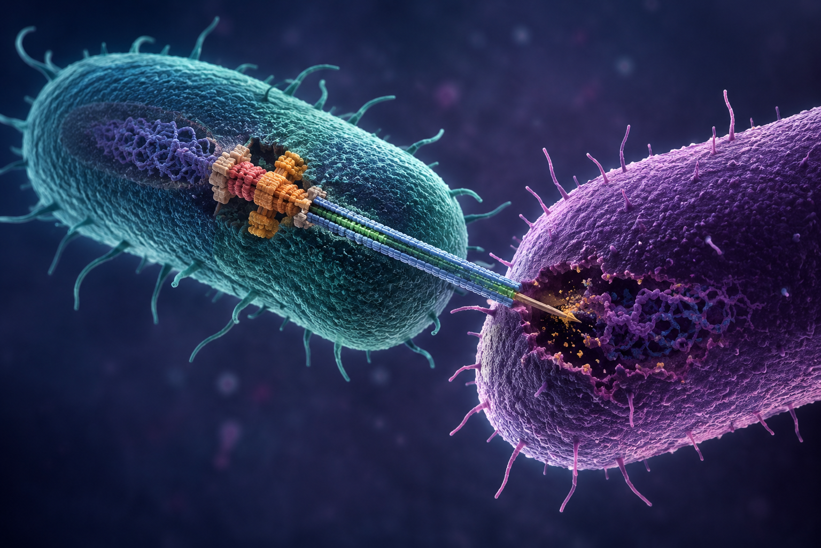
Microbes have been competing with each other for billions of years over nutrients, space, and survival. This relentless inter-microbial competition has been a powerful force in shaping bacterial evolution, driving bacteria to develop new strategies and increasingly sophisticated weapons to outcompete their rivals. The type VI secretion system (T6SS) is one such weapon found in many Gram-negative bacteria, and provides immense advantage in the microbial warfare. It is a nanoscale protein delivery system embedded in the bacterial cell envelope, made up of multiple conserved structural components. The T6SS remarkably resembles the tail of a bacteriophage in both its architecture and mechanism of action.
The primary function of the T6SS is to deliver toxic effector proteins directly to a neighbouring microbe or to a eukaryotic host cell. These effector toxins attach to some of the core components of the T6SS secretion machinery either by non-covalent bonds, or are translated as a fused part of the secretion system component. When the T6SS fires, the inner tube and the associated effector payload is delivered to the target simply by brute force. Once delivered, the effectors unleash their toxic activities, including disruption of cell walls and membranes, degradation of proteins and nucleic acids, and ultimately damaging or modulating the target.
Over the past two decades, since the discovery of the T6SS in 2006, structural biology techniques- particularly X-ray crystallography, high-resolution cryo-EM, and in situ cryo-electron tomography (cryo-ET) – have been employed extensively to understand the atomic details of individual T6SS component proteins across different bacterial species, as well as to reveal the overall architecture of the secretion apparatus. Years of rigorous research have also generated extensive biochemical and bioinformatic knowledge about the diverse types of T6SS effectors found across pathogenic and commensal bacterial species, including Vibrio cholerae, Salmonella spp., and the infamous drug-resistant ESKAPE pathogens.
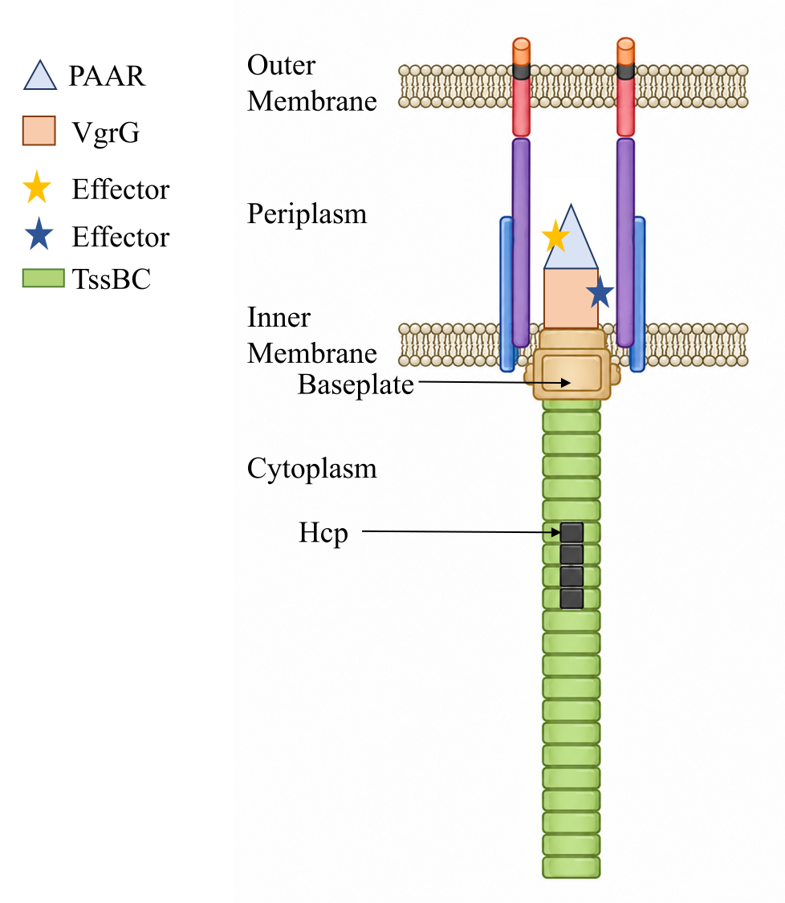
The basic architecture of the T6SS can be divided into three major structural sub-complexes: a cytoplasmic baseplate complex which serves as a nucleation point for other components to assemble, a membrane complex which spans the bacterial inner and outer membranes and anchors the secretion machinery to the cell envelope; and a bacteriophage tail-like tail complex which has two concentric tubes capped by a cone-shaped spike that functions as a puncturing device. The inner tube, composed of hexameric rings of Hcp proteins, encloses smaller effector proteins while the spike components VgrG and PAAR repeat containing proteins can carry relatively larger effectors. When the T6SS is fully assembled and ready to fire, the outer tail-tube undergoes rapid contraction. This propels the inner Hcp tube, along with the VgrG-PAAR spike and their associated effector payload, towards the target.
This extensive structural and biochemical understanding of the T6SS could prove invaluable in the ‘post-antibiotic’ era that we are rapidly approaching. Since the discovery of penicillin, the overuse and misuse of antibiotics have driven the rapid spread of antimicrobial resistance, giving rise to drug-resistant pathogens that can render conventional treatment options useless. This growing threat highlights the urgent need for alternatives to conventional antibiotics. In this context, the T6SS offers two promising avenues for developing new antimicrobial strategies.
Firstly, the idea of antivirulence, targeting or blocking the virulence factors of pathogens, thereby disarming them without essentially threatening their survival, thus minimizing the selection pressure that leads to development of resistance. T6SS, with its high structural conservation across species, widespread presence in pathogenic bacteria, and crucial role in infection establishment, is a prime target for antivirulence strategies. Developing a broad-spectrum T6SS inhibitor could become an attractive antivirulence strategy in future.
The second option is perhaps even more intriguing: repurposing the T6SS as an antimicrobial delivery platform to transport selected toxins directly into target pathogens in a controlled manner. Through bioengineering, the T6SS of a non-pathogenic bacterium could potentially be transformed into an efficient delivery vehicle capable of transporting a cocktail of antimicrobial proteins. These could include canonical T6SS effectors from different bacterial species, as well as non-T6SS toxic proteins with diverse antibacterial and antifungal activities. When coupled with advances in omics and synthetic biology, this approach could provide a highly customizable platform for delivering tailored combinations of toxins against specific microbial targets. Such a strategy offers several potential advantages. It could be used to selectively eliminate harmful pathogens in clinical settings or reshape polymicrobial communities by suppressing undesirable species while promoting the growth of beneficial microbes. The potential applications extend beyond medicine to areas like agriculture and environmental management. However, though several proof-of-concept studies have shown highly promising results in this context, there are limitations regarding the size of the toxic protein, their stability in the required settings, and their toxic effects in the delivery bacterium. To sum up, recent advances in our understanding of T6SS structure, coupled with the use of this knowledge to develop alternative antimicrobial strategies, hold significant promise in an era of rising drug resistance and emerging superbugs. T6SS-based antimicrobial applications are still in their infancy, and several major challenges remain to be addressed. However, with continued advances in structural biology, bioengineering, and omics, the T6SS could evolve into a powerful and highly customizable tool in the fight against antimicrobial resistance.