Modern medicine has radically transformed our understanding and treatment of serious illness, offering unprecedented interventions and diagnostic capabilities. Yet, illness is never purely biological. A severe diagnosis echoes far beyond physical symptoms, profoundly impacting a person’s emotional state, family dynamics, sense of identity, core values, beliefs, and expectations for the future.
Increasingly, clinical practice recognizes that caring for the whole person requires addressing these human dimensions alongside evidence-based medical treatment. Spirituality, psychology, compassion, and the medical humanities offer essential layers of support provided they are integrated responsibly, ethically, and with deep respect for individual patient belief systems.
Role of Spirituality in Coping with Illness
Personal beliefs and spirituality frequently serve as vital emotional and psychological anchors when individuals face serious illness. They provide structure and comfort, helping patients and their families navigate overwhelming uncertainty, process grief, and deliberate over complex medical decisions.
Serious illness invariably prompts existential questions that clinical medicine alone cannot answer: Why is this happening to me? How can my family and I cope with this uncertainty? Where do I find internal strength? What gives my life meaning now? Facing this level of personal vulnerability tests every emotional and spiritual reserve. Under such conditions, abstract spiritual concepts and personal beliefs convert into concrete, daily coping strategies.
Practices such as prayer, meditation, mindfulness, or religious rituals offer tangible benefits by helping to reduce anxiety, depression, and feelings of isolation. They lower physiological stress levels, promote comfort, and foster a sustained sense of hope, whether that hope is directed toward physical recovery, inner peace, or a meaningful life transition. Furthermore, the experience of illness often impels individuals to resolve lingering past conflicts, extend forgiveness, and deepen personal relationships, bringing a profound sense of emotional completion.
Ultimately, the primary contribution of spirituality is not that it provides a guaranteed explanation or cure for illness, but that it helps individuals discover meaning, connection, comfort, and hope within circumstances they cannot control. Spirituality may not alter the medical diagnosis itself, but it fundamentally transforms how a person experiences, frames, and responds to that diagnosis. Family members similarly draw strength from shared beliefs, collective prayer, quiet presence, and the supportive network of a faith community.
“Spirituality may not change the medical diagnosis, but it can change how a person experiences and responds to that diagnosis.”
Integrating Spirituality, Psychology, and Conventional Medicine
Whole-person healthcare relies on understanding the distinct yet complementary roles played by different disciplines: Conventional Medicine: Focuses primarily on the physical body, providing the scientific foundation for diagnosis, medical treatment, disease prevention, and physical symptom management. Psychology: Focuses on the mind and behavior, assisting patients in processing complex emotions, building healthy coping mechanisms, reworking negative thought patterns, and working through psychological trauma. Spirituality: Focuses on meaning, purpose, and values, restoring hope, resolving existential distress, and strengthening a sense of broader connection. Rather than competing, these approaches form what modern healthcare identifies as the Biopsychosocial-Spiritual Model. Instead of treating illness in isolation, this comprehensive framework treats the individual as an integrated whole body, mind, and spirit. In specialized clinical settings such as oncology, palliative care, and chronic disease management, multidisciplinary teams comprising physicians, nurses, therapists, social workers, and chaplains collaborate to support the patient at every stage of disease progression. This integrated care ensures that while medicine stabilizes the physical body, psychology and spiritual care safeguard emotional well-being and personal purpose.
Maintaining Hope Without Unrealistic Expectations
Hope is essential to human resilience, but clinical practice must distinguish realistic hope from false reassurance. Healthcare professionals bear a professional and moral obligation to communicate honestly about diagnosis, prognosis, treatment risks, and uncertainties. Patients and their families deserve clear, truthful information, even when the truth is difficult to convey.
Simultaneously, maintaining hope does not require promising a medical cure. While a patient may initially hope for successful treatment or remission, hope is dynamic and evolves throughout the illness journey. Hope can refocus toward achievable, deeply meaningful outcomes: relief from physical pain, spending quality time with loved ones, preserving personal autonomy, reconciling family relationships, or achieving a peaceful end-of-life experience. Hope does not depend on clinical certainty; it empowers people to find possibility, dignity, and meaning even in the presence of uncertainty.
“Hope does not require certainty. It allows people to find meaning and possibility even in the presence of uncertainty.”
Lessons from Contemplative and Compassionate Traditions
Long before the advent of modern healthcare systems, diverse cultural and spiritual traditions developed practices to help individuals face suffering, illness, and mortality. These historical traditions offer contemporary medicine valuable insights regarding presence, community support, compassion, and self-reflection.
While modern medicine excels at technical interventions and biological diagnostics, it can struggle with the relational and existential dimensions of patient care. Contemplative practices offer centuries of practical wisdom that can convert transactional medical interactions into holistic healing environments. Emerging research in psychoneuroimmunology highlights that practices like meditation, prayer, and mindfulness help down-regulate the sympathetic nervous system, reducing stress responses and acting as a resilience engine during medical crises.
However, incorporating these concepts into clinical settings requires strict professional boundaries. Spiritual care must always remain voluntary, non-coercive, and centered entirely on the patient’s values. Healthcare providers must never impose their personal beliefs. Instead, clinicians should evaluate practices by asking: What does this practice mean to the patient? Does it provide comfort? Is it safe? Can it be safely integrated alongside evidence-based medical treatments?
Current Scientific Research on Spiritual Well-Being
A growing body of scientific literature explores the relationship between spiritual well-being, resilience, and clinical outcomes. A major systematic review published in JAMA demonstrated substantial evidence that spirituality is positively associated with better quality-of-life outcomes in serious illness, recommending its consideration within person-centered care models. Research in palliative and end-of-life care indicates that structured spiritual-care interventions measurably improve spiritual well-being, alleviate psychological distress, and enhance overall quality of life. Studies demonstrate that spiritual practices help facilitate psychological recovery and coping following severe stress or major medical diagnoses. Despite these positive associations, researchers emphasize that results must be interpreted carefully. Methodologies vary, and association must not be confused with causation. Current research supports spirituality as an effective resource for coping, emotional resilience, and quality of life, but it does not support claims that spiritual practices cure physical diseases like cancer or serve as a substitute for standard medical care.
Addressing Spiritual Needs in Evidence-Based Practice
Healthcare professionals can address spiritual needs while upholding rigorous evidence-based practice through respectful curiosity and active listening. Clinicians can open communication by asking simple, non-judgmental questions about whether personal beliefs, culture, or spirituality play a role in how patients handle their health and well-being.
Medical providers do not need to act as religious experts. When specialized support is required, clinicians should collaborate with trained chaplains, social workers, psychologists, and recognized community faith leaders. This collaborative approach is critical during advanced illness or end-of-life planning, where spiritual beliefs heavily influence views on suffering, medical decisions, and personal dignity.
Core Principle: Evidence guides medical treatment; patient values guide individualized care.
Spiritual practices should always complement scientific medicine rather than replace it. Clinicians must maintain transparency regarding medical possibilities while offering genuine empathy, recognizing that true compassion does not require making promises that medicine cannot fulfil.
The Future of Integrative Healthcare
The future of medicine relies on establishing an equilibrium where scientific excellence and humanistic care are valued as equally essential components of health services.
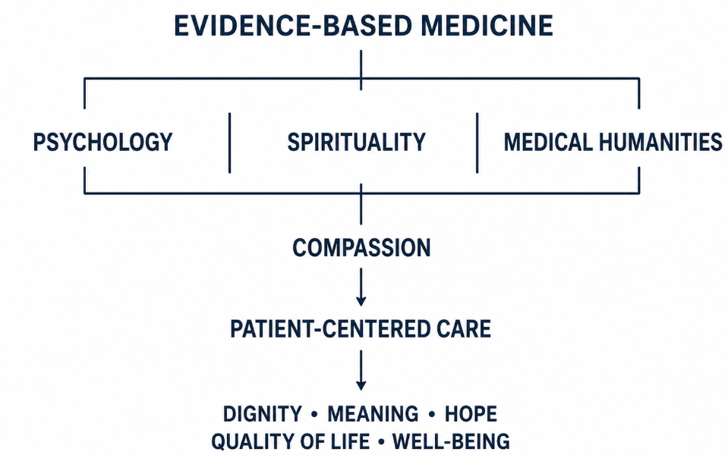
As medical technology continues to advance through artificial intelligence, precision medicine, complex diagnostics, and specialized therapies, preserving authentic human connection becomes increasingly vital. The future healthcare delivery model will rely on interdisciplinary teams physicians, nurses, psychologists, social workers, palliative specialists, and spiritual care providers working collaboratively to address individual patient needs.
In this framework, the medical humanities (literature, philosophy, ethics, narrative medicine, and the arts) play a vital role. They train healthcare providers to look beyond medical charts to understand the human story behind the illness. Ultimately, integrative healthcare does not mean endorsing unproven therapies; it means combining scientific rigor, clinical expertise, patient values, and compassionate support. The overarching goal is not merely to become more efficient at treating diseases, but to become far more effective at caring for human beings.
Conclusion
The human side of healing serves as a constant reminder that illness is simultaneously a biological, emotional, social, and existential experience. Modern medicine provides indispensable tools for diagnosing and curing disease, while spirituality, psychology, compassion, and the humanities protect meaning, emotional resilience, dignity, and personal voice. The challenge facing modern healthcare is not choosing between scientific rigor and human spirituality. The true challenge is ensuring that continuous scientific and technological progress remains dedicated to the fundamental purpose of medicine: helping human beings live, cope, heal, and, when physical cure is no longer attainable, experience care with unyielding dignity and compassion.