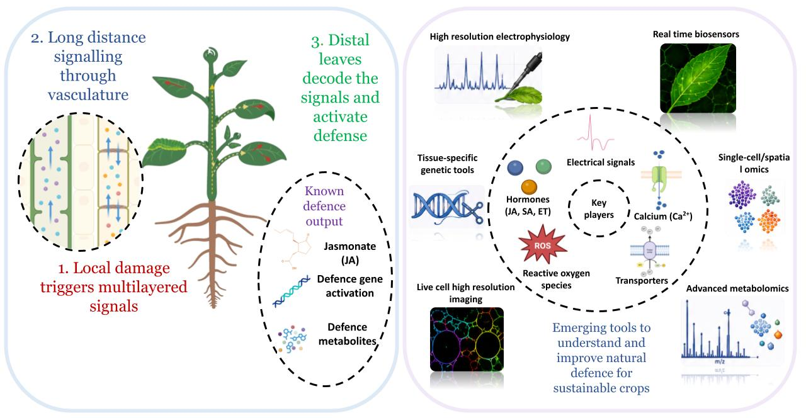
When an insect damages one leaf, information about the attack must rapidly reach undamaged tissues, allowing distant parts of the plant to defend against further attack. Plants achieve this through an interconnected communication network involving calcium, reactive oxygen species, changes in electrical activity, and defense hormones such as jasmonate. However, important question remains about how these signals are coordinated in space and time. Our work on the plasma membrane H⁺-ATPase 1(AHA1) highlights the importance of this coordination: the autoinhibitory C-terminal tail of AHA1 regulates proton-pump activity, the duration of wound-induced slow wave potentials, and downstream jasmonate responses in both local-wounded and distally connected tissue. However, we still lack a complete understanding of how changes in proton transport and membrane potential are translated into hormonal and metabolic defense outputs. The next major advances will likely come from technologies that allow us to monitor and manipulate these processes with greater spatial and temporal precision. Real-time electrophysiological recording (probably using voltage sensors), tissue-specific genetic manipulation, live reporters for jasmonate and other signaling molecules, and spatially resolved metabolomics could help connect electrical signals with hormonal activation and metabolic reprogramming. The demonstrated importance of phloem-specific AHA1 activity suggests that understanding where a signaling component acts may be as important as understanding how much it is activated. Together, these approaches could reveal the molecular “language” through which plants communicate damage and coordinate systemic defense. Such knowledge may ultimately allow us to manipulate plant signaling pathways in a tissue-specific and inducible manner, strengthening natural defense responses while minimizing growth penalties. The broader goal is to move from simply understanding plant defense to harnessing the plant’s own communication network for sustainable crop protection.
The Missing Pieces in Plant Defense
Despite growing evidence that plants use electrical, hormonal, and metabolic signals to coordinate defense, it remains unclear how these signals interact together to create a rapid and effective whole-plant response. How strength, duration, and spatial distribution of signals determine specific responses. It is also crucial to understand how plants distinguish between different types of stresses and adapt their responses accordingly, and balance rapid defense with continued growth. Ultimately, the field needs to move beyond identifying individual signals toward understanding the integrated language of plant communication – how information is encoded, transmitted, and decoded into responses.
Further, several gaps stand out in this work. First, the precise molecular link between membrane electrical signaling (the slow wave potential) and downstream metabolic reprogramming is still unclear. The study shows a strong correlation among SWP duration, JAZ10 expression, and glucosinolate accumulation, but the direct mechanistic link between proton pump regulation and systemic hormone and metabolite induction remains unresolved. Another important question is why the precise level and location of AHA1 activity are so critical for defense. Increased AHA1 activity through C-tail truncation compromises systemic defense, whereas tissue-specific expression in phloem cells can restore electrical signaling and largely alleviate growth defects. This raises the possibility that plants require tightly controlled, cell-specific modulation of proton-pump activity rather than simply increasing or decreasing its activity. Ultimately, we need to determine whether this AHA1-electrical signaling-jasmonate-metabolic network operates similarly across different plant species and agriculturally important crops.
New Tools to Unlock Plant Defense
Recent cross-linking mass spectrometry and covalent-labelling studies on AHA2 (Blackburn et al. 2025) have provided insight into how the C-terminal regulatory domain physically contacts the pump’s catalytic domains in three dimensions and how those contacts shift during activation. Extending this kind of structural resolution to AHA1 and capturing it in real time during wounding would allow researchers to observe the release and re-imposition of autoinhibition. Comparable gene-editing precision applied to AHA1’s C-tail phosphosites could dissect exactly which phosphorylation events matter for defense versus growth, instead of removing the whole regulatory module. Better tools for cell-type-resolved electrophysiology are also needed. Current surface potential measurements capture aggregate signals across whole petioles; more precise, non-invasive methods to record membrane potential changes specifically in sieve elements during herbivory would give more details, like the aphid-electrode intracellular recordings used in earlier phloem signaling work (Salvador-Recatalà et al. 2014).
Finally, genome editing pipelines for introducing precise, tissue-restricted regulatory changes (not just knockouts) in crop species would be needed to translate the promoter-restricted expression strategy used here in Arabidopsis into applied breeding programs. Further, small-molecule modulation of proton pumps could provide a promising strategy for enhancing plant resilience and engineering crops with tailored stress responses while minimizing growth penalties.
The Rise of Precision Crop Protection
The most promising trend illustrated by this paper, is precise, targeted genetic engineering rather than whole-plant or whole-gene modification. Using cell-type-restricted promoters (like GLR3.3 for phloem) to fine-tune AHA1 activity in one tissue avoided the growth penalties seen with constitutive C-tail truncation- mirroring the broader shift seen elsewhere in the field, such as the CRISPR-edited GLR3.3 desensitization allele that boosted herbivore defense by altering a single feedback mechanism rather than removing the whole channel (Shao et al. 2024).
Multi-omics integration is another clear trend: combining electrophysiology, transcriptional reporters, and untargeted metabolomics in a single study, as done here, gives a far more complete systems-level view than any single technique could- and recent reviews (Li et al. 2025) increasingly frame plant systemic defense as a coordinated multi-signal network (electrical, calcium, glutathione, ROS) rather than a single linear pathway, which pushes the field toward integrated experimental designs.
There is also growing interest in identifying conserved “master regulators” that act across species and even across land-plant evolution. Work showing that the AHA R-domain itself is an evolutionary innovation tied to plant terrestrialization (Stéger et al. 2022) and that GLR-based long-range signaling is broadly conserved from mosses to flowering plants (Watanabe et al. 2024) suggests these regulatory modules are promising, evolutionarily robust targets for crop engineering. There’s also growing interest in exploiting proton pump regulators as targets, taking inspiration from how animal biology already targets ATPases pharmacologically- a translational bridge between basic membrane biophysics and applied crop protection.
The Next Decade of Plant Defense Research
We expect the field to move from establishing that individual components- AHA1, GLR3.3, calcium channels- matter for defense (much of the last decade’s work, including this study), toward a quantitative model of how these components interact as an integrated network. Recent reviews already frame wound signaling as running through parallel, interacting channels of electrical, calcium, ROS, and glutathione signals (Li et al. 2025). and we expect the field to increasingly build predictive, system-level models rather than studying each signal in isolation.
We also expect stronger convergence between structural biology and physiology. As cryo-EM and cross-linking methods resolve exactly how regulatory domains like AHA’s C-tail or GLR’s desensitization loop physically regulate activity (Blackburn et al. 2025), researchers will be able to design far more targeted point mutations or small molecules instead of blunt truncations or knockouts- reducing the growth trade-offs that studies like this one still report. Translational work will likely accelerate too: the demonstrated success of precision editing in boosting defense without major fitness costs (as with the GLR3.3 desensitization allele) provides a template that crop scientists are likely to test in tomato, rice, Brassica, and other economically important species over this timeframe, moving the field from Arabidopsis proof-of-concept toward field-deployable traits.
Finally, given increasing climate pressure on crops, we think proton pump and electrical signaling research will be studied less as a “herbivory-specific” topic and more as a general stress-integration node, since AHAs and GLR channels are already implicated in drought, salinity, and pathogen responses alongside insect defense. Researchers will likely build detailed regulatory maps that show exactly which kinases and 14-3-3 interactions govern AHA activity for each specific stimulus. We also expect a stronger push toward translational work- testing whether the same C-tail regulatory logic holds in crop plants like tomato, rice, or Brassica species, and whether tissue-restricted engineering strategies can be deployed without unacceptable trade-offs in the field.
Toward Smarter, More Resilient Crops
The major developments expected in this rapidly advancing field will likely focus on precision engineering of AHA1 rather than complete removal of its regulatory C-tail. Specific phosphosites within the C-tail could be modified to determine whether defense responses can be enhanced while avoiding growth penalties. It will also be important to test whether AHA1’s phloem-specific regulatory mechanism and the broader glutamate-calcium-electrical signaling network operate similarly in crop species under field conditions, moving beyond Arabidopsis and controlled laboratory environments. Structural studies examining the dynamic conformation of the AHA1 C-tail could further clarify how pump activation is linked to downstream signaling. Finally, small molecules that target proton pumps or their regulatory domains could provide an inducible, non-genetic approach for enhancing plant defense.