
A child with type 1 diabetes (T1D) whose insulin dose keeps rising while glucose control does not improve may have a second problem: insulin resistance. This combination is called double diabetes, and it matters because it is associated with a higher risk of diabetic complications. Two gaps hold back progress: we cannot reliably measure insulin resistance in T1D, and we have little evidence on how to treat it in young people.
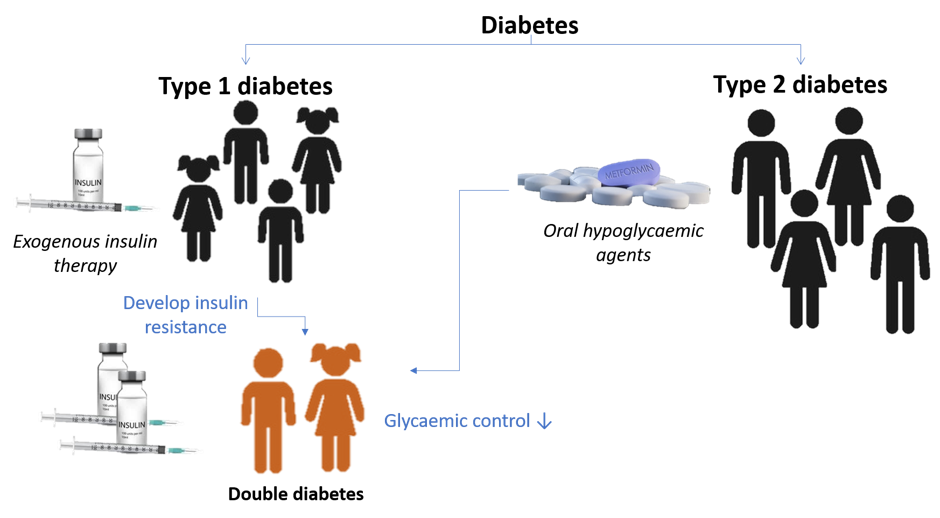
Diabetes mellitus is characterised by persistently high blood glucose. Long-standing diabetes raises the risk of kidney, nerve, eye, and cardiovascular complications, with cardiovascular disease the leading cause of death. Diabetes is common and rising in India. T1D, the insulin-dependent form, is characterised by insufficient insulin production by the pancreatic islets. Globally, T1D accounts for a minority of cases (roughly 5–10%), while type 2 diabetes (T2D) accounts for over 90%. In most people, T1D follows autoimmune destruction of the insulin-producing beta cells and is therefore treated with exogenous insulin. T1D typically begins in childhood but can start at any age. T2D is driven largely by insulin resistance, in which tissues respond poorly to insulin. Unlike T1D, T2D is often treated with oral drugs, such as metformin, that improve insulin sensitivity (Magliano & Boyko, 2021).
Some children and adults with T1D develop insulin resistance, often first noticed as a rising insulin dose needed to keep glucose in range. However, current evidence does not support use of Metformin in T1D adolescents to improve HbA1c. Therefore, treatment of double diabetes in children remains an unmet clinical need (Figure 1). Measurement is the other problem. Though higher insulin requirement indicates insulin resistance, it is also influenced by diet, physical exercise, puberty, and other factors.
Why insulin resistance is hard to measure in T1D
Clinicians look for signs such as acanthosis nigricans, a velvety darkening of the skin. The reference method is the hyperinsulinaemic-euglycaemic clamp (HEC). However, acanthosis nigricans is not specific, and HEC is too laborious for small clinics. As a result, alternative equations have been developed based on routinely measured clinical parameters. One such equation, the homeostasis model assessment of insulin resistance (HOMA-IR), is widely used in T2D. However, HOMA-IR relies on fasting insulin, which is typically raised in T2D but often very low or undetectable in T1D. It is therefore unsuitable for T1D.
In a systematic review of how insulin resistance and metabolic syndrome are assessed in T1D, we identified three equations (Khandagale et al., 2024). These combine waist circumference or waist-to-hip ratio, HbA1c, triglycerides or HDL-cholesterol, and blood pressure. However, few studies have tested whether they predict clinical outcomes. More importantly, the equations agree poorly with one another, so the choice of equation can change who is classified as insulin resistant.
What the biology of double diabetes may tell us
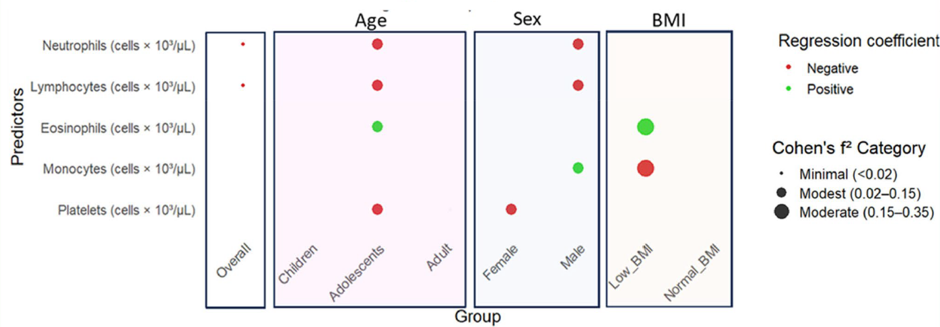
As noted above, drugs used for insulin resistance in T2D have limited use in young people with T1D. This is the second unmet need. New treatments need a better understanding of the underlying biology. We recently examined blood-cell correlates of insulin sensitivity in 343 children and youth with T1D in western India. Insulin sensitivity was estimated using the equation from the Coronary Artery Calcification in Type 1 Diabetes (CACTI) study (Duca et al., 2016). In our cohort, most participants had a normal-to-low BMI yet low estimated insulin sensitivity. Eosinophil counts were positively associated, and neutrophil, lymphocyte and platelet counts negatively associated, with insulin sensitivity. Most effects were modest, and they varied by age, sex and BMI (Figure 2). These associations differed from those reported in adults without T1D (Khandagale et al., 2026). These findings hint that double diabetes may differ biologically from insulin resistance in T2D. A single retrospective study cannot show this, so replication is essential.
Where this leaves clinicians and researchers
Although T1D is a minority of diabetes, it affects children who will live with its consequences for decades, and it deserves dedicated attention. Inconsistent measurement methods and scarce data linking double diabetes to complications make interventions hard to design. Few biological studies also slow the search for new treatments, especially in children. In light of the above, three priorities can be set: (1) validating a T1D-specific insulin resistance index against the clamp in Indian youth; (2) multicentre paediatric T1D cohorts with standardised measurement and follow-up for complications; and (3) safety and efficacy trials of insulin sensitisers in younger children. We cannot treat what we cannot measure, and in young people with double diabetes we can do neither well yet.