
Histone deacetylases (HDACs) regulate the acetylation state of histone and non-histone proteins and therefore affect transcription, chromatin organization, cell cycle control and various signalling processes. The human HDAC family is composed of zinc-dependent enzymes of classes I, IIa, IIb and IV and the class III enzymes, sirtuins, which use NAD+ instead of zinc to catalyze the reaction. HDAC8 is a class I enzyme but, with distinct active-site properties and conformational flexibility, is amenable to selective ligand recognition. This makes HDAC8 attractive not only because it can be inhibited, but because selective inhibition provides a route to chemically precise target modulation. Importantly, intracellular substrates, e.g., SMC3, provide a practical means of linking enzyme inhibition to cellular target engagement.
The challenge, however, is not whether HDAC8 can be inhibited. There are already potent inhibitors. The more pertinent question is what should constitute a convincing selective HDAC8 inhibitor. We believe the field should now move beyond a potency-centred strategy to one that integrates zinc recognition, isoform selectivity, intracellular target engagement and pharmacological behaviour.
Why bother with selective HDAC8 inhibition when broad HDAC inhibition is already clinically validated? The therapeutic tractability of the HDAC family has been demonstrated by broad-spectrum HDAC inhibition. Simultaneous inhibition of multiple HDAC isoforms may also prevent separating a desirable pharmacological effect from the effects of global protein hyperacetylation. This is not to say that pan-HDAC inhibition is inherently undesirable; in some disease settings, concurrent modulation of multiple HDACs may enhance efficacy. But when the biological question concerns a single isoform, selectivity provides a cleaner way to link target inhibition to downstream biology.
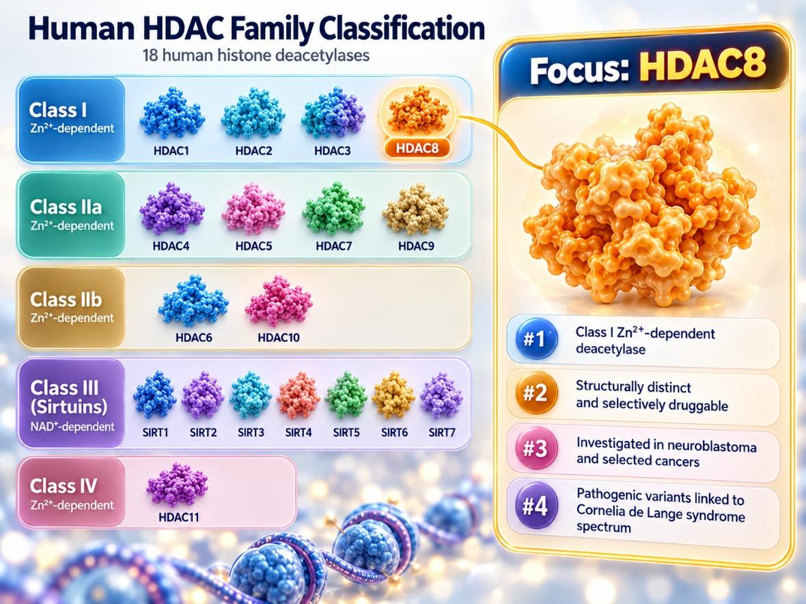
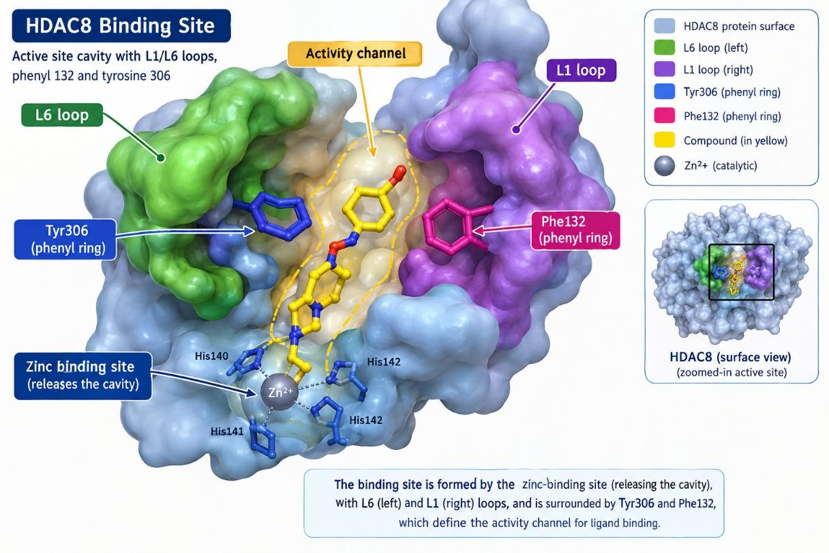
Why It’s Important? The HDAC8 catalytic site contains a narrow hydrophobic channel that leads to the catalytic Zn2+ center. Flexible surface loops around the entrance to the channel contribute to substrate and inhibitor recognition. These structural features provide opportunities for selectivity, with the cap group interacting with loop- and surface-associated regions, the linker occupying the catalytic channel, and the zinc-binding group oriented toward the metal center.
Aberrant HDAC8 activity is linked to various diseases, especially cancer, including neuroblastoma and acute myeloid leukemia. Elevated HDAC8 levels correlate with tumor growth in neuroblastoma, where selective inhibition can curb proliferation and promote differentiation. The challenge lies in identifying selective and pharmacologically credible inhibitors through a comprehensive assessment that includes enzyme activity and intracellular target engagement. HDAC8 can be effectively studied using specific biomarkers like SMC3, which shows increased acetylation after treatment. However, this increase does not imply that all cellular changes are solely due to HDAC8 inhibition.
“Isoform selectivity should be considered first a mechanistic advantage, and its therapeutic advantage must be demonstrated experimentally.”
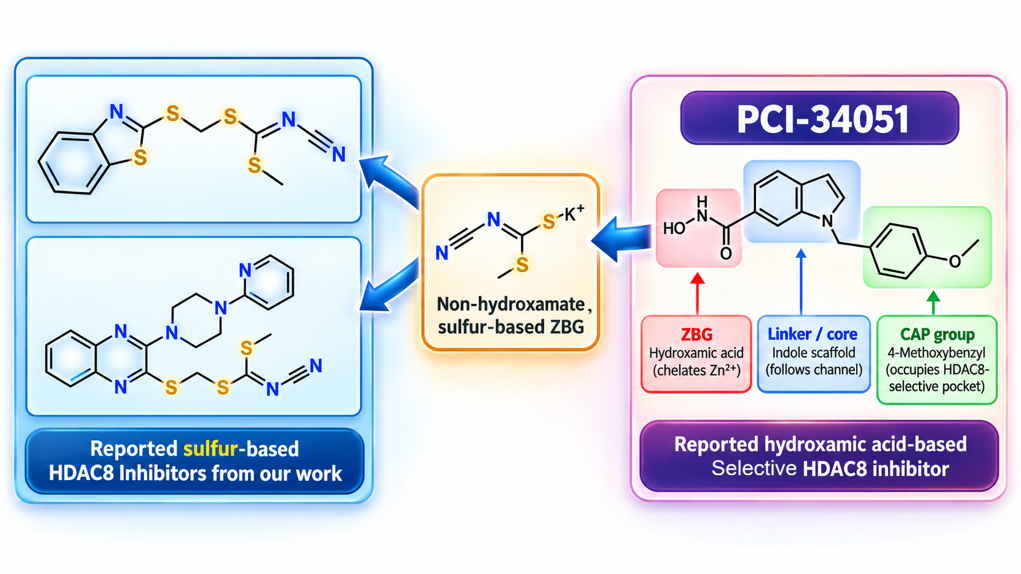
Have we become too dependent on hydroxamates for zinc recognition? Most HDAC inhibitors consist of three main regions: a cap group for surface recognition, a linker, and a zinc-binding group (ZBG) near the catalytic Zn2+ ion. Hydroxamic acid, commonly used for its effective zinc coordination and potent inhibitors, raises the question of whether medicinal chemists are over-relying on the ZBG while seeking selectivity through modifications of the cap and linker. Changes to the ZBG can significantly influence binding-site coordination, ligand orientation, and other physicochemical properties. Therefore, exploring alternative ZBGs is not just about replicating the potency of hydroxamates but also about potentially altering the pharmacological behavior of inhibitors through different interactions with catalytic zinc. Non-hydroxamate approaches such as benzamides, thiols, mercaptoamides, hydrazides and other sulfur containing groups suggest that the answer may be yes. The scientific contribution of these chemotypes is to expand the interaction space available to HDAC medicinal chemistry, rather than to assume that any alternative ZBG will be safer or more selective.
Where does cyanocarbonimidodithioate fit in? Among these alternatives, cyanocarbonimidodithioate is a particularly interesting sulfur-rich metal-binding chemotype. Our recent work provides a clear demonstration of this integrated approach in the design of selective HDAC8 inhibitors. We have reported non-hydroxamate HDAC8 inhibitors as neuroblastoma anticancer agents, not as treatments for all HDAC8-related diseases. In the benzothiazole derivatives containing cyanocarbonimidodithioates, we combined potent biochemical activity with isoform profiling, cellular evaluation and computational studies to understand how to modulate activity with zinc recognition and molecular geometry. The same sulfur-rich zinc binding concept has later been applied to quinoxaline and thieno[3,2-d]pyrimidine scaffolds, which enabled a systematic study of the effects of cap-group and linker on HDAC8 potency, selectivity and cellular behavior. Selected compounds were further evaluated by colony-formation assays, apoptosis and caspase-3/7 studies, cell-cycle analysis, and acetylated SMC3 measurements, which linked enzyme inhibition to intracellular HDAC8-related target engagement. The experiments were also complemented by molecular docking and molecular dynamics simulations, which provided structural hypotheses for ligand recognition within the HDAC8 catalytic pocket. In our studies, selected quinoxaline and thieno[3,2-d]pyrimidine derivatives showed inhibition of proliferation in IMR-32 neuroblastoma cells with supporting mechanistic evidence. Together, these studies demonstrate that the discovery of selective HDAC8 inhibitors is best served by integrating synthetic chemistry, enzymology, cellular pharmacology, and computational modelling rather than executing them as separate stages. Our studies show that molecules with this motif can provide potent HDAC8 inhibition and that its activity is highly dependent on the surrounding cap and linker architecture. Rather than a hydroxamate replacement, cyanocarbonimidodithioate is more useful as a tunable zinc-recognition element that expands the coordination and interaction space in HDAC medicinal chemistry.
Computational studies suggest a Zn-associated binding orientation for certain molecules, while biochemical studies indicate preferential HDAC8 activity in specific structures. However, the precise geometry of metal coordination remains experimentally undetermined. This is further complicated by the chemotype’s variable isoform behaviour based on the molecular environment. PCI-34051, a selective HDAC8 inhibitor, serves as a benchmark distinguishing HDAC8 from other isoforms. Additionally, our cyanocarbonimidodithioate-based compounds propose an alternative non-hydroxamate zinc-binding strategy, demonstrating selective HDAC8 inhibition, intracellular Ac-SMC3 modulation, and anticancer effects.
“Isoform selectivity is a property of the complete inhibitor, not the zinc-binding group alone.”
If potency is driven by zinc binding, why is the most potent enzyme inhibitor not always the best lead? This is one of the most useful questions in the field of selective HDAC medicinal chemistry. Biochemical assays offer the inhibitor direct access to purified enzyme under controlled conditions. Cells form additional barriers. The molecule must enter the cell, not be effluxed or metabolized too much, reach sufficient intracellular free concentration and interact with HDAC8 in its physiological environment.
Therefore, enzyme potency and cellular potency do not need to be measured in parallel. In our HDAC8 studies, the compounds that showed excellent biochemical inhibition were not necessarily those that displayed the most balanced cellular behaviour. Potency ranking alone provided less insight for lead prioritization than compounds that combined enzyme inhibition with intracellular readouts such as enhanced Ac-SMC3.
Don’t dismiss this kind of discrepancy as bad cellular activity. It is to be taken as diagnostic information. The right question is: where is the biochemical potency being lost? Possibilities include limited permeability, active efflux, metabolism, nonspecific binding or insufficient intracellular accumulation. The explanations should be tested, not assumed.
This change how medicinal chemists ought to assign priority to compounds. A ten-fold improvement in purified-enzyme IC50 may be less valuable than a small improvement in permeability, intracellular exposure or target engagement.
“The best HDAC8 inhibitor may not be the compound with the lowest biochemical IC50, but the one that most selectively and effectively engages HDAC8 in the relevant biological system.”
Does molecular docking prove that a novel zinc-binding group binds Zn2+? Docking and molecular dynamics simulations are valuable for validating inhibitor orientations and stability in the catalytic pocket of HDAC8. These methods assist in hypothesis generation, especially with new zinc-binding groups (ZBGs). However, calculated interactions differ from experimental coordination, particularly for cyanocarbonimidodithioates, necessitating direct structural evidence for accuracy. A co-crystal structure of the protein and ligand would provide the clearest evidence, supported by spectroscopic methods. Claims of improved selectivity must be rigorously validated against both HDAC isoforms and relevant non-HDAC metalloenzymes to confirm the effectiveness of new ZBGs in avoiding nonspecific metal chelation.
What makes a good HDAC8 inhibitor? The discovery of HDAC8 should be viewed as a chain of evidence rather than simply a race for potency. An effective development pathway should connect biochemical inhibition, isoform selectivity, physicochemical properties, intracellular exposure, HDAC8 target engagement, relevant phenotype, and experimental ADME/PK. Although not all early studies will conform to this sequence, it provides a more meaningful foundation for determining which molecules to optimize. This perspective also challenges the traditional view of the CAP-linker-ZBG pharmacophore as independent components. Instead, data suggest that the cap’s recognition affects surface orientation, the linker’s length and flexibility influences passage through the catalytic channel, and the ZBG must achieve proper geometry to engage with the catalytic metal. Therefore, the design focus shifts from identifying the strongest ZBG to combining CAP, linker, and zinc-recognition chemistry for optimal molecular behavior.
Where does the discovery of selective HDAC8 go from here? The next step forward is unlikely to be based on biochemical potency alone. Other zinc-binding groups are worthy of further investigation but should be optimized when considering complete molecular architectures. Lead optimization requires earlier measurements of cellular target engagement. Design should be guided by structural models, but experiments are needed to validate key binding hypotheses. Claims of selectivity should be backed by broader isoform and metalloenzyme profiling. Increasingly, permeability, stability and pharmacokinetics should influence compound ranking before extensive biological resources are committed.
Finally, the disease context matters. The therapeutic utility of a highly selective inhibitor will only be realized if the disease of interest is sufficiently dependent on HDAC8 biology.
The central question of the field has thus changed. We already know that HDAC8 can be inhibited. But the more important questions are: can we control the interaction between the inhibitor and the catalytic zinc? Can we achieve true intracellular isoform selectivity? Is it possible to convert biochemical inhibition into measurable target engagement? And is there a disease context in which that interaction is important for HDAC8 inhibition? Whether selective HDAC8 inhibition will make the leap from promising medicinal chemistry to meaningful pharmacology will depend on answering those questions, not generating yet another lower IC50.