The evolution of living forms from RNA molecules capable of performing functions and carrying information to more complex, refined systems is a journey of billions of years. Over the course of evolution, DNA evolved as a stable archive for genetic information, and RNA became a molecular courier and an orchestrator to guide the synthesis of biological machinery that builds, maintains, and drives life – the protein. Across the evolutionary landscape, from the extremes of heat to the depths of cold, organisms are shaped by evolutionary pressure to adapt to their environments. Thermophiles, mesophiles, and psychrophiles reflect how life thrives under different conditions and how organisms adapt to their thermal niches. In particular, protein structure, dynamics, surface hydration, and interactions are driven by the surrounding environment.
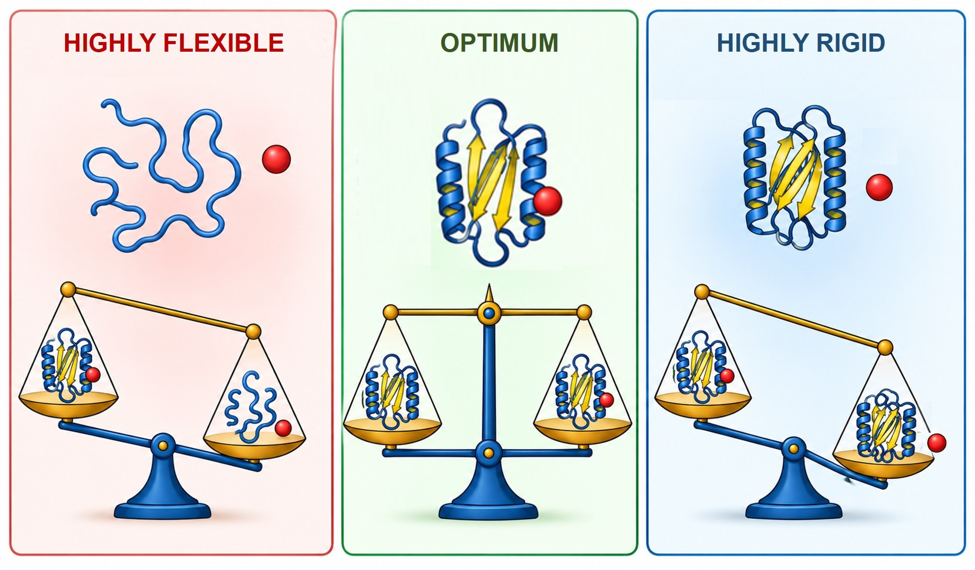
Molecular interactions are essential for organisms to communicate and coordinate different functions. This necessitates that molecules be flexible and dynamic, whereas unrestrained flexibility will compromise the specificity of interactions. Thus, the molecules need to maintain certain rigidity and retain structural constraints on their dynamics. Higher temperatures might facilitate flexibility but collapse the structure, whereas lower temperatures might provide structural rigidity but reduce the flexibility. Balancing these two factors across the temperature range is challenging and evolutionarily optimized.
Harmony between stability and flexibility in proteins
Proteins have adapted to diverse environments and can function under conditions ranging from freezing polar regions to hot-spring hydrothermal vents. The three-dimensional structure provides a foundation for their function. While a protein structurally adapts to various temperatures, the regions responsible for performing its function are carefully maintained with enough flexibility to interact with other molecules. However, other parts of the protein provide a more rigid or flexible scaffold depending on the environmental condition, whether it is hot or cold, respectively. Altogether, this allows the protein to protect its structural integrity while unyielding its essential dynamics to function under different conditions.
For example, IscU, an essential protein involved in synthesizing iron–sulfur (Fe-S) clusters across several organisms, requires larger flexibility to accommodate Fe-S clusters having a volume of ~70 Å3 (compared to ~11.5 Å3 for a water molecule). IscU adapts to various thermal niches and has a conserved flexible region common among thermophiles, mesophiles, and psychrophiles. However, to stabilize its global structure in thermophiles, the regions around the Fe-S binding site have become more compact than the corresponding regions in mesophiles and psychrophiles. PEPCK (phosphoenolpyruvate carboxykinase) is a protein that plays pivotal roles in carbon dioxide fixation in microorganisms and plants and in gluconeogenesis in animals, and is widely adapted to different temperatures. In thermophiles, the protein exhibits strong interactions and a compact overall structure; in mesophiles and psychrophiles, loose intramolecular interactions allow more flexible structures. This phenomenon of “corresponding states”, adaptation of flexibility with respect to the survival temperature, has been observed in many other proteins as well.
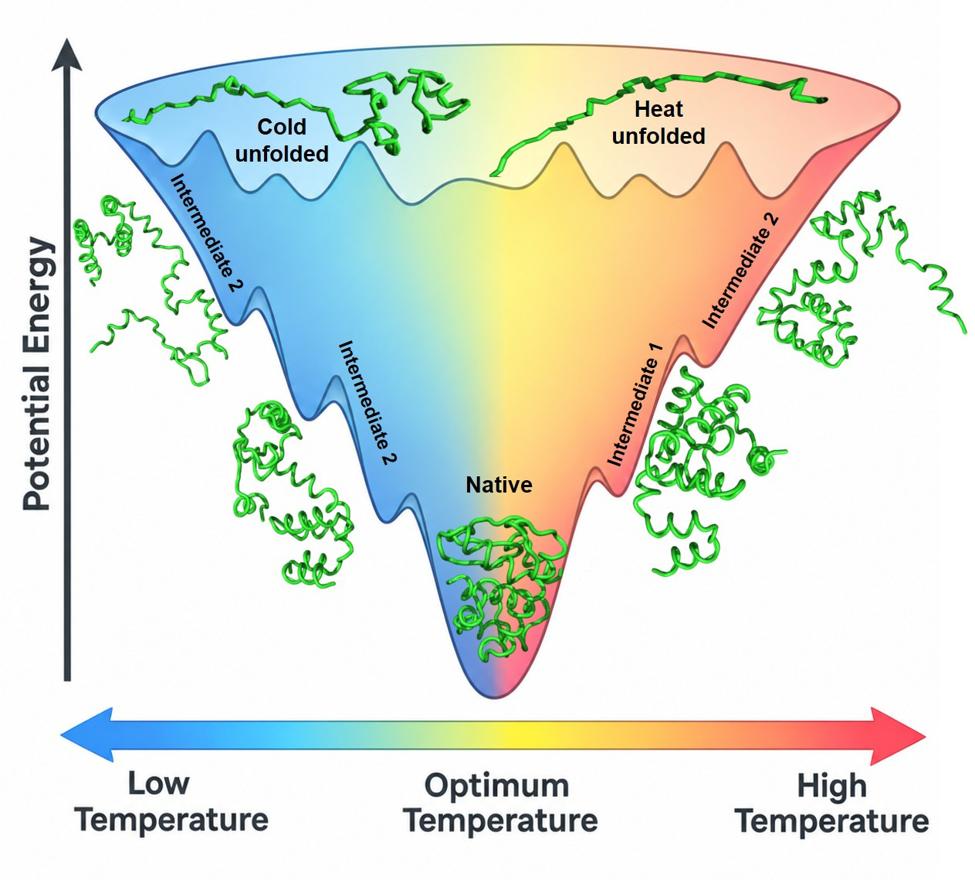
Extreme heat and cold challenge the stability of proteins
Proteins function under the environmental conditions to which they adapt. Any temperature beyond this limit can disrupt their structure and eventually cause a loss of function. When temperature increases, it enhances molecular motion and disrupts the interacting forces that provide structure, leading to protein unfolding. At the same time, a decrease in temperature can also disrupt the molecular interactions, leading to protein denaturation. Protein denaturation at higher temperatures is widely studied. Due to the higher stability of globular proteins at sub-zero temperatures, cold denaturation studies are less explored. Hardly, cold denaturation has been experimentally observed only for a dozen of proteins so far. This may be due to the challenges in attaining and maintaining such low, sub-zero temperatures that can unfold globular proteins. This practically limits the cold-denaturation studies.
Temperature-induced changes are primarily investigated using circular dichroism (CD), fluorescence spectroscopy, and NMR. CD assesses global structural changes across temperature ranges; fluorescence spectroscopy reveals whether the compact packing region is exposed to solvent by monitoring intrinsic fluorescence changes of the protein. NMR spectroscopy captures changes in the structure and dynamics of different regions of the protein, revealing alterations at the individual-residue level. Thus, combining optical and magnetic resonance spectroscopic methods can provide a comprehensive view of the pathways and intermediates involved in cold-induced denaturation.
The alternative pathways of cold and heat denaturation
Protein structure may be categorized into a core region and flexible regions. The core region is packed with amino acids that interact with substrate molecules to carry out their activity. This region is mostly surrounded by hydrophobic (water-hating) amino acid residues, whereas the flexible region is primarily composed of hydrophilic (water-loving) amino acid residues that are exposed to the solvent, water. The core region is mostly shielded by the flexible region to keep the region away from the surrounding water. Stability and overall compactness are governed by interactions among the hydrophilic residues and with water (hydrogen bonding and electrostatic). The hydrophobic residues pack themselves to minimize their exposure to water (hydrophobic interactions), which also significantly contributes to protein stability. Loss of either of these interactions can lead to protein unfolding.
At sub-zero temperatures, water can penetrate the core region, possibly due to favorable interactions between water and hydrophobic surfaces. This phenomenon is called hydrophobic hydration. Increased water-core interaction weakens the overall compactness, and eventually the protein starts to unfold. The amino acids in the flexible region and solvent-exposed amino acids in the core region may respond to low temperature first, followed by the other residues. Nevertheless, denaturation at high temperatures follows a different pathway. At high temperatures, increased molecular motion reduces the interactions between hydrophilic residues. The unfolding process begins with solvent-exposed residues in flexible regions that lose their native conformation. As the temperature increases, the core region is affected, which eventually results in disruption of the overall three-dimensional structure. Therefore, the intermediates formed during these two processes differ markedly in structure and in their interactions with water. Generally, the unfolded state formed by cold denaturation is compact and may partially retain some of the structural features, whereas the heat-induced unfolded state is more of a random coil structure.
Cold as a protector: Implications of cold denaturation
Cold conditions are useful for storage and preservation. Reduced molecular motion in cold temperatures slows down undesirable chemical reactions, substrate activities, and microbial growth. This can increase the stability and shelf life of the materials. Refrigeration is a common method for preserving temperature-sensitive biological samples, pharmaceuticals, vaccines, enzymes, and food materials. Controlled temperatures can help preserve sensitive ingredients such as peptides, proteins, vitamins, and antioxidants by maintaining their properties and functions in drugs, cosmetics, and other products. For long-term storage of cells, tissues, and other biological materials, cryopreservation with additives is very important. Additives protect biological materials from the damaging effects caused by freezing. Compounds such as glycerol, dimethyl sulfoxide (DMSO), and trehalose are the most commonly used additives that help in storage by lowering the freezing point of solvents.
However, the effects of additives on the structure and stability of biological molecules, particularly proteins, under low-temperature conditions are not fully understood. Emerging studies reveal that additives might exert an asymmetric effect on protein stability, stabilizing proteins at low temperatures but promoting denaturation at higher temperatures, or vice versa. Such effects of various classes of additives on DNA and other biological macromolecules have yet to be investigated. This emphasizes that the experimental landscape of cold denaturation studies requires further exploration. Future experiments must not only explain the theoretical framework for the effects of cold on the stability of proteins and other biological molecules, but also elucidate the effects of various additives, thereby benefiting research labs and the biological industry.