For many people, recovery from COVID-19 means returning to normal health after the acute infection has resolved. Yet a proportion of individuals continue to experience symptoms such as fatigue, exercise intolerance, cognitive difficulties, headache, sleep disturbance and breathlessness for weeks or months. Children and young adults can also experience persistent symptoms, raising an important question: what keeps the disease process going after the acute infection has passed?
Long COVID is unlikely to have a single biological cause. Persistent viral material, immune dysregulation, endothelial activation, altered coagulation, platelet responses and inflammatory pathways may interact in different combinations between individuals. One emerging possibility is that the vascular system may serve as a biological convergence point where several of these processes meet.
Our recent work has led us to explore one potentially important molecular connection: the interaction between SARS-CoV-2 spike protein and fibrinogen, a major blood-clotting protein. This perspective raises the possibility that interactions involving spike, fibrinogen, fibrin, immune cells and endothelial cells could contribute to a persistent thromboinflammatory environment.
The vascular system is an active participant
Blood vessels are not simply tubes that transport blood. Their inner lining, the vascular endothelium, regulates permeability, blood coagulation, immune-cell trafficking and communication between the circulation and tissues.
The endothelial cells can be activated during infection. This is usually a protective mechanism that assists coordinate inflammation and repair. However, continued vascular activation, may lead to endothelial dysfunction and abnormal blood cell-vessel wall interactions with coagulation proteins.
This possibility is particularly interesting in Long COVID. There are reported abnormalities in endothelial function, coagulation, platelet activity and inflammatory pathways. Some studies have also found unusual forms of fibrin referred to as microclots or fibrinaloid particles.
The interpretation of these observations must be done carefully. The presence of microclots does not prove that they are the primary cause of Long COVID. They may be a result of long-term inflammation, a factor that facilitates disease persistence, or part of a vicious cycle of coagulation and immune activation.
In our recent Pediatric Research Comment, we explored this issue specifically for the pediatric population, noting that endothelial activation and thromboinflammation may be important factors in Long COVID biology in children and young adults.
The central question is therefore not simply whether or not there are vascular abnormalities, but whether they play a role in sustaining the disease state.
Could fibrinogen connect viral proteins with vascular dysfunction?
Fibrinogen provides an intriguing molecular link.
Fibrinogen is a blood protein that is converted to fibrin in blood coagulation. Then fibres of fibrin create the structure of a blood clot. However, fibrinogen and fibrin are also biologically active molecules that can interact with cells and inflammatory pathways.
In our 2025 ACS Pharmacology & Translational Science Viewpoint, we proposed that the SARS-CoV-2 spike protein can interact with fibrinogen through its N-terminal domain. We suggested that this interaction could provide an immune-evasion advantage by masking a relatively conserved region of spike from recognition by neutralizing antibodies.
This observation led to a broader question: could the same interaction have consequences beyond immune evasion?
Our subsequent 2026 ACS Pharmacology & Translational Science Viewpoint proposed that fibrinogen may function as a molecular bridge between SARS-CoV-2 immune evasion and endothelial access. We hypothesized that when spike associates with fibrinogen, the resulting molecular arrangement could influence how spike-associated complexes interact with cellular receptors, including integrins, potentially facilitating interactions with endothelial cells.
This remains a mechanistic hypothesis, not an established explanation for Long COVID. Its importance lies in its testability.
If the proposed interaction can be demonstrated experimentally under physiologically relevant conditions, it could provide a molecular connection between viral proteins, coagulation biology and vascular dysfunction.
From spike-fibrinogen interaction to thromboinflammation
A broader model can now be considered.
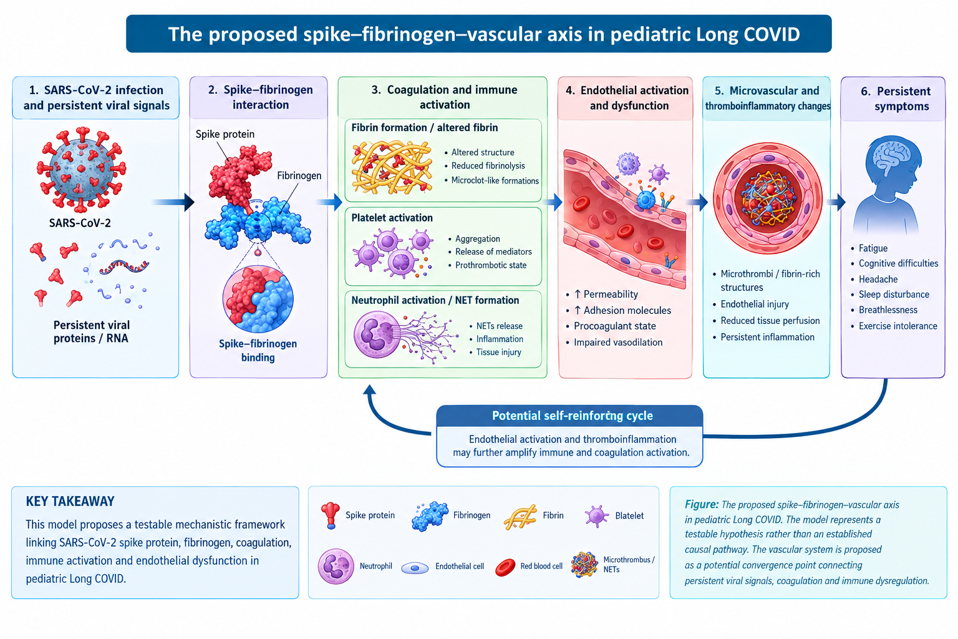
Persistent viral material or viral proteins could provide continuing inflammatory signals. Spike-fibrinogen interactions could influence the biological behaviour of fibrinogen or fibrin-associated complexes. Altered fibrin structures could interact with platelets and immune cells. Activated neutrophils can release neutrophil extracellular traps, or NETs, which are useful in host defence but can also contribute to inflammation and thrombosis when excessively activated.
The endothelium may then become persistently activated or dysfunctional.
This creates the possibility of a reinforcing biological network:
Persistent viral signals → spike–fibrinogen interaction → altered fibrin biology → platelet and neutrophil activation → endothelial dysfunction → further thromboinflammation
Such a framework could help explain why abnormalities in viral persistence, coagulation and immunity may coexist in some individuals with Long COVID.
It also provides a possible explanation for why the vascular system deserves particular attention in children and young adults. These individuals generally have fewer traditional risk factors for vascular disease. If vascular and thromboinflammatory abnormalities are detected after SARS-CoV-2 infection, infection-associated mechanisms may therefore deserve closer investigation.
The vascular system may not be the single cause of Long COVID. Rather, it may represent a convergence point where several biological pathways interact.
What should we investigate next?
The next stage of Long COVID research should move beyond asking whether a particular abnormality is present. We need to determine what initiates the process, what maintains it and which molecular interactions are therapeutically actionable.
Several questions are particularly important.
Does persistent spike or other viral material directly activate endothelial cells? Does spike-fibrinogen binding alter fibrin formation, structure or fibrinolysis? Can fibrin-associated viral components influence platelet activation or NET formation? Are these mechanisms different in children compared with adults? Can combinations of vascular, coagulation, immune and viral biomarkers identify biologically distinct forms of Long COVID?
Answering these questions could also improve patient stratification. Long COVID may represent a collection of overlapping biological phenotypes rather than a single disease mechanism. Some individuals may have dominant vascular or thromboinflammatory abnormalities, whereas others may have predominantly immune, neurological, metabolic or autonomic disturbances.
This distinction is important for therapeutic development. A treatment designed to modify coagulation or platelet activity, for example, should not be assumed to benefit every patient with Long COVID. Such interventions must be evaluated carefully, particularly in children, because normal coagulation is essential for health and excessive interference can cause harm.
The immediate priority is therefore mechanistic validation.
LOOKING TOWARD THE FUTURE
Our three recent publications represent complementary steps toward this question. The first one identified a potential interaction between spike protein and fibrinogen. The second considered how endothelial activation and thromboinflammation could contribute to persistent symptoms in pediatric Long COVID. The third proposed fibrinogen as a possible molecular bridge connecting spike-mediated immune evasion with endothelial access.
All together these observations suggest a research model in which viral proteins, coagulation and vascular biology are viewed as a system of interconnected pathways instead of separate pathways.
The future challenge is to determine whether this proposed molecular network operates in patients, which components are causal, and whether disrupting specific interactions can alter disease progression.
The blood vessels may therefore not be the key to Long COVID. But they may be one of the places where several important biological pathways converge.
Recognizing this vascular interface could be useful to answer one of the most fundamental questions: why do some children get over SARS-CoV-2 infection without any symptoms and others continue to experience symptoms long after the acute infection has ended?
If future studies establish a causal connection between spike–fibrinogen interactions, thromboinflammation and endothelial dysfunction, this could open new opportunities for biomarker discovery and targeted therapeutic strategies.
The next chapter of Long COVID research may therefore begin not only with the virus itself, but with understanding what happens at the interface between the virus, the blood and the vascular system.
1. The vascular system may be a convergence point in Long COVID.
Persistent immune, coagulation and endothelial abnormalities may interact rather than operate as independent mechanisms.
2. Fibrinogen may provide a molecular connection between SARS-CoV-2 and vascular biology.
The proposed spike-fibrinogen interaction raises the possibility that a coagulation protein may influence both immune evasion and endothelial access.
3. The next step is mechanistic validation.
Determining whether spike-fibrinogen interactions, abnormal fibrin, platelet activation and NET formation form a causal pathway could guide future biomarkers and therapeutic strategies.