Iridium Compounds for Precision Phototherapy
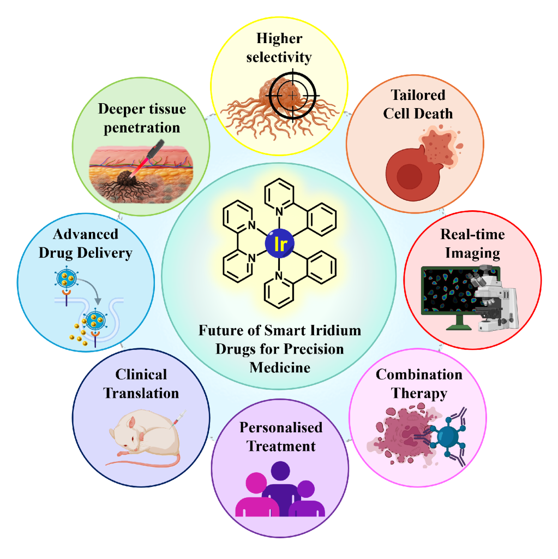
The next step in photodynamic cancer therapy is to move beyond simply designing more powerful photosensitizers. The real goal is to develop “intelligent” photosensitizers that can decide when, where, and how to act. Iridium (III) complexes are particularly attractive for this purpose because their photophysical properties can be tuned through ligand design. They can also produce reactive oxygen species (ROS), target specific cellular organelles, and, importantly, possess intrinsic luminescence that can be used for imaging. Future systems are therefore likely to combine several functions within one molecular platform. An Ir(III) complex could, for example, recognize a tumour-associated feature, remain relatively inactive in healthy tissues, become activated by conditions such as acidic pH or elevated glutathione, and then generate ROS after exposure to light. At the same time, its luminescence could provide information about its cellular localisation. This represents a shift from photodynamic therapy to precision phototherapy, where the objective is not simply to kill cancer cells, but to control the location and timing of therapeutic activity.
Understanding What Happens Inside Cancer Cells
Perhaps the biggest question is how much control we actually have over the biological outcome of phototherapy. We know that ROS can damage DNA, proteins, membranes, and organelles. But the consequences of that damage are not always predictable. Depending on where ROS are produced and how much oxidative stress is generated, a cell may undergo apoptosis, ferroptosis, pyroptosis, necroptosis, or other forms of programmed cell death. This raises a fascinating possibility: can we design a molecule to determine not only whether a cancer cell dies, but how it dies?
There are other fundamental questions too. How does an Ir (III) complex behave after entering a living organism? Does it remain intact? Which proteins bind to it? Where does it accumulate? How is it metabolized and eventually eliminated? And what happens after repeated exposure?
These questions are still much less understood than the photochemistry of these compounds, yet they could ultimately determine whether an otherwise promising molecule can become a useful therapeutic agent.
Reaching Deeper Tumours and Overcoming Low Oxygen
The most important breakthroughs may not come from chemistry alone. Better light delivery, biological modelling, and quantitative dosimetry are equally important. At present, many laboratory studies use carefully controlled irradiation conditions that are difficult to reproduce across different experiments. Wavelength, light intensity, exposure time, and delivered energy can all influence the biological outcome. Establishing more consistent approaches to light dosimetry would make results easier to compare and could help bridge the gap between laboratory experiments and clinical applications. Technology must also solve the problem of delivering light to tumours located deep inside the body. This creates an opportunity for red/NIR excitation, multiphoton approaches, and other strategies capable of extending the effective treatment depth.
At the molecular level, another important breakthrough will be the development of reliable oxygen-independent photochemical pathways. If therapeutic ROS can be generated efficiently even under hypoxic conditions, one of the fundamental limitations of conventional PDT could be addressed.
Combining Light, Targeted Treatment and Immune Defence
One of the most interesting trends is the convergence of phototherapy and cancer immunology.
For a long time, the objective of PDT was viewed mainly as direct destruction of tumour cells. We now know that certain forms of treatment-induced cell death can release danger signals and tumour-associated material that influence the immune system. This creates the possibility of using phototherapy not only to destroy a tumour locally, but also to help stimulate an antitumour immune response. Another important development is the increasing interest in combination therapy. Instead of expecting one molecule to solve every problem, researchers are exploring combinations of photodynamic therapy with chemotherapy, drug delivery systems, and immunotherapy.
At the molecular level, organelle targeting is also becoming increasingly sophisticated. Directing a photosensitizer specifically toward mitochondria, lysosomes, endoplasmic reticulum or other vulnerable compartments provides a way of controlling where oxidative damage begins.
The most promising systems may therefore be those that combine spatial control, multiple therapeutic mechanisms, and biological selectivity.

Building a Complete Picture of Treatment Performance
We think the field will gradually move away from evaluating photosensitizers primarily through parameters such as phototoxicity, IC₅₀ values, or ROS production, and toward a much more complete picture of therapeutic performance.
A future study may need to answer a sequence of questions: Where does the molecule go? How long does it remain there? What activates it? What type of ROS does it produce? Which biomolecules are damaged? Which signaling pathways are affected? What type of cell death follows? And what happens to the compound after treatment?
This will require closer collaboration between synthetic chemistry, photophysics, cell biology, pharmacology, imaging, and materials science.
We also expect the field to become more selective about complexity. Multifunctional nanoparticles and sophisticated delivery platforms can produce impressive results, but every additional component introduces questions of reproducibility, manufacturing, characterisation, and regulation. Consequently, the next decade may favour designs that achieve sophisticated biological behaviour while remaining chemically well-defined and practically manufacturable.
From Laboratory Molecules to Future Cancer Medicines
Several developments will fundamentally reshape the field in the future. Firstly, deeper light penetration through red/NIR and multiphoton activation could expand phototherapy to tumours that are difficult to reach with conventional visible light. Secondly, the development of hypoxia-tolerant photosensitizers and oxygen-independent photochemical pathways could help overcome one of the major limitations of conventional PDT. Thirdly, the integration of therapy with diagnosis could enable Ir(III) complexes to simultaneously treat tumours and provide information about their localization and behaviour through their intrinsic luminescence. Fourthly, a deeper understanding of alternative cell-death pathways, including ferroptosis, pyroptosis, necroptosis, and immunogenic cell death, could open new strategies against treatment-resistant tumours.
Finally, perhaps the most important development will be the transition from elegant molecules to clinically realistic medicines. Demonstrating predictable activity, distribution, safety, and scalable manufacturing will be essential for moving Ir(III)-based phototherapy beyond the laboratory.
The future may therefore be less about finding a single “perfect” photosensitizer and more about engineering molecular systems that can sense, respond, treat, and report within the complex environment of a tumour.