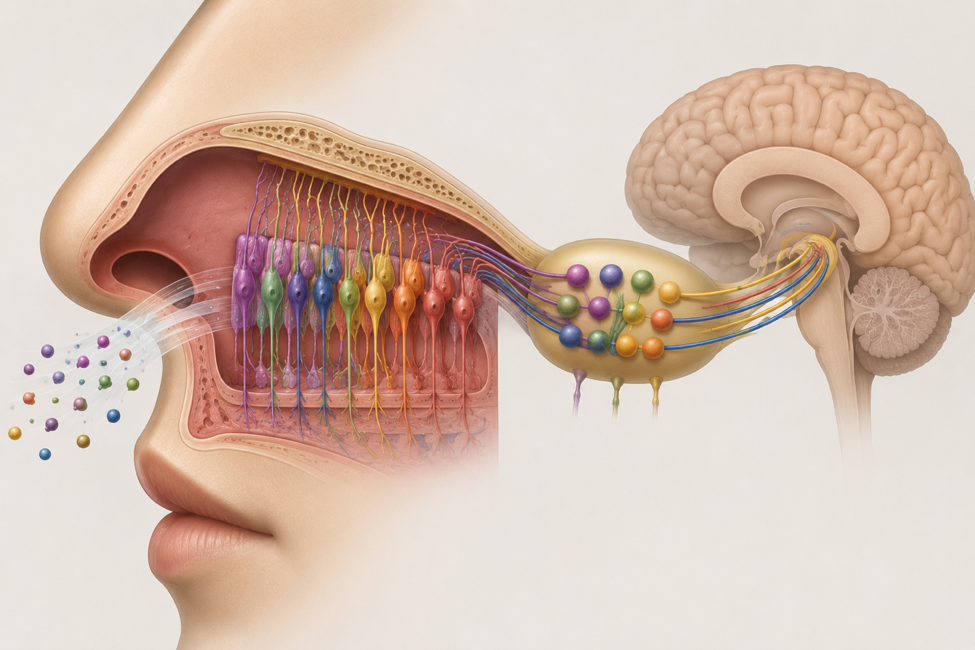
The smell of freshly brewed coffee may draw us toward the kitchen even before we notice the cup. Smoke can alert us to danger, while a familiar perfume can instantly bring back memories of a place or moment long forgotten. Although such experiences feel automatic, recognizing an odor is actually a complex pattern-recognition process carried out by the nervous system. The process begins when airborne chemicals, known as odorants, enter the nasal cavity during normal breathing or sniffing. These molecules dissolve in the mucus that covers the olfactory epithelium, a specialized sensory tissue located high inside the nose. They then bind to receptor proteins present on the cilia of olfactory sensory neurons. Odorants provide the initial chemical information, but it is the brain that interprets this information and transforms it into the conscious perception of smell.
“A few hundred molecular detectors, working through a combinatorial neural code, allow the brain to create our remarkably rich world of smell.”
A code built from combinations
Our understanding of how smell works at the molecular level advanced significantly in 1991, when Linda Buck and Richard Axel discovered a large family of genes responsible for encoding odorant receptors. Humans have about 400 potentially functional odorant-receptor genes, although the exact set of active receptors differs slightly from one person to another. This raises an interesting question: how can only a few hundred receptor types allow us to recognize such a wide range of smells? The answer lies in combinatorial coding. A single odorant can stimulate several different receptors, and each receptor can respond to more than one odorant. As a result, every odor produces a distinct pattern of receptor activity rather than activating a single receptor specifically assigned to smells such as rose, coffee, or smoke. The olfactory system can be compared to a piano. Although a piano has only a limited number of keys, those keys can be combined to create countless chords and melodies. In much the same way, different combinations of odorant receptors allow the nose to distinguish an enormous variety of smells. The pattern of receptor activation also changes with odor concentration. At low concentrations, an odorant may stimulate only the receptors that are most sensitive to it. As the concentration increases, additional receptors may become involved, altering not only how strong the odor seems but, in some cases, how it is perceived. Natural smells are even more complicated because substances such as coffee, flowers, soil, and food release mixtures containing many volatile compounds. These compounds do not always act independently. They may compete for the same receptors, reduce each other’s effects, or interact to produce an overall smell that is quite different from the simple combination of its individual components.
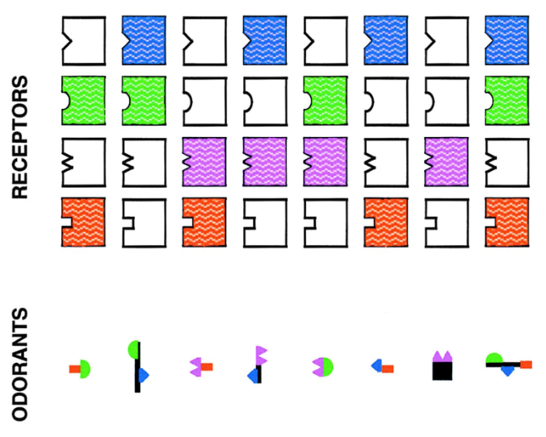
Olfactory sensory neurons carrying the same receptor identity are scattered across the nasal epithelium, but their axons converge in the olfactory bulb onto structures called glomeruli. This arrangement pools signals from similar neurons and helps organize the receptor pattern before it is transmitted to the piriform cortex and regions involved in recognition, emotion, learning and memory. The nose therefore detects and organizes chemical information; the brain interprets it. An odorant is a molecule outside the body. An odor is the perception produced when the nervous system combines receptor activity with context and experience.
What can seven smell categories tell us?
Scientists have long searched for primary odors comparable to the primary colors of vision. Smell has resisted such a neat classification because odor molecules differ in size, shape, flexibility, charge distribution, functional groups and volatility. Structurally similar molecules can smell different, while unrelated molecules can receive similar descriptions. A study by Sharma & Varadwaj examined seven widely used categories namely floral, fruity, minty, nutty, pungent, sweet and woody. The researchers assembled a dataset of 1,136 odorants and used computational analysis to investigate pharmacophores the stereo spatial arrangements of molecular features that may influence biological recognition and other structural characteristics. They proposed 19 structural features that could help distinguish the seven groups. The analysis also revealed shared regions of chemical-feature space, helping explain why odor categories overlap rather than forming completely separate boxes. The study does not prove that all smells are constructed from exactly seven primary odors. Instead, the categories provide a practical framework for studying structure odor relationships. Its broader message is that molecular features contain useful statistical signals, although no universal rule can yet translate a chemical structure directly into a predictable human experience. Personal biology further complicates the picture. Genetic variation can change receptor sensitivity. Variants of the receptor OR7D4, for example, influence how people perceive androstenone (mammalian pheromone); some experience it as strong and unpleasant, whereas others detect it weakly or describe it differently. It has been studied and reported that age, gender even personality also shape perception. Perfumers and flavor scientists do not necessarily have more receptor types; training improves attention, sensory memory and vocabulary.
Current challenges and emerging opportunities
Despite considerable progress, scientists still cannot consistently predict how a molecule or a mixture of molecules will smell to a person. Chemical structure is only part of the story, but the odor perception is also shaped by concentration, volatility, nasal airflow, interactions between compounds, and differences in human odor receptors. Natural aromas such as coffee, smoke, flowers, and cooked food may contain dozens or hundreds of volatile chemicals. These compounds can strengthen, suppress, or modify one another’s effects, creating a smell that cannot be understood simply by adding together the odors of the individual ingredients. The limited quality and diversity of available data create another major challenge. Many olfactory datasets are based on isolated molecules tested under different conditions, concentrations, and naming systems. Descriptions such as “fresh,” “green,” “earthy,” or “musky” may also vary across languages and cultures. Future databases will therefore require standardized testing, chemically verified samples, and sensory panels drawn from more diverse populations. Resources such as OlfactionBase already provide a useful foundation by linking odorants with receptors, perceptual categories, and known receptor–odorant interactions, but much larger international datasets are still needed. Artificial intelligence may help researchers manage this complexity. Machine-learning models can already predict certain aspects of odor perception from molecular features, while graph neural networks have been used to create principal odor maps that connect chemical structure with human sensory descriptions. These tools could support the discovery of new fragrance and flavor compounds, identify unpleasant odors, and reduce the number of molecules requiring laboratory screening. However, present AI models work best with individual molecules tested under controlled conditions. Their performance is less reliable for complex mixtures, unusual concentrations, and real-world environments affected by humidity, pollution, or changing temperatures. They can estimate how people may describe an odor, but they do not recreate the biological experience of smelling. Electronic and bioelectronic noses offer another promising direction. Sensor arrays could detect food spoilage, hazardous leaks, industrial emissions, poor indoor air quality, or volatile signals linked to plants, microbes, and human health. Their practical use is still limited by changes in temperature and humidity, gradual sensor drift, and poor performance when unfamiliar mixtures are encountered. Systems intended for healthcare, environmental monitoring, or food safety will therefore need standardized evaluation and validation under varied real-world conditions. The wider potential is considerable. Improved smell technologies could reduce food waste, strengthen agricultural storage, detect environmental hazards, and support non-invasive health monitoring. Achieving this will require close integration of chemistry, receptor biology, engineering, artificial intelligence, and culturally diverse sensory research rather than treating smell as a purely computational problem.
Future perspective
Future progress will probably combine molecular chemistry, receptor biology, airflow modelling, sensory testing and artificial intelligence. Better datasets could record not only a molecule and its odor label, but also concentration, mixture composition, receptor responses, participant genetics and cultural background. Bioelectronic noses may eventually use biological odorant receptors, receptor-bearing cells or receptor-inspired materials. Such systems could support food-quality monitoring, environmental surveillance, industrial leak detection and analysis of volatile patterns associated with disease. Medical applications require rigorous validation because altered smell or breath chemistry can have many causes. Machines may become excellent chemical detectors, but reproducing human smell will remain difficult. Biological olfaction actively controls sampling through sniffing, adapts to continuing exposure and combines incoming signals with memory, emotion and expectation. Detecting molecules is not the same as experiencing their meaning.
Conclusion
Our nose recognizes many smells without requiring one receptor for every odor. Volatile molecules activate overlapping receptor combinations; the olfactory bulb organizes these patterns; and the brain interprets them using genetics, learning, memory and context. Research on seven odor categories, olfactory databases, AI-generated odor maps and electronic noses is beginning to reveal the logic of this sensory code. It may also lead to better tools for healthcare, food safety and environmental monitoring. The next time coffee, rain or perfume brings back a vivid memory, remember the nose begins the chemical message, but the brain completes the story.