This article is currently maintained under temporary RFCSR publication support until 13 June 2026.
PFAS, known as “forever chemicals,” persist due to strong carbon–fluorine bonds, creating significant water contamination challenges. Current treatment approaches include adsorption, membrane separation, and destruction, each with limitations. Key gaps involve selectivity, energy efficiency, and scalability. Integrated systems and advanced materials offer promising pathways toward sustainable, efficient, and scalable PFAS remediation solutions.
A Journey from Persistence to Possibility
Water has always symbolized purity, yet modern chemistry has introduced substances that challenge this idea. Among them, per- and polyfluoroalkyl substances, commonly referred to as PFAS, stand out because of their unusual persistence. These chemicals are called “forever chemicals” because they resist breaking down in natural conditions. The reason lies in the carbon–fluorine bond, one of the strongest in chemistry, which prevents degradation through heat, sunlight, or biological activity. As a result, PFAS remain in water, soil, and living organisms for decades. Their widespread use has made the problem even more complex. PFAS have been used in everyday products such as non-stick cookware, water-resistant fabrics, firefighting foams, and food packaging. Over time, these substances have entered groundwater, rivers, and even drinking water supplies. Once present, they travel easily and accumulate, creating long-term risks to ecosystems and human health. The challenge is not only their presence but also the difficulty in removing them effectively.
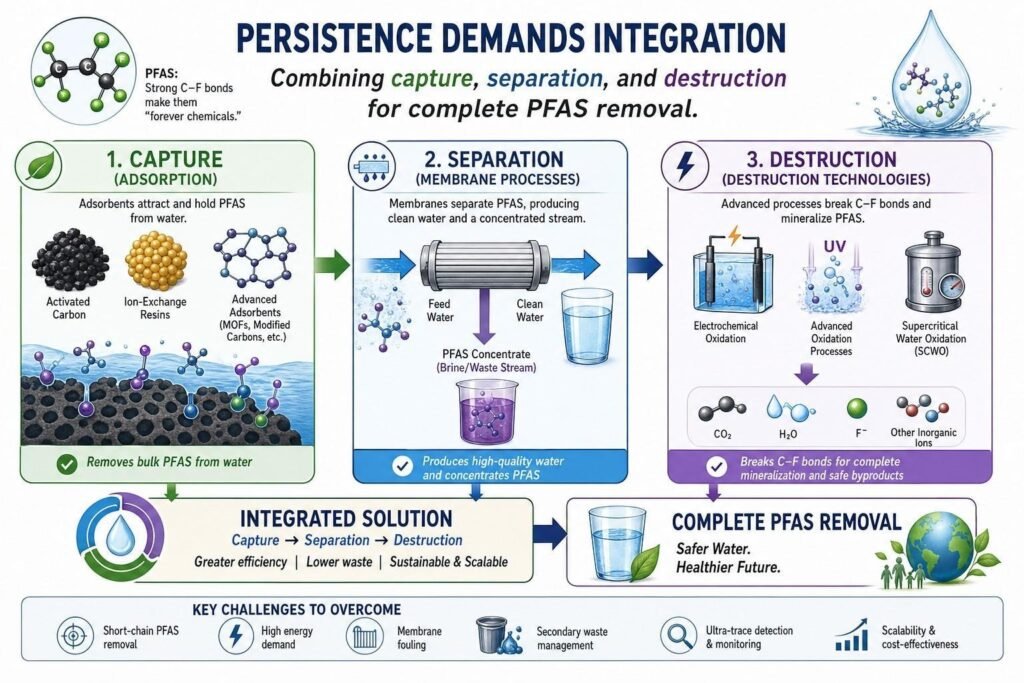
Scientific efforts have gradually transformed this challenge into an area of active innovation. Recent research has focused on understanding how PFAS interact with different materials and how these interactions can be used to remove them from water. Among various approaches, adsorption has emerged as a practical and widely used method. Traditional materials such as granular activated carbon have shown reliable performance, especially for long-chain PFAS. However, research has gone further to explore engineered adsorbents with improved surface properties. Modified carbons and functionalized materials have demonstrated better efficiency, particularly in complex water systems where multiple contaminants compete for removal.
Another important contribution has been the study of advanced porous materials such as metal-organic frameworks and covalent organic frameworks. These materials offer very high surface areas and tunable pore structures, enabling stronger interactions with PFAS molecules. Such developments highlight the potential for designing materials that are not only more effective but also more selective. At the same time, research has emphasized the importance of understanding real-world conditions, ensuring that performance observed in laboratories can be translated into practical applications.
Membrane technologies have also played a significant role in advancing PFAS treatment. Processes such as reverse osmosis and nanofiltration can remove nearly all PFAS from water through physical separation. These systems provide high-quality treated water but create concentrated waste streams that still require further treatment. This limitation has led to growing interest in combining different technologies rather than relying on a single method.
Destructive technologies represent another important step forward. Techniques such as electrochemical oxidation are capable of breaking the strong carbon–fluorine bonds, leading to complete mineralization of PFAS. This approach addresses the root of the problem by eliminating the compounds rather than simply separating them. However, high energy requirements and operational complexity limit widespread application at present.
Despite these advances, several limitations continue to shape the field. Adsorption systems often struggle with short-chain PFAS, which are more mobile and less likely to bind strongly to materials. The presence of dissolved organic matter and other ions further reduces efficiency. Membrane systems face challenges related to fouling, energy consumption, and the management of concentrated waste. Advanced materials, while promising, remain expensive and difficult to scale. Destructive technologies, although effective, require significant energy input and further optimization.
These limitations point toward deeper scientific and technological gaps. One major gap lies in the development of materials that can selectively remove a wide range of PFAS compounds under realistic conditions. Another challenge involves improving energy efficiency, ensuring that treatment systems remain sustainable as they scale up. In addition, the behavior of PFAS in complex water systems is not yet fully understood. Variations in water chemistry can significantly influence treatment performance, making it difficult to predict outcomes.
Several unanswered questions continue to guide future research. A key question involves whether a single treatment system can effectively address both long-chain and short-chain PFAS. Understanding the pathways of PFAS degradation during destructive processes is also essential to ensure that no harmful byproducts are formed. Scaling laboratory innovations into full-scale systems presents another challenge, requiring solutions that are not only effective but also economically viable and easy to operate. At the same time, safe management of secondary waste and accurate detection at very low concentrations remain critical concerns.
Looking ahead, the future of PFAS treatment lies in integration and innovation. Hybrid systems that combine adsorption, membrane separation, and destruction offer a balanced approach. Adsorption can capture bulk contaminants, membranes can concentrate them, and destructive technologies can eliminate them completely. Such systems reduce overall energy use and improve efficiency while addressing multiple challenges simultaneously.
Emerging materials will play a central role in this transition. Research is moving toward designing adsorbents that are not only highly efficient but also durable, regenerable, and cost-effective. Advances in membrane design aim to reduce fouling and improve selectivity, while new approaches in destructive treatment focus on reducing energy demand. Digital monitoring tools and data-driven methods are expected to enhance system performance through real-time control and optimization.
For young researchers, this field offers both challenge and opportunity. Addressing PFAS contamination requires knowledge across chemistry, materials science, and environmental engineering, along with creativity and problem-solving skills. The journey ahead calls for innovative thinking that connects fundamental science with practical solutions. Contributions from the next generation will be essential in developing technologies that are scalable, sustainable, and accessible.
The story of PFAS is still unfolding. What began as a problem of persistence is gradually becoming a pathway toward innovation. With continued effort, collaboration, and forward-looking research, the goal of safe and sustainable water systems can move closer to reality.