
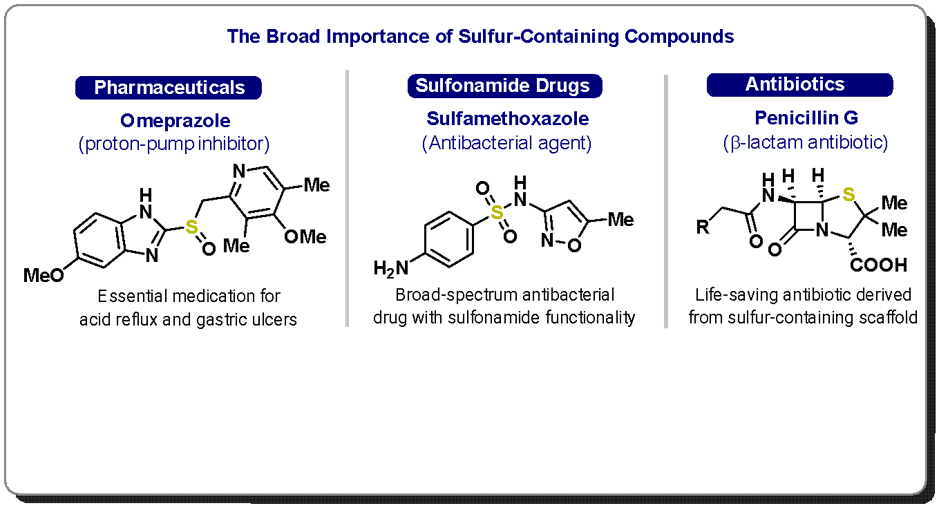
Sulfur is among the most intriguing elements in chemistry. It quietly resides in antibiotics, pharmaceuticals, agrochemicals, functional materials, and even in molecules essential for life itself. The influence of sulfur chemistry extends far beyond the realm of laboratory synthesis. Sulfur-containing molecular frameworks form the core of several important pharmaceuticals and biologically active compounds, where sulfur functionalities often govern molecular properties and biological activity. Molecules such as proton-pump inhibitors (e.g., omeprazole), sulfur-containing antibiotics, sulfonamide drugs, anticancer agents, and various agrochemicals derive essential functionality from sulfur-based structural motifs. Beyond medicinal chemistry, sulfur-containing architectures have also found broad applications in materials science and advanced technologies, highlighting the remarkable versatility of sulfur in modern chemical science (Figure 1).
Yet sulfur chemistry has long carried a paradox. While sulfur-containing compounds possess enormous biological and synthetic importance, the chemistry used to construct them is frequently associated with unpleasant odor, challenging reagent handling, sensitivity issues, and limitations in selectivity.
“The most fascinating discoveries in chemistry often emerge not when we search for new molecules, but when we learn to ask new questions from familiar ones.”
Despite their importance, the synthesis of sulfur-containing architectures often remains a challenging task. Conventional sulfur-transfer methodologies frequently rely on reagents associated with unpleasant odor, oxidation sensitivity, difficult handling, and the requirement of expensive catalysts or harsh reaction conditions. Such limitations often increase synthetic complexity and reduce operational simplicity.
As chemistry increasingly moves toward sustainable and environmentally responsible practices, the development of greener sulfur-transfer methodologies has become particularly important. Green chemistry principles encourage replacing hazardous reagents with environmentally benign alternatives capable of minimizing waste generation while maintaining efficiency and practicality. Consequently, identifying cleaner and operationally simple sulfur-transfer systems has emerged as an important challenge in contemporary synthetic chemistry.
As chemists, we often accept these practical limitations as unavoidable. But science progresses precisely when we challenge assumptions that have become too familiar. What if sulfur transfer could be achieved through a cleaner, simpler, and more sustainable pathway? What if a common, inexpensive salt could reveal entirely new behavior when placed in the right chemical environment? Such questions formed the scientific curiosity behind our recent work on stereoselective thiosulfonylation of alkynes. The conceptual evolution of this strategy, moving from traditional sulfur sources toward a greener sulfur-transfer paradigm, is illustrated in Figure 2.
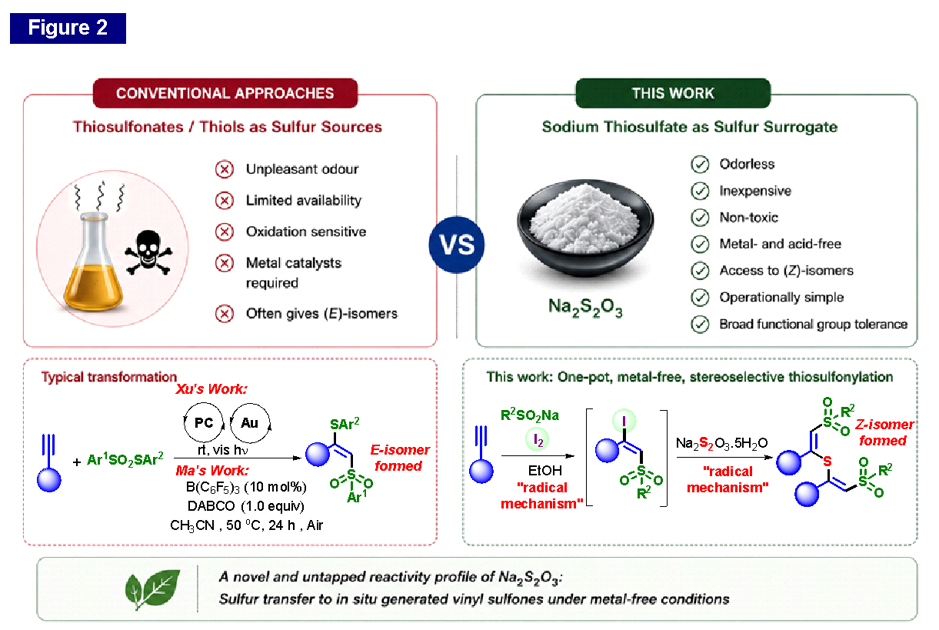
Alkynes represent highly versatile building blocks, carbon-carbon triple bond stores substantial chemical potential and can be transformed into structurally sophisticated molecules. Among the valuable products accessible from alkynes are vinyl sulfones, compounds that have attracted significant interest because of their broad utility in medicinal chemistry, chemical biology, and materials science.
However, synthesizing these molecules with precise stereochemical control remains challenging. Nature often favors the thermodynamically stable pathway, whereas chemists frequently seek access to less accessible and synthetically valuable alternatives. Controlling such outcomes requires not merely carrying out reactions, but understanding and directing molecular behavior itself.
Our study explored an unexpected role for sodium thiosulfate, a simple, inexpensive, non-toxic, and odorless reagent commonly used in laboratories for entirely different purposes. Instead of behaving according to conventional expectations, this reagent exhibited a previously unexplored reactivity profile and functioned as an efficient sulfur transfer agent under metal-free and acid-free conditions.
The excitement in research rarely comes from observing expected behavior. It comes when molecules behave in ways they were never anticipated to. A reaction flask may appear quiet externally, but at the molecular level an extraordinary sequence of events unfolds, bonds break, radicals emerge, intermediates form and disappear within fractions of a second, ultimately constructing new architectures with remarkable precision.
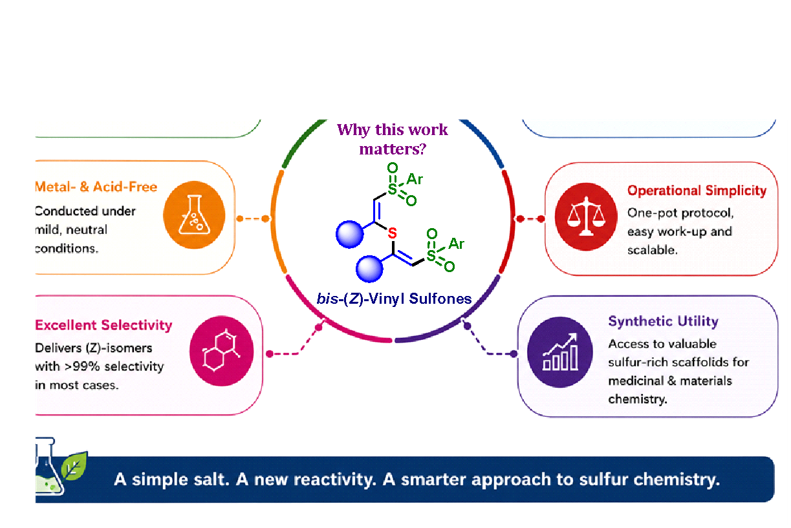
Perhaps this is one of the most beautiful aspects of chemistry: molecules possess their own language, and our responsibility as scientists is to learn how to listen. Beyond the immediate synthetic achievement, the broader implications are equally important (Figure 3). Modern chemistry increasingly demands sustainability alongside efficiency. Green chemistry is no longer an optional direction; it has become a scientific necessity. Developing reactions that reduce hazardous reagents, avoid expensive catalysts, and improve operational simplicity contributes not only to laboratory convenience but also toward a more responsible future for chemical science.
For young researchers, sulfur chemistry presents a remarkably fertile landscape for exploration. The field sits at the intersection of synthetic chemistry, mechanistic understanding, medicinal science, materials development, and sustainable technologies. Questions remain everywhere: Can sulfur-centered radicals reveal entirely new reactivity? Can we design smarter sulfur transfer systems? Can sustainable sulfur chemistry transform molecular design itself?
These questions remain unanswered, and that is precisely why the field remains exciting.
Looking back, I believe chemistry has always rewarded curiosity more than certainty. Reactions that initially seem routine sometimes become gateways toward entirely new concepts. Often, the difference between an ordinary observation and an important discovery lies only in asking one additional question. After all, chemistry is not simply about making molecules. It is about uncovering possibilities hidden within them.