When Antibiotics Are No Longer Enough
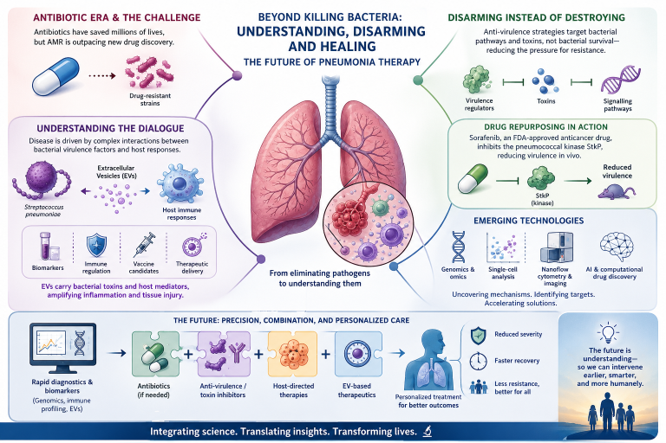
For nearly a century, antibiotics have transformed the treatment of bacterial infections, saving millions of lives and making modern medicine possible. However, this success is increasingly threatened by antimicrobial resistance (AMR), which is reducing the effectiveness of many frontline antibiotics while the discovery of new antibacterial drugs struggles to keep pace. Among the pathogens contributing to this global crisis is Streptococcus pneumoniae, a leading cause of community-acquired pneumonia, meningitis, and bloodstream infections. As resistant strains continue to emerge, it has become clear that simply developing more antibiotics is unlikely to provide a long-term solution.
This realization is reshaping infectious disease research. Rather than asking only how to kill bacteria, scientists are increasingly exploring how pathogens establish infection, evade immune defence, and damage host tissues. By targeting these processes instead of bacterial survival alone, it may be possible to develop therapies that are both effective against drug-resistant pathogens and less likely to drive the evolution of resistance.
Our understanding of pneumococcal disease has changed considerably over the past decade. Research from many laboratories, including our own, has revealed that disease progression is governed not only by bacterial replication but also by a complex dialogue between bacterial virulence factors and host immune responses. One of the most exciting developments has been the recognition of extracellular vesicles (EVs) as important mediators of this communication.
Extracellular vesicles are nanosized membrane-bound particles released by almost every cell type. Once considered merely cellular debris, they are now recognized as sophisticated biological messengers that transport proteins, lipids, and nucleic acids between cells, coordinating immune responses and tissue homeostasis. In 2022, we proposed that EVs could play previously underappreciated roles during pneumococcal infection, not only as biomarkers of disease but also as regulators of immunity, potential vaccine candidates, and therapeutic delivery vehicles.
Subsequent studies from our laboratory provided experimental evidence supporting this concept. We demonstrated that pneumolysin, the major pore-forming cytotoxin produced by S. pneumoniae, stimulates infected host cells to release extracellular vesicles carrying both bacterial toxin and host inflammatory mediators (iScience, 2024). Rather than remaining confined to the initial site of infection, these vesicles can disseminate inflammatory signals to neighbouring and distant cells, amplifying tissue injury. More recently, we found that EV-bound pneumolysin interacts with host cell membranes through mechanisms extending beyond its classical pore-forming activity (bioRxiv 2026), suggesting that bacterial toxins exploit host-derived vesicles to propagate disease in ways that were previously unrecognized.
These discoveries reinforce an important concept that successful bacterial infections are not determined solely by the pathogen but by the intricate interactions between microbial virulence factors and host biology. Understanding these interactions is opening entirely new therapeutic opportunities that extend beyond conventional antimicrobial strategies.
Turning Existing Medicines into New Weapons
A complementary approach emerging from our research is drug repurposing. Developing a new antibiotic is a lengthy, expensive, and high-risk process, whereas clinically approved drugs already have established safety profiles and can reach patients much more rapidly if new therapeutic applications are identified. Through computational simulations, biochemical tests, and mouse models of bacterial pneumonia, we found that sorafenib, an FDA-approved cancer drug blocks StkP, a key bacterial kinase that controls growth and virulence and is conserved across many clinically relevant drug-resistant pathogens (mBio, 2026). We showed that sorafenib disrupts key regulatory pathways required for disease progression, significantly reducing pneumococcal virulence in experimental models.
This work illustrates the promise of anti-virulence therapies-an emerging strategy that seeks to disarm pathogens instead of eliminating them outright. By targeting bacterial signalling pathways or toxins while preserving bacterial viability, these therapies may reduce the selective pressure that drives antimicrobial resistance. Although still in their early stages, anti-virulence approaches, together with advances in extracellular vesicle biology, are redefining how we think about combating bacterial infections and provide a glimpse of what the future of pneumonia treatment might look like.
The Questions That Will Shape the Next Decade
Where do we go from here? Despite remarkable progress, many fundamental questions remain unanswered. Why does S. pneumoniae exist harmlessly in the upper respiratory tract of many healthy individuals but cause severe pneumonia or invasive disease in others? How do bacterial virulence factors, host genetics, and immune responses interact to determine disease severity? And can we identify these processes early enough to intervene before irreversible tissue damage occurs?
Our work on extracellular vesicles has opened another intriguing area of investigation. We now know that EVs can transport pneumolysin and inflammatory mediators between cells, but many questions remain. How are bacterial proteins selectively packaged into these vesicles? Do different EV populations perform distinct functions during infection? Could circulating EVs serve as early biomarkers of disease severity or treatment response? Equally exciting is the possibility of engineering EVs as therapeutic delivery systems that can transport drugs, RNA molecules, or antibodies directly to infected tissues.
New Technologies Driving the Next Breakthroughs
Answering these questions will require advances across multiple disciplines. Single-cell sequencing, spatial transcriptomics, quantitative proteomics, nanoflow cytometry and high-resolution imaging are already transforming our understanding of host-pathogen interactions by revealing how individual cells respond during infection. At the same time, artificial intelligence is accelerating antimicrobial discovery by identifying promising drug candidates, predicting drug–target interactions, and uncovering new opportunities for drug repurposing. These technologies, combined with sophisticated infection models and computational biology, are making it increasingly possible to translate mechanistic discoveries into clinically relevant therapies.
Among the most promising trends is the growing shift toward anti-virulence and host-directed therapies. Rather than relying exclusively on antibiotics, future treatment strategies are likely to combine conventional antimicrobials with agents that neutralize bacterial toxins, inhibit virulence regulators, or modulate harmful inflammatory responses. Such combination therapies may not only improve patient outcomes but also reduce the selective pressure that drives antimicrobial resistance.
The Future of Precision Pneumonia Medicine
I believe that the next decade will witness a gradual transition from empirical treatment toward precision medicine. Future clinicians may look beyond simply identifying the infecting organism. Rapid genome sequencing, host immune profiling, and extracellular vesicle biomarkers could help determine which virulence pathways are active and which therapeutic combinations are most likely to benefit an individual patient. A patient with severe pneumococcal pneumonia might receive an antibiotic together with an anti-virulence drug, an immune-modulating therapy, or an extracellular vesicle-based therapeutic designed to limit tissue injury and promote recovery.
Several developments are particularly worth watching. Clinical evaluation of repurposed drugs for bacterial infections is likely to expand, while bacterial virulence inhibitors and toxin-neutralizing therapies continue to advance toward translation. Extracellular vesicles are emerging not only as biomarkers for early diagnosis and disease monitoring but also as versatile platforms for targeted drug delivery. Together with artificial intelligence and precision diagnostics, these innovations are reshaping how we think about treating bacterial infections.
Looking Ahead
The history of infectious disease has largely been defined by our ability to eliminate pathogens. The future may instead be defined by our ability to understand them. By deciphering the molecular conversations between bacteria and their hosts, we are uncovering opportunities to intervene before infection progresses to severe disease. The next generation of pneumonia therapies is therefore unlikely to depend on a single revolutionary antibiotic. Instead, it will emerge from integrating anti-virulence strategies, drug repurposing, extracellular vesicle biology, host-directed therapies, and precision medicine into a more holistic approach to infection. Although significant scientific and translational challenges remain, these advances offer genuine optimism that drug-resistant pneumonia will become a more preventable and treatable disease in the years ahead.