
Multiplex sensing: Looking beyond a single biomarker.
Imagine planning your day based solely on today’s temperature. Without knowing the humidity, wind speed, rainfall, or air pressure, your forecast would be incomplete and often inaccurate. Our bodies function in much the same way. Health and disease are rarely governed by a single biomarker; instead, they arise from a complex network of biological signals that change together. Measuring only one biomarker therefore provides only a limited snapshot of an inherently dynamic system. Instead, a sensing platform capable of detecting multiple analytes simultaneously provides a far more complete picture of the underlying biological processes. By measuring several biomarkers in a single analysis, multiplex sensing reduces the need for multiple independent tests, lowers cost, shortens analysis time, and requires only a small sample volume. More importantly, it improves diagnostic accuracy, enables earlier disease detection, and supports the growing shift toward personalized and precision medicine. Rather than relying on a single clue, multiplex sensing reveals the broader biological landscape, transforming diagnostics from isolated measurements into comprehensive health monitoring.
A traditional sensor is much like a thermometer; it measures one parameter exceptionally well. A multiplex sensor, in contrast, resembles a comprehensive health check-up, where multiple physiological indicators are evaluated together before a diagnosis is made. The true strength of multiplex sensing therefore lies not simply in detecting more analytes, but in extracting more meaningful information from every measurement. Relationships between biomarkers often reveal far more about a biological system than the concentration of any individual molecule.
These advantages have fuelled the rapid growth of multiplex sensing in recent years. Advances in precision medicine, wearable technologies, point-of-care diagnostics, and portable analytical devices have created an increasing demand for rapid and comprehensive molecular analysis. Instead of sending samples to centralized laboratories for multiple independent tests, clinicians increasingly seek compact platforms capable of analysing several biomarkers simultaneously. Similar needs extend well beyond healthcare to environmental monitoring, food safety, agriculture, and industrial process control, where reliable decisions frequently depend on information obtained from multiple chemical species rather than a single analyte.
For decades, however, most chemical sensors were designed to detect one target at a time. While highly effective for specific analytical tasks, such sensors cannot fully capture the complexity of biological systems. Diseases such as cancer, inflammatory disorders, metabolic syndromes, and infectious diseases involve intricate networks of interacting biomarkers whose concentrations change together over time. Equally important is the ability to monitor these dynamic changes. A single measurement represents only a snapshot, whereas continuous multiplex sensing can reveal disease progression, treatment response, and physiological trends that would otherwise remain hidden. Nature itself provides an elegant blueprint for this approach. Human taste, smell, and immune systems do not rely on a single receptor; instead, they integrate information from multiple recognition events before generating a response. Multiplex sensing follows the same principle, combining several molecular interactions to produce a more reliable and informative analytical outcome. Supramolecular chemistry is particularly well suited to this challenge because molecular recognition is inherently dynamic. Weak non-covalent interactions—including hydrogen bonding, electrostatic interactions, π–π stacking, metal coordination, and hydrophobic forces—can be combined, tuned, or reversibly switched in response to external stimuli. This remarkable adaptability enables a single molecular framework to recognise different analytes under different conditions, making supramolecular systems exceptionally versatile platforms for programmable multiplex sensing.
The challenge of detecting many targets at once
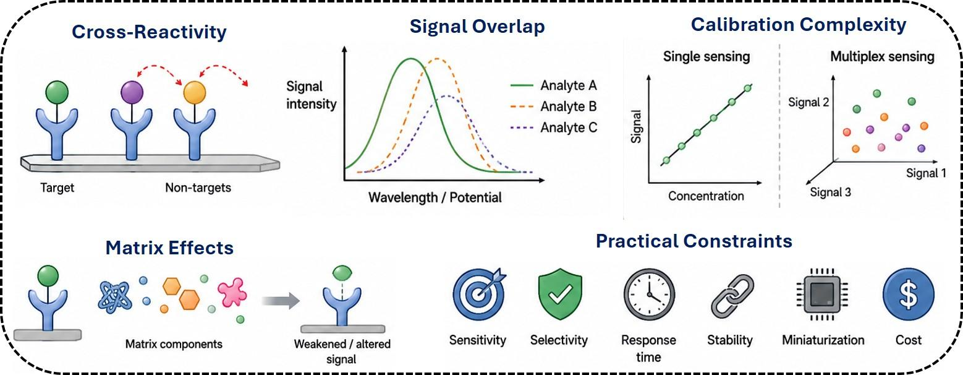
Although multiplex sensing promises faster, richer, and more informative diagnostics, designing a single platform capable of detecting multiple analytes simultaneously is far from straightforward. Unlike conventional sensors that monitor one target at a time, multiplex systems must recognize several analytes independently while ensuring that each generates a unique, reliable, and quantifiable response. Simply combining multiple sensing elements into a single device does not guarantee successful multiplex detection (Figure 1).
One of the greatest challenges is cross-reactivity, where non-target molecules interfere with molecular recognition, leading to false-positive or false-negative responses. Analytes may also compete for common binding sites or modify the local sensing environment, resulting in signal suppression, signal enhancement, or changes in binding affinity. Such interactions can distort the analytical response, reducing both sensitivity and quantitative accuracy.
Another major obstacle is signal overlap. In many sensing platforms, different analytes generate similar fluorescence emissions, electrochemical responses, or optical signals, making it difficult to distinguish individual targets. Effective multiplex sensing therefore requires orthogonal sensing events, where each analyte produces an independent analytical signature or “chemical fingerprint.” These fingerprints may arise from distinct fluorescence colours, emission lifetimes, Raman bands, electrochemical potentials, polarization signals, or other spectroscopic outputs. Much like several people speaking simultaneously in different languages, independent analytical signatures allow each molecular “voice” to be recognised without confusion, even when many analytes are present together. Designing such orthogonal responses while maintaining high sensitivity and selectivity remains one of the central challenges in materials chemistry.
Calibration presents an equally important challenge. Unlike single-analyte sensors, where the signal depends only on the concentration of one target, multiplex sensors often exhibit interconnected responses in which one analyte influences the detection of another. Conventional one-dimensional calibration curves therefore become inadequate. Instead, multidimensional calibration models capable of accounting for simultaneous variations in multiple analytes are required to achieve reliable quantitative analysis.
Real biological and environmental samples further increase the complexity. Proteins, salts, metabolites, and numerous background species can foul sensor surfaces, mask weak signals, or alter the local chemical environment through nonspecific interactions. Variations in pH, temperature, ionic strength, and sample composition introduce additional matrix effects that can compromise reproducibility and analytical accuracy. As multiplex sensors become increasingly sophisticated, they must also balance sensitivity, dynamic range, response time, long-term stability, miniaturization, manufacturability, and cost without sacrificing analytical performance.
Researchers are overcoming these challenges through advances in molecular design, functional materials, and computational analysis. Highly selective recognition elements minimize cross-reactivity, while engineered nanomaterials amplify weak signals and improve signal discrimination. Ratiometric sensing, multichannel detection, and orthogonal spectroscopic outputs further enhance analyte identification. At the same time, chemometric analysis and machine-learning algorithms can deconvolute complex datasets, compensate for matrix effects, and extract meaningful information from overlapping analytical responses. Together, these advances are steadily transforming multiplex sensing from an elegant laboratory concept into a practical technology for healthcare, environmental monitoring, food safety, and wearable diagnostics.
Engineering selectivity
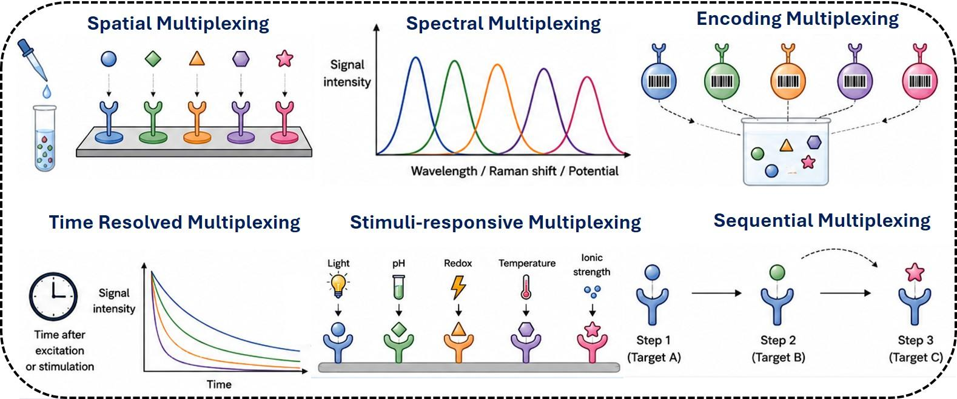
Teaching one sensor to recognize many targets: One of the most fascinating aspects of multiplex sensing is that selectivity can often be engineered rather than discovered. Instead of designing an entirely new sensor for every analyte, researchers can manipulate the sensing environment or molecular recognition process so that the same sensing platform responds selectively to different targets under different conditions. This adaptability is one of the defining strengths of supramolecular sensing.
Perhaps the simplest strategy is to modify the sensing environment. Parameters such as solvent composition, pH, ionic strength, or temperature can dramatically influence host–guest interactions. For example, polar protic solvents weaken the interaction between receptors and strongly basic anions through competitive hydrogen bonding, thereby suppressing unwanted binding while enhancing selectivity toward other analytes. Similarly, changing the solution pH alters the protonation state of the receptor, effectively switching specific binding sites on or off and controlling which analytes can be recognized.
Another widely used approach employs selective masking agents. Certain molecules bind strongly to specific interfering species, temporarily removing them from the sensing process without affecting the target analyte. For instance, ethylenediamine selectively complexes Cu²⁺ ions, whereas cysteine exhibits a high affinity for Hg²⁺. Such masking strategies simplify complex analytical mixtures and significantly improve sensing selectivity.
Selectivity can also be regulated using external stimuli. Light-responsive molecules undergo reversible conformational changes upon irradiation, exposing or shielding particular recognition sites and thereby altering analyte binding. Likewise, acid- or base-induced protonation and deprotonation can reversibly block one binding event while promoting another. These stimulus-responsive systems effectively transform a single molecular receptor into a programmable sensing platform capable of performing multiple recognition tasks on demand.
An even more sophisticated strategy is relay recognition, in which molecular recognition occurs through a programmed sequence of events rather than a single binding process. One analyte first interacts with the sensor to generate a new recognition environment, enabling a second analyte to form a ternary complex. Alternatively, the second analyte may displace the first—a mechanism widely exploited in metal-ion displacement assays, where an incoming anion replaces a coordinated metal ion and produces a distinct optical or electrochemical response. Such sequential recognition processes substantially expand the analytical capability of a single sensing platform. Collectively, these approaches illustrate that multiplex sensing is far more than the integration of multiple receptors into one device. Instead, it represents the intelligent programming of molecular recognition, where chemical interactions are deliberately controlled in space, time, and chemical environment to enable the selective, accurate, and simultaneous detection of multiple analytes (Figure 2).
From proof-of-concept to practical technology
Designing a multiplex sensing platform is only the beginning; demonstrating that it performs reliably under realistic conditions is equally important. A sensor that works under carefully controlled laboratory conditions may not necessarily deliver accurate results when confronted with complex biological or environmental samples. Consequently, rigorous validation is essential before multiplex sensing can be translated into practical applications.
Understanding the molecular recognition process is the first step toward reliable sensor design. Hill plot analysis provides valuable insight into whether analyte binding is cooperative, non-cooperative, or negatively cooperative, revealing how one recognition event influences subsequent binding events. Such analyses can also identify allosteric effects, where binding of one analyte alters the affinity of the receptor for another. Because multiplex sensing often involves multiple simultaneous or sequential recognition processes, these cooperative interactions play a crucial role in determining overall sensor performance.
Equally important are interference and cross-reactivity studies. A robust multiplex sensor must be challenged with structurally related molecules and common interferents present in real samples to ensure that each analyte is recognised selectively. Beyond simple selectivity tests, researchers should also investigate competitive binding, signal suppression or enhancement, and other inter-analyte effects that may influence quantitative measurements.
A detailed understanding of molecular recognition also requires the determination of binding stoichiometry and affinity constants. Methods such as Job’s plot, nonlinear regression analysis, and, where appropriate, isothermal titration calorimetry provide quantitative information on host–guest interactions. These measurements not only validate the sensing mechanism but also guide the rational optimization of receptor design.
Analytical performance must then be evaluated comprehensively. Standard performance metrics, including the limit of detection (LOD), limit of quantification (LOQ), linear dynamic range, sensitivity, response time, precision, reproducibility, and recovery should be established for both individual analytes and the multiplex platform as a whole. Importantly, analytical performance determined under single-analyte conditions may not remain unchanged when multiple analytes are present simultaneously. Competition for binding sites, signal overlap, cooperative interactions, and matrix effects can all influence sensitivity, dynamic range, and detection limits.
Unlike conventional sensors, where the analytical signal depends primarily on the concentration of a single analyte, multiplex sensing generates multidimensional datasets in which multiple responses are often interdependent. Consequently, simple one-dimensional calibration curves are frequently insufficient. Instead, multidimensional calibration models, chemometric approaches, and increasingly machine-learning algorithms are being employed to deconvolute overlapping signals, compensate for matrix effects, and accurately predict the concentrations of several analytes simultaneously. Rather than replacing traditional analytical chemistry, these computational tools extend its capabilities by extracting meaningful information from complex datasets that would otherwise be difficult to interpret.
Ultimately, rigorous mechanistic studies, comprehensive analytical validation, and advanced data analysis transform multiplex sensing from an elegant laboratory demonstration into a robust analytical technology capable of delivering reliable and quantitative information in real-world applications.
Looking ahead
The future of multiplex sensing: As sensing technologies continue to evolve, the future of multiplex sensing will involve far more than simply detecting an increasing number of molecules. The next generation of sensors will seek to understand how multiple biomarkers interact, revealing the complex molecular networks that underpin health, disease, and environmental processes. In this sense, multiplex sensing represents a shift from measuring individual chemical species to interpreting the molecular language of complex systems.
This transformation is being driven by the convergence of supramolecular chemistry, advanced functional materials, flexible electronics, artificial intelligence, and wireless communication. Future sensing platforms are expected to evolve into compact, self-contained analytical systems capable of continuously monitoring multiple biomarkers while processing and interpreting the data in real time. Rather than functioning solely as analytical devices, these intelligent sensors will increasingly serve as decision-support tools for clinicians, researchers, and environmental scientists.
Wearable and non-invasive diagnostics are likely to be among the first beneficiaries of these advances. Biomarkers present in sweat, saliva, tears, breath, and interstitial fluid can now be monitored without the need for repeated blood sampling. Future wearable devices may continuously analyse these biofluids while wirelessly transmitting results to smartphones or healthcare providers, enabling earlier disease detection, personalised treatment, and proactive health management instead of reactive diagnosis.
Artificial intelligence will play an increasingly important role in this evolution. Modern multiplex sensors generate complex multidimensional datasets that often contain hundreds of analytical variables. Machine-learning algorithms can identify subtle relationships among these signals, distinguish overlapping analytical responses, and continuously improve prediction accuracy as more data become available. As these computational tools mature, they will transform multiplex sensing from simple molecular detection into intelligent molecular interpretation.
Looking further ahead, multiplex sensing may become a cornerstone of digital health twins, where continuous molecular information is integrated with physiological, clinical, and wearable-device data to generate dynamic, personalised models of human health. Such systems could predict disease progression, evaluate treatment response, and support truly personalised medicine through continuous molecular surveillance rather than occasional clinical testing.
At the same time, future progress must balance analytical sophistication with practical considerations. Increasing the number of sensing channels can improve information content but also introduces greater molecular complexity, computational demands, and opportunities for signal interference. Likewise, next-generation sensing platforms should be designed with sustainability in mind. Miniaturised devices require smaller sample volumes and fewer reagents, reducing analytical waste, while paper-based sensors, biodegradable materials, and low-power electronics can make multiplex sensing more environmentally responsible and accessible in resource-limited settings. Ultimately, the success of multiplex sensing will not be measured simply by the number of analytes that can be detected simultaneously, but by the quality of the information that can be extracted from them. As supramolecular chemistry, intelligent materials, artificial intelligence, and wearable technologies continue to converge, multiplex sensing is poised to evolve from a powerful analytical technique into an integrated platform for understanding complex molecular systems. In doing so, it has the potential to transform not only diagnostics, but also environmental monitoring, food safety, precision agriculture, and the broader future of smart analytical technologies.