
When 32-year-old Meena (name changed to protect identity) married, she hoped for a secure and happy life with her husband. Instead, over the next eleven years, she found herself trapped in a cycle of control, humiliation, and fear. Her husband struggled with alcohol dependence and was unable to provide for the family. Meena even took a loan through a women’s self-help group so he could purchase an auto-rickshaw and earn a livelihood. He promised to repay the loan but never did. As the debt mounted, the burden fell entirely on her. She faced pressure from lenders, borrowed money from relatives to make repayments, and endured constant criticism from her husband. He blamed her for the family’s financial problems, belittled her efforts, and repeatedly undermined her confidence. Eventually, the abuse escalated. One night, after an argument, he physically assaulted her and threw her out of the house.
Meena’s story is not unique. It reflects the experiences of countless women whose suffering remains invisible because it leaves no obvious physical scars.
Domestic violence and abuse (DVA) is often imagined as physical assault resulting in visible injuries. Yet for many women, the most devastating wounds are not seen. Emotional manipulation, verbal degradation, financial control, social isolation, and reproductive coercion frequently occur behind closed doors, leaving profound and lasting consequences for health and wellbeing. At our hospital-based crisis center in South India, our team examined the experiences of 299 women who sought support for domestic violence and abuse over a one-year period. The findings offer an important glimpse into the realities faced by survivors and highlight the crucial role healthcare institutions can play in identifying and responding to violence.
A Hidden Crisis in Plain Sight
Domestic violence remains one of the most widespread violations of women’s rights worldwide. While national surveys estimate that nearly one in three women experience some form of intimate partner violence during their lifetime, many cases remain unreported due to fear, stigma, financial dependence, and concerns about family disruption.
Our study found that most survivors seeking help were in their reproductive years, with an average age of 34 years. Nearly three-quarters were married, and in more than three-fourths of cases, the perpetrator was the husband. These findings reinforce the reality that violence frequently occurs within relationships that are expected to provide safety and support. Violence was observed across educational and occupational strata, emphasizing the need for universal screening approaches rather than targeted screening based on perceived socioeconomic risk.
The Abuse We Don’t See
One of the most striking findings was that emotional abuse was the most common form of violence, affecting 86% of survivors. Verbal abuse was reported by more than 80%, while almost 70% experienced economic abuse. Economic abuse in these cases also extended beyond coercive financial control to include debt bondage, wherein the perpetrator creates or transfers debt obligations to the survivor, representing an insidious mechanism of control that limits autonomy and reinforces dependency. These forms of violence often receive less attention than physical assault but can be equally, if not more, damaging. Survivors described experiences ranging from humiliation and intimidation to financial restrictions that limited their independence and ability to leave abusive relationships.
The findings challenge the misconception that domestic violence is only about physical harm. Instead, many women endure multiple overlapping forms of abuse that collectively erode self-esteem, autonomy, and mental health.
The Impact on Health
The consequences of domestic violence have a major impact on health. More than half of survivors had sustained physical injuries. However, the emotional burden was even more significant. Nearly 96% reported psychological distress, including symptoms of depression, impaired concentration, anxiety, and suicidal thoughts. The study also identified reproductive health consequences, including unwanted pregnancies and genital injuries. Evidence shows that abuse worsens in pregnancy in over 30% cases resulting in miscarriages, preterm birth and growth restriction. These findings underscore the close relationship between domestic violence and reproductive health outcomes, an area that often remains under-recognized in clinical practice.
For healthcare professionals, these observations reinforce an important message that domestic violence is not merely a social issue. It is a critical health issue with implications for physical, mental, sexual, and reproductive wellbeing. Healthcare interactions during pregnancy provide a crucial opportunity for identifying women experiencing DVA and initiating early intervention. Professional guidelines recommend routine inquiry about DVA during antenatal care and emphasize the role of healthcare providers in ensuring safe disclosure, documentation, and referral.
The Role of Family and Social Structures
While husbands were the primary perpetrators, the study also highlighted the influence of extended family dynamics. Interference by in-laws, dowry-related pressures, and extramarital relationships emerged as common themes contributing to abuse. Alcohol use was reported among nearly half of perpetrators, consistent with international evidence linking substance misuse and increased violence severity. These findings demonstrate how individual behaviors interact with broader social and cultural factors to perpetuate abuse.
Why Survivors Often Remain Silent
Despite the severity of violence experienced, only about one-third of survivors had reported the abuse to the police, and just one in ten had initiated legal proceedings. Government of India offers legal protections under the Protection of Women from Domestic Violence Act (PWDVA). The police department also has women safety teams (e.g. SHE teams in Telangana) and One Stop Crisis Centres to support victims of DVA. The gap between experiencing violence and pursuing legal action reflects the many barriers survivors face. Fear of retaliation, economic dependency, concern for children, social stigma, and lack of awareness of available protections all contribute to delayed or absent reporting. The fact that most survivors lacked documentary evidence of abuse further illustrates the challenges women encounter when seeking justice.
Healthcare as a Gateway to Support
Perhaps the most important lesson from our study is the unique role healthcare institutions can play in responding to domestic violence. Many survivors first interact with healthcare providers before approaching law enforcement or legal services. Hospitals therefore represent a critical opportunity for early identification, documentation, counselling, and referral.
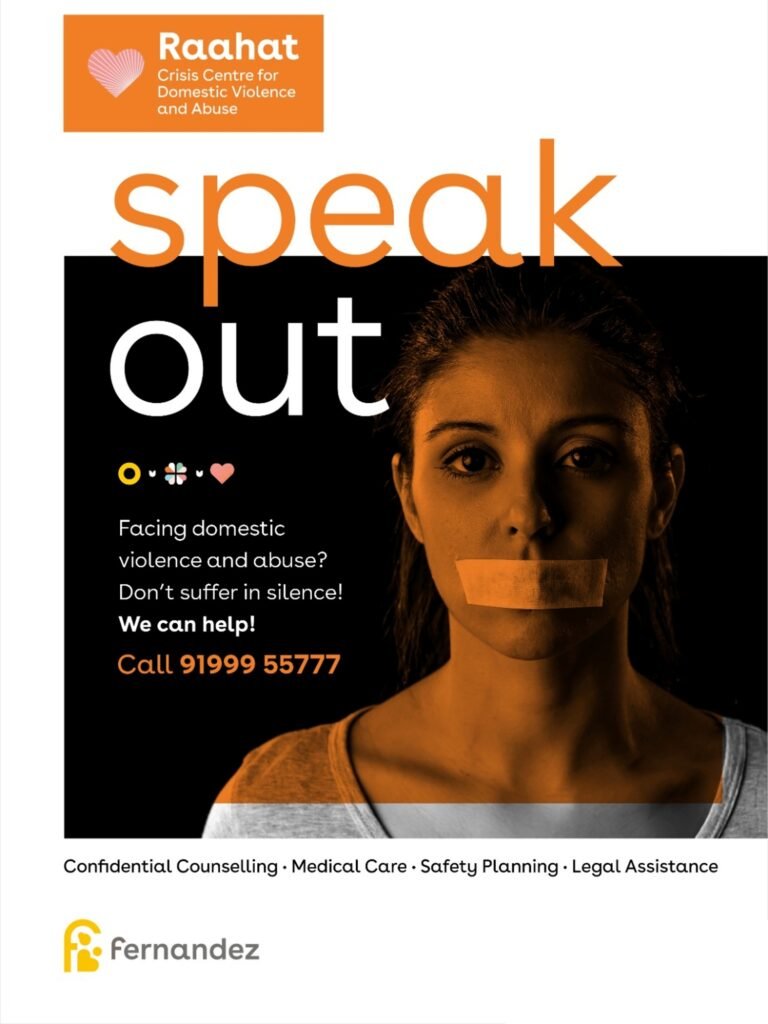
Our Raahat crisis center provides an integrated model of care that combines medical support, psychological counselling, legal guidance, livelihood assistance, and community outreach. Survivors access the center through multiple pathways, including center helpline number (Figure 1), direct walk-in, referral by healthcare professionals within the hospital, police referral, and community outreach mechanisms. Trained counsellors conduct intake assessment, crisis intervention, risk assessment, and documentation. The center also collaborates with government services and partner non-governmental organizations to ensure timely access to police assistance, legal support, and livelihood opportunities for survivors depending on their individual needs. Such multidisciplinary approaches acknowledge that recovery requires more than treatment of injuries alone.
The way forward
Domestic violence and abuse is a complex public health challenge that affects women across educational, occupational, and socioeconomic backgrounds. Our findings demonstrate that emotional and economic abuse are highly prevalent and frequently coexist with physical and sexual violence. As healthcare systems increasingly embrace patient-centered care, routine inquiry about domestic violence should become a standard component of reproductive and women’s health services. Hospitals must be equipped not only to treat the consequences of violence but also to help prevent further harm through timely support and intervention. Creating safe spaces where survivors are heard, believed, and supported is not simply good clinical practice but an essential step toward improving women’s health and advancing gender equity. Meera sought help from our crisis centre and understood that what she had endured was not simply a difficult marriage but a pattern of domestic violence and abuse. With counselling, legal guidance, and support to secure employment, she gradually rebuilt her life and achieved financial independence. Meera’s journey from abuse to independence is testament to the fact that every time a survivor is heard, believed, and supported; the cycle of abuse is weakened. Recognising the hidden forms of violence is the first step toward creating safer lives for women and healthier communities.