In the world of modern medicine, Minimally Invasive Surgery (MIS) or “keyhole surgery” is the gold standard. It offers patients smaller scars, less pain, and lightning-fast recovery times. But for surgeons in low-resource settings, the path to mastering these skills is blocked by a massive financial wall. High-fidelity simulators can cost upwards of INR 600000, a price tag that keeps life-saving training out of reach for many. Enter the Rural Surgery Innovations (RSI) Simulator: a high-fidelity, full-procedure training platform that costs a fraction of the price and is designed specifically for the realities of rural healthcare.
“The RSI Simulator makes modern minimally invasive surgery training affordable and accessible for rural surgeons, ensuring better care for patients everywhere.“
What happens when you bring together surgeons, artists, and engineers? You get a simulator that doesn’t just look like a patient it feels like one. This is because artists, engineers and surgeons worked together to produce this.
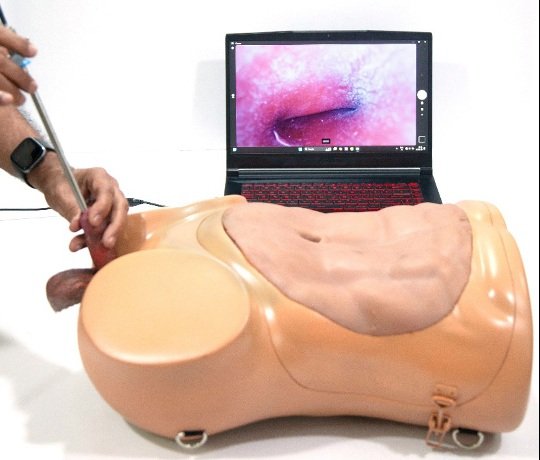
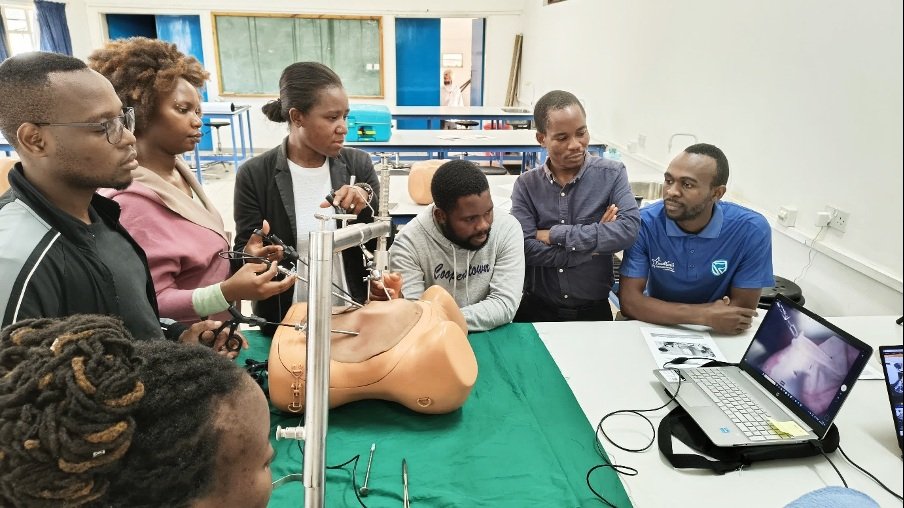
The RSI Simulator uses a clever mix of resin, glass fibre, latex, and silicon to replicate the human torso. But the true genius lies in its replaceable organs. Whether it’s an appendix, a gallbladder, or an ovary, these components cost only a few rupees each to replace. This allows trainees to perform “full-procedure” resections repeatedly without draining the hospital’s budget. Traditional “box trainers” are often too simple they teach you how to move a peg from point A to point B. But real surgery is a team sport. The RSI Simulator is built to work with frugal technology already used in rural theatres: The Laptop Cystoscope: A plug-and-play imaging device that replaces 12 to 15 lakh laparoscopic towers. Because it must be held by an assistant, it forces the surgeon and the camera-holder to communicate and synchronize a vital skill in a real operating room. The GILLS Device (Gas Insufflation Less Laparoscopic Surgery): Instead of using expensive carbon di oxide gas to inflate the abdomen, this mechanical lift creates the workspace. The simulator’s realistic abdominal wall provides the exact resistance a surgeon will feel when using the GILLS device on a living patient.
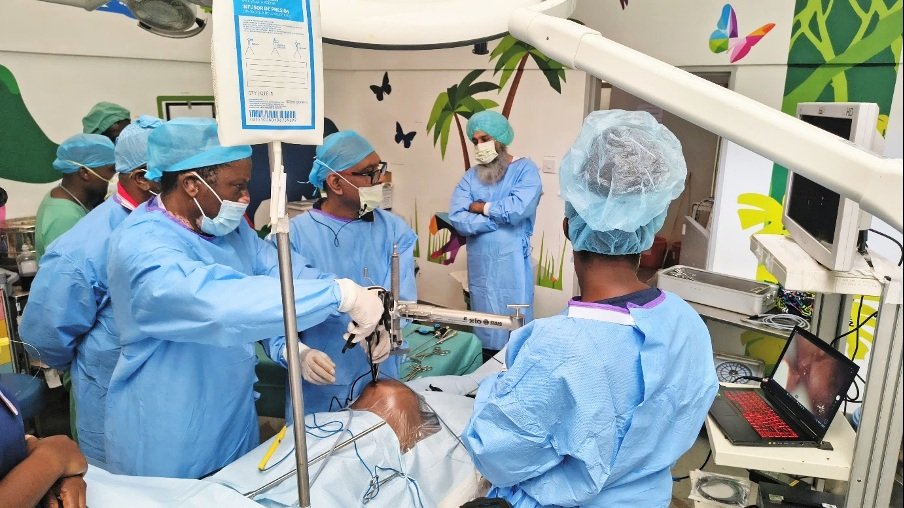
The impact of this innovation is already being felt across the globe. From workshops in rural India to the Southeast African region (Malawi, Uganda, Kenya), the results are quantifiable. In Malawi, data showed that after training on the RSI model, surgeons performed cystoscopies significantly faster and with fewer mistakes. More importantly, the skills were immediately transferable. Surgeons who trained on the simulator were able to perform minor procedures on real patients under supervision almost immediately afterward.
“The training has successfully transitioned from theory to application, addressing the critical skill gap safely via simulation.” Report from Zomba Central Hospital, Malawi.
We believe that the quality of a surgeon’s training should not be determined by the size of their hospital’s budget. By combining “frugal” materials with “high-fidelity” design, we are democratizing surgical excellence.
The RSI Simulator isn’t just a piece of equipment; it’s a bridge. It allows rural surgeons to cross the gap from traditional open surgery to modern MIS safely, affordably, and sustainably. This is more than just a training tool it’s a crucial step toward ensuring that every patient, regardless of where they live, has access to the best surgical care possible.
| Location | Participants | Key Outcome |
| Lilongwe | 22 Surgeons | 96% of post-training procedures were faster and error-free. |
| Blantyre | 11 Surgeons | Successful adoption of Laptop Cystoscopy in district-level hospitals. |
| Zomba | 11 Surgeons | Safe transition from simulation to real-world application. |