
Cancer therapeutics at present is undergoing a transition from traditional chemotherapy to more advanced mechanism based molecularly driven and patient specific treatment. The scope of anti cancer drug discovery in future is largely depended on the integration of molecular modeling, medicinal chemistry, structural biology, artificial intelligence, genomics, chemical biology and precision medicine. The primary objective is to design specific therapeutic drug candidates which recognize diseases related molecular vulnerabilities while minimizing toxicity effects rather than simply identifying molecules that can kill the cancer cells. Our research demonstrates this transformation through design and synthesis of anticancer scaffolds through molecular docking, 3D QSAR, molecular dynamics simulations and biological evaluation.
Molecular innovation as the basis for next generation cancer therapeutics
The discovery of new potent anticancer agents starts with molecular innovation. The privileged heterocyclic scaffolds, molecular hybrids and structurally modified analogues continue to provide crucial chemical foundation for discovery of new potent molecules. Triazole, thiadiazole, thiazolidinedione, Indole, Azaindole, pyrazole and related heterocyclic entities are highly valuable because of their physicochemical and electronic properties which can be modified systematically to achieve improved selectivity, target recognition and biological activity.
Our recent research particularly demonstrated this strategy well. We reported Meldrum’s acid based 7-azaindole based 1,2,3- triazole hybrids and evaluated their anticancer properties against various cell lines, combining chemical synthesis and biological activity. In another study we reported indole 1,3,4, thiadiazole schiff based hybrids as anticancer agents which showed potent and selective cytotoxicity against cancer cell lines while showing lower toxicity towards normal cells, demonstrating the significance of chemical optimization for achieving a therapeutic window. The same is evident in another study involving 1,2,3-triazole based thiazolidine-2,4-dione derivatives, where synthesis, molecular docking and anticancer/antimicrobial evaluation were combined into a single discovery. These investigations illustrate that molecular innovation is most powerful when synthesis, computational prediction and experimental validations are done recursively rather than isolated stages.
From one drug one target to interconnected network pharmacology
The scope of cancer drug discovery in future will require a paradigm shift from single target to understanding the interconnected signalling networks. Cancer cells generally develop resistance by mutating active site where the drug binds, modifies apoptosis signalling, alters microenvironment or activating alternative pathways. Therefore, inhibition of one protein produces only limited or temporary therapeutic benefit.
Molecular modeling approaches can help in identifying the crucial nodes within cancer associated signalling networks. Our research included molecular modeling studies on various kinase targets relevant to cancer. For example, an insilico study was carried out on Akt inhibitors using computational approaches. Akt is an important component of PI3K/Akt/mTOR signalling pathway which is known to regulate survival, proliferation metabolism and is often dysregulated in cancer. Earlier we also investigated B-Raf kinase inhibitors through integrated molecular design and computational approaches. All these studies show that computational chemistry is not merely used to rank the compounds but understand how modifications at molecular level influence the target engagement, pathway modulation and even resistance mechanisms.
Artificial Intelligence-Machine learning (AI/ML) and computational drug discovery
Artificial Intelligence and Machine learning are sophisticated tools that are expected to drive next generation anticancer drug discovery. Current medicinal chemistry approaches require synthesis and biological evaluation of millions of compounds where as advanced AI-assisted protocols can prioritize promising leads even before synthesis by predicting biological activities, ADMET profiles, protein-ligand interactions, physicochemical and electronic properties.
The integrated molecular modeling approaches along with machine learning techniques provides a powerful structural framework that can narrow down the chemical space. This computational evolution is reflected in one of our publications involving Molecular docking, MM/GBSA, 3DQSAR, Pharmacophore modeling and Molecular dynamics simulations. Our work on pim-3 inhibitors involving pragmatic pharmaco-informatics strategy is one of the classic examples of using computational techniques for indentifying new potent anticancer agents.
An important future development in this area is integration of generative AI with structure-based drug design. Generative models rather than searching only existing molecular libraries can propose novel molecular entities or chemical probes optimized simultaneously for selectivity, solubility, potency, synthetic accessibility and metabolic stability. Medicinal chemists will continue to play essential role because AI- generated molecules must still meet synthetic feasibility, safety, biological relevance and require expert prioritization, retro synthetic planning, experimental validation to be satisfied as a useful drug candidate.
Precision Medicine: Administering the right drug to the right patient at the right time
The paramount goal of molecular innovations is precision medicine. Cancer is not a single disease but rather a collection of molecularly different diseases. Two patients with same anatomical cancer diagnosis may harbour entirely different genetic alterations, drug sensitivities and signalling dependencies. As a result, future anticancer therapy will eventually depend on the molecular characterization of individual tumours.
Proteomics, metabolomics, transcriptomics, genomic sequencing can identify actionable alterations and therapeutic vulnerabilities. Computational approaches can then link molecular signatures with suitable targets and drug candidates. In our previous study we explored the relationship between cancer mutations and drug sensitivity/resistivity. In particular, we investigated how mutations in Epidermal Growth Factor Receptor (EGFR) can influence differential sensitivity towards kinase inhibitors, substantiating the relevance of molecular variation to therapeutic response.
This approach will become gradually important for the causes that are driven by heterogeneous mutations. Instead of specifying treatment solely on the basis of tumour location, future clinical decision making will slowly consider the molecular topology of the tumour. Companion diagnostics, liquid biopsy, circulating tumour DNA and real time molecular monitoring may authorize clinicians to identify emerging resistance before it becomes clinically apparent.
Overcoming Drug resistance
One of the greatest challenges in oncology even today is drug resistance. Cancer cells continue to evolve under therapeutic pressure, causing highly effective targeted therapies fail. Therefore, it is essential for future anticancer discovery to envision resistance at the early stages of molecular design.
One of the promising strategies is development of molecular entities that are capable of identifying mutant forms of therapeutic targets. Other strategies include development of covalent inhibitors, allosteric inhibitors, multi target directed ligands and molecular degraders. Combination therapy can simultaneously suppress shared survival pathways and decrease the probability of resistant clones arising thereof.
In this context design of molecular hybrids is an attractive strategy. Medicinal chemists and researchers can generate potential compounds capable of interacting with more than one disease relevant mechanism by integrating pharmacologically relevant structural motifs into a single molecular framework. Our work on azaindole-triazole and thiadiazole containing compounds and relevant heterocyclic hybrids is perfect example of this molecular hybridization approach.
This concept may be further extended in future by proteolysis targeting chimeras, (PROTACS) molecular genes and other targeted protein degradation strategies. These technologies remove or destabilize the pathogen protein itself rather than inhibiting a cancer associated protein.
From insilico predictions to invivo validated medicines
One of the major challenges in the process of computational drug discovery is translation of predicated activity into reproducible experimental and clinical outcomes. Docking score or binding energy values alone cannot establish whether a compound can become a successful drug (or) hit molecule. Various parameters such as solvent effects, protein flexibility, cellular permeability, ADMET profiling and tumour heterogeneity must all be considered. Therefore, a closed loop discovery model would be ideal for future workflow.
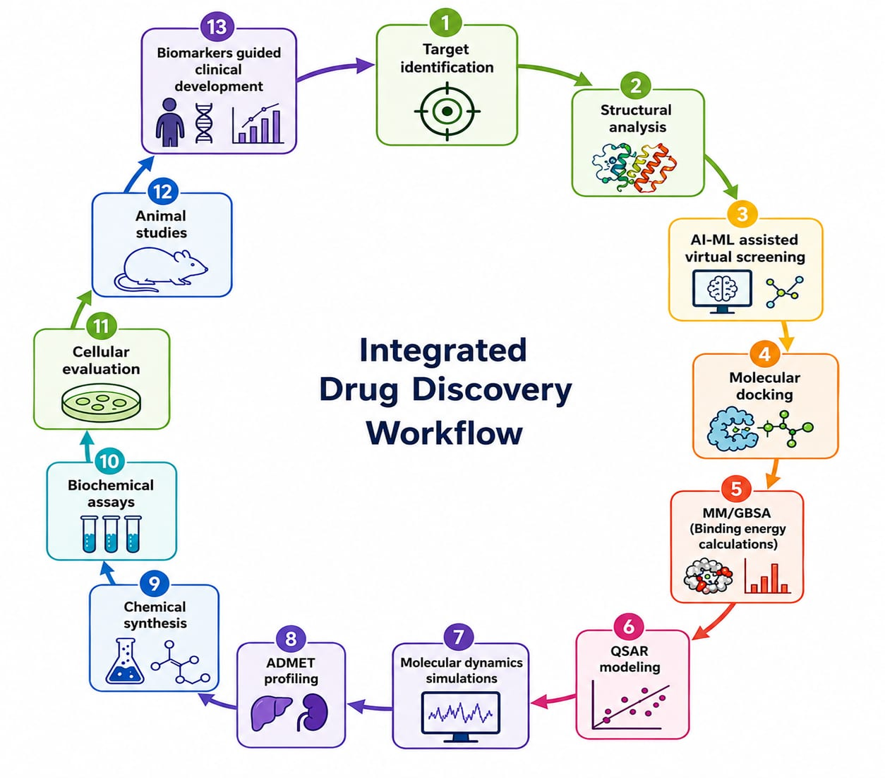
The strength of our research lies in the interconnection mechanism where interdisciplinary areas of molecular modeling and medicinal chemistry are connected. Our recent studies combine computational studies, synthetic chemistry and biological testing, providing a combined route from the molecular hypothesis to the experimentally endorsed lead compounds.
The next decade: Towards insightful and patient –specific oncology
The next decade of anticancer drug discovery will be increasingly defined by convergence. Molecular modeling will converge with high through-put experimentation, medicinal chemistry with synthetic biology, drug discovery with genomic medicine and artificial intelligence-machine learning with structural biology. The convergence will enable researchers worldwide to design molecules precisely for defined molecular vulnerabilities rather than identifying broadly cytotoxic compounds. The next generation may involve single cell sequencing, patient derived tumour organoids, computationally generated disease models and spatial transcriptomics. These sophisticated techniques not only help in identifying which mutation is present but also determine which tumour cell population depends upon a particular pathway. Drug like candidates can be thereafter evaluated in biologically relevant patient derived models before entering into clinical trials. Our recent work demonstrates this continuing evolution of the above research. Our publication on 7-azaindole linked imidazole-1,2,3-triazole hybrids in 2026 combines computational screening, synthesis and antiproliferative evaluation depicting the continuing integration of molecular design and computation in anticancer drug discovery.
Conclusion
The future course of anticancer drug discovery will be determined by the capacity to translate molecular understanding into adaptive, selective and patient specific therapies. The impact of molecular innovation will be amplified through artificial intelligence, computational chemistry, precision medicine, systems pharmacology and structured biology. Our research contributions substantiate how heterocyclic molecular design, hybridization, computational modeling, QSAR studies, molecular docking, binding free energies, molecular dynamics simulations and biological evaluation can be altogether integrated to address the contemporary and future challenges in drug discovery. The fundamental idea is not to discover a greater number of anticancer molecules, but to develop therapeutics which can exclusively exploit the molecular weakness of individual tumours, overcome resistance, minimize toxicity and improve quality of life. Therefore, it is obvious that future oncology paradigm will increasingly depend on the continuous integration of molecular innovation with precision medicine.