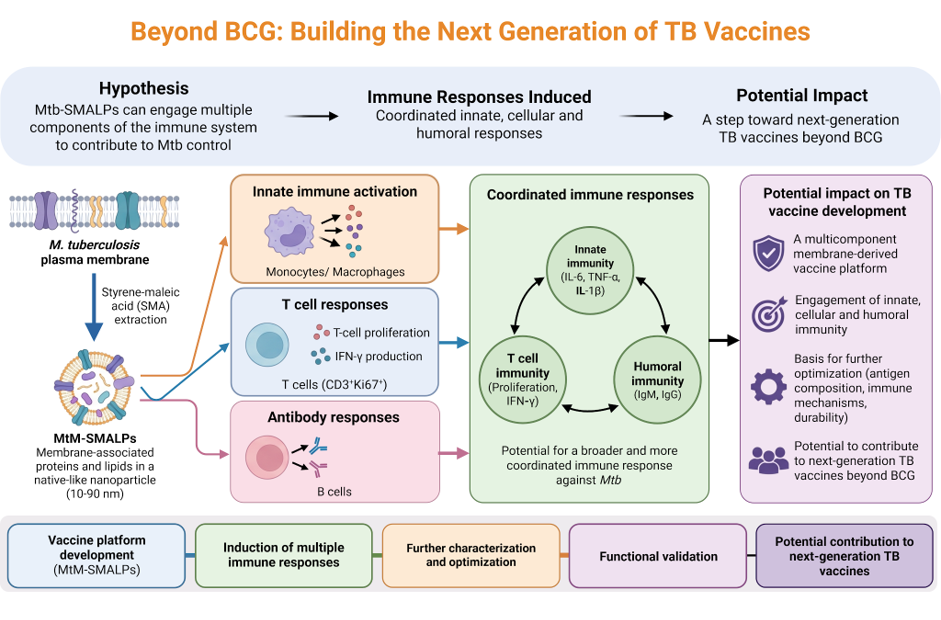
Tuberculosis (TB) remains a serious health problem worldwide. Bacillus Calmette–Guérin (BCG) has been the only widely used TB vaccine for many years and protects against severe TB in children, but its protection against other TB, such as pulmonary TB in older children and adults, is inconsistent. The continuing burden of TB and the rise of drug-resistant Mycobacterium tuberculosis (Mtb) highlight the need to develop additional vaccine approaches. Current TB vaccine research has largely focused on T-cell-mediated immunity, particularly CD4+ T-cell responses and IFN-γ production. However, immune responses to Mtb involve multiple components, including innate cytokine responses, macrophage activity, T-cell responses and antibody production. Recent findings with Mtb plasma membrane-derived styrene–maleic acid lipid particles (MtM-SMALPs) demonstrate that a membrane-derived preparation can stimulate several of these immune responses simultaneously.
A broader view of TB vaccine immunity
Macrophages are among the first host cells to interact with Mtb and are central to antigen processing, cytokine production, and intracellular control of mycobacteria. T cells subsequently contribute to macrophage activation and cellular immune responses. B cells and antibodies also contribute to the Mtb immune response. Our recent MtM-SMALP study shows that stimulation of different immune components can be observed following exposure to the membrane-derived preparation. In blood cultures from healthcare workers with previous Mtb exposure, MtM-SMALPs increased production of IL-6, TNF-α, and IL-1β, cytokines related to innate immune activation. IFN-γ production was also noted, suggesting an adaptive immune response. These findings support a broader investigation of TB vaccine-induced immunity.
Mtb Plasma Membrane as a Potential Source for TB Vaccine Development
The plasma membrane of Mtb contains a range of proteins, lipoproteins, and glycolipids and interacts with host immune cells. However, isolating membrane proteins without disturbing their surrounding lipid environment is technically difficult. Styrene–maleic acid (SMA) provides an alternative approach for extracting membrane components while retaining membrane-associated molecules within lipid particles. Earlier characterization demonstrated that MtM-SMALPs contain several Mtb membrane-associated components, including PRA, PstS1, LpqH, Ag85 and lipoarabinomannan (LAM). In contrast, they largely excluded some peripheral membrane proteins, including Acr and PspA. MtM-SMALPs appeared as nanoparticles with diameters of approximately 10–90 nm, with the largest proportion ranging from 20–40 nm. This characterization is important because SMA-derived MtM-SMALPs selectively retain a defined subset of membrane-associated components and show biological activity linked to their molecular composition.
Key Immunological Findings of the Recent Study
In our recent study (Sinha et al 2026) we evaluated immune responses to MtM and MtM-SMALPs using blood samples from 15 healthcare workers from North India with evidence of previous Mtb exposure. We measured cytokine production, T-cell proliferation, and antibody response after stimulation with MtM or MtM-SMALPs. Our main findings were a concentration-dependent increase in IL-6, TNF-α, and IL-1β after MtM-SMALP stimulation. IFN-γ production was also detected. In contrast, higher concentrations of crude MtM suppressed some cytokine responses, with a significant reduction particularly observed for IL-1β. Thus, immune stimulation induced by MtM-SMALPs differed from that induced by the crude membrane preparation. Further, MtM-SMALPs induced T-cell proliferation, assessed by Ki67 expression in CD3+ cells, and IFN-γ production was detected after stimulation. It was also observed that T-cell proliferation was positively correlated with IFN-γ production. These findings suggest that MtM-SMALPs trigger immune responses (cellular) in addition to cytokine production.
Antibody responses were also found to be differ between the two preparations. IgM responses were more prominent after exposure to crude MtM, whereas IgG responses were more prominent after stimulation with MtM-SMALPs. The detection of MtM-SMALP-specific IgG responses demonstrates that the membrane-derived particles can induce an antibody response and highlights their ability to engage both cellular and humoral components of immunity. Although the overall antibody levels were relatively modest, these findings provide a basis for further characterization and optimization of the MtM-SMALP-induced antibody response. Overall, the observed cytokine, T-cell, and antibody responses indicate the immunological potential of MtM-SMALPs and support their further validation as a potential platform for TB vaccine development.
Key Research Directions for Further Characterization and Development of MtM-SMALPs
The next stage should focus on defining the relationship between MtM-SMALP composition and immune activity. Proteomic and lipidomic analyses can be used to establish the components consistently retained during SMALP preparation and to determine their relationship with cytokine, T-cell and antibody responses.
A second direction is to examine macrophage responses more directly. The current study demonstrated cytokine production in blood cultures, but the contribution of individual innate immune cell populations requires further characterization. Studies using isolated monocytes and macrophages can determine how MtM-SMALPs influence activation and subsequent immune-cell interactions.
A third direction is to further characterize T-cell responses. The published study demonstrated Ki67+CD3+ T-cell proliferation and IFN-γ production. Future work should define the responding T-cell populations and determine whether these responses are maintained following repeated stimulation.
Antibody responses require additional characterization. Because IgG responses were more prominent against MtM-SMALPs but overall antibody levels were low, subsequent studies should examine antibody titers alongside binding characteristics and functional activity.
Finally, the immunological findings need to be connected with functional control of Mtb. Cytokine production, T-cell proliferation and antibody responses provide measurable indicators of immune activation, but their relevance to protection must be established in appropriate experimental models. Reproducibility of MtM-SMALP preparation, molecular composition, safety, immune durability, and protective activity will therefore be important steps in further development.
Conclusion
Developing next-generation TB vaccines requires a comprehensive understanding of the immune responses that contribute to effective control of Mtb. The recent findings on MtM-SMALPs provide encouraging evidence that a membrane-derived preparation can engage multiple components of the immune system, including innate cytokine responses, IFN-γ production, T-cell proliferation, and antibody responses. The observed induction of IL-6, TNF-α, IL-1β and IFN-γ, together with measurable T-cell and antibody responses, highlights the multifaceted immunological activity of MtM-SMALPs and provides a strong basis for their continued investigation as a potential TB vaccine platform.
These findings establish an important foundation for further development. The membrane-derived composition of MtM-SMALPs provides an opportunity to investigate multiple Mtb-associated immune determinants within a single preparation, while the observed cellular and humoral responses provide measurable parameters for evaluating and optimizing the platform. Further studies can build on these findings by defining the membrane components associated with specific immune responses, characterizing macrophage and T-cell activation, and improving the understanding of MtM-SMALP-induced antibody responses.
A key next step will be to connect these measurable immune responses with functional activity against Mtb. Evaluation in appropriate experimental systems, together with assessment of response durability, safety, reproducibility and protective activity, will help establish the translational potential of this approach. This stepwise progression—from molecular characterization and immune activation to functional validation—can provide a clear framework for advancing MtM-SMALPs from an experimental membrane-derived preparation toward a more developed TB vaccine platform.
Overall, the current evidence positions MtM-SMALPs as a promising, innovative approach to broadening TB vaccine research. Continued investigation of their molecular composition, immunological activity, and functional relevance may contribute to the development of new vaccine strategies capable of generating coordinated innate and adaptive immune responses against Mtb.