Inflammation is one of the body’s first-line defense mechanisms against infection or injury. While a regulated inflammatory response balancing pro- and anti-inflammatory mediators is essential to protect the host from pathogens or tissue damage, excessive or dysregulated proinflammatory response causes tissue damage and impairs organ function. Such dysregulated inflammatory response underlies diseases such as rheumatoid arthritis, sepsis and psoriasis, substantially affecting the quality of human life. Current estimates indicate that inflammatory diseases affect a substantial and growing proportion of the population across the globe. Moreover, the expenditure associated with inflammatory disease diagnosis and management represents a considerable and increasing economic burden across these regions. Both the prevalence of chronic inflammatory diseases such as rheumatoid arthritis, and the cost of clinical management of these diseases have increased substantially over recent decades, underscoring their societal burden. Existing anti-inflammatory drugs reduce the proinflammatory response and tissue damage. However, some of these drugs adversely affect other organ systems or carry the risk of compromising the hosts’ protective immune responses, highlighting the need for new drugs with minimal adverse effects on protective immune responses or organ function.
The discovery of novel drugs including anti-inflammatory agents requires rigorous testing for their efficacy and safety through preclinical studies, non-human animal models, and clinical trials in humans, a process that is time-consuming and costly. An alternative strategy is drug repurposing, i.e. investigating the potential of existing drugs, originally developed to target molecules other than those in inflammatory response but with established safety in humans to therapeutically modulate inflammation. This approach might be more economical and faster compared with de novo drug synthesis and development.
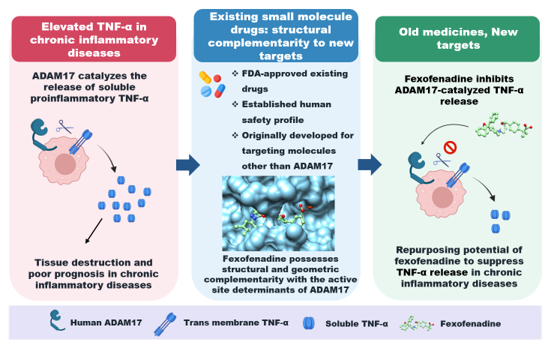
A key inflammatory pathway component emerging as a promising target for anti-inflammatory drug discovery program is the protease ADAM17. ADAM17 mediates the cleavage of membrane-anchored precursor form of TNF-α to release soluble TNF-α, a potent proinflammatory cytokine. By inhibiting the catalytic activity of ADAM17, the production of soluble TNF-α with potent proinflammatory activity could be reduced. This could limit tissue damage associated with aberrant proinflammatory TNF-α signaling and preserve organ function. ADAM17 has an extracellular region containing the active site, transmembrane domain and a cytoplasmic domain. Existing ADAM17 inhibitors showed toxicity or lack of efficacy in clinical trials and have not received FDA approval for therapeutic use, indicating the need for new ADAM17 inhibitor drugs to treat TNF-driven inflammatory diseases.
Studies in our laboratory have shown that some of the existing small molecule drugs, developed to target biomolecules other than ADAM17 and with established safety and tolerability in humans, could inhibit ADAM17. Notably, fexofenadine, developed as an antihistamine with established safety and tolerability in humans including paediatric subjects, has been shown to inhibit ADAM17 and protect against the tissue destructive proinflammatory effects of TNF-α. It suggests the repurposing potential of fexofenadine as a new ADAM17 inhibitor drug for treating TNF-α-driven inflammatory diseases. Fexofenadine can be administered orally, and is readily available and more economical compared with current anti-TNF-α biologics which require parenteral administration. The identification of fexofenadine’s repurposing potential to inhibit ADAM17 and protect against TNF-α-driven inflammation, with efficacy similar to the current anti- TNF-α biologic etanercept became possible through an integrated approach involving computational protein–small molecule interaction modeling, in vitro assays with recombinant human ADAM17, in vitro models of inflammatory-activated human monocytic cells, and 3D cell cultures of vascular endothelial cells (which constitute the inner lining of human blood vessels). These findings align with previous independent studies reporting decreased soluble TNF-α concentration in patients following fexofenadine treatment. Collectively, this evidence reveals the repurposing potential of fexofenadine, originally developed and used as an antihistamine, to reduce TNF-driven proinflammatory response and consequent tissue destruction in inflammatory diseases such as rheumatoid arthritis. Additionally, the molecular structure of fexofenadine could guide the design of novel small molecule ADAM17 inhibitors for potential therapeutic use.
Additionally, this finding has implications for precision medicine, in which treatments including drug type and dose, are tailored to individual patient, even in diseases not primarily driven by inflammatory pathology but where inflammation is a component or associated feature. It is important to note that inflammation has been shown to affect the pharmacokinetics including drug metabolism. Moreover, there may be a subset of patients in whom inflammation might accelerate tissue damage or contribute to disease progression. It is anticipated that biomarkers to define the type of inflammatory response contributing to tissue damage in patients with different diseases could be identified, enabling treatments targeting specific inflammatory components in different patient subsets of each disease setting to maximize therapeutic benefit. For example, an integrated screening determining soluble TNF-α concentration, ADAM17 activity, and proteomics signature to identify “TNF-α–high” subgroups, who are likely to respond to fexofenadine or other repurposed ADAM17 modulators could be performed. Using this approach, targeted modulation of inflammation could, in future, improve outcomes in diseases not traditionally classified as inflammatory.
Computational virtual screening to identify off-target interaction between proteins and small molecule drugs, followed by disease network analysis, and in vitro and in vivo experiments using appropriate animal models, could provide insights into the repurposing potential of existing small molecule drugs to control inflammation. By selectively inhibiting ADAM17, inflammatory responses could be controlled without increasing the risk of infection in the host. This would enable a transformation from the current anti-inflammatory therapy to precision inflammation-control therapy, potentially reducing hospitalization and healthcare expenditure. It should be noted that determination and characterization of off-target interactions could not only guide drug repurposing but also help elucidate the molecular basis of adverse drug reactions, thereby enabling a more accurate assessment of the benefit–risk ratio across different patient populations, including individuals of varying ages and developmental stages. For example, a drug that is well tolerated in adults may produce distinct or more pronounced adverse effects in paediatric patients because of age-dependent differences in drug metabolism, receptor expression, signaling pathways, and organ maturation. Characterizing such off-target interactions could therefore help identify patient subgroups that are particularly susceptible to specific adverse effects and support the development of safer, more individualized therapeutic strategies.