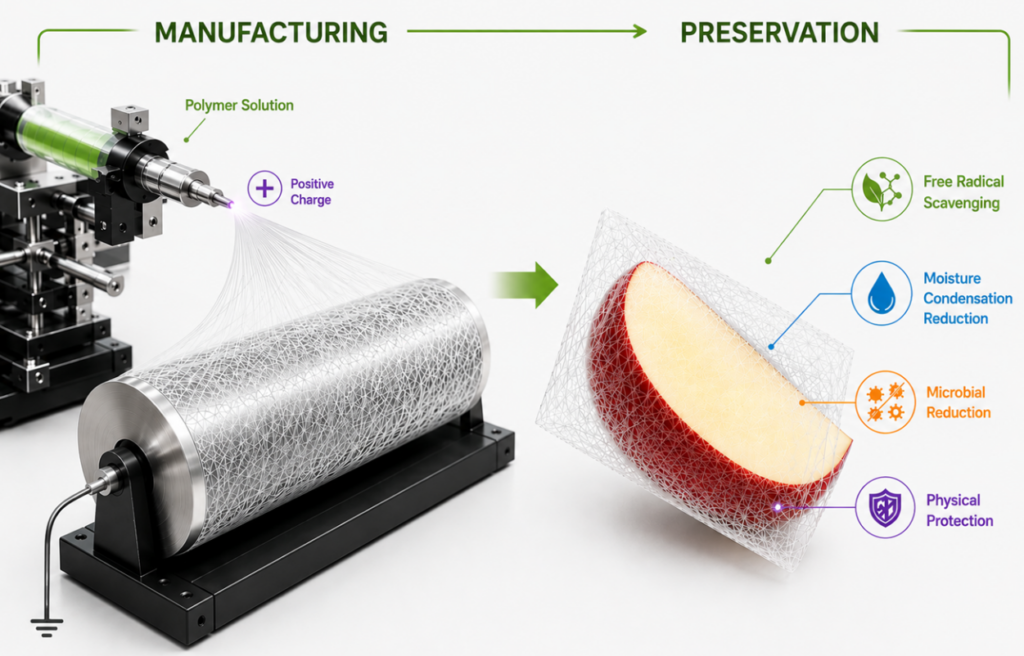
Fresh-cut fruits have become more popular in modern lifestyles for their convenience, health benefits, and easy consumption as ready-to-eat snacks, whether packed in school lunch boxes, sold in supermarkets, or in restaurants. However, anyone who has sliced an apple notices one common problem: browning. Within minutes, the fresh white surface slowly turns brown. Along with color change, the fruit gradually loses moisture, texture, nutritional quality, and freshness.
“Smart packaging does more than wrap food, it actively protects freshness, slows spoilage, and helps reduce both food waste and plastic pollution.”
Browning in fresh-cut apples is mainly caused by enzymatic oxidation reactions, which are triggered when the tissue of the fruit is exposed to air. The enzymes, such as polyphenol oxidase, mediate the development of brown colors. In addition, moisture condensation and microbiological contamination accelerate the deterioration of quality.
Each year, tons of fruit are discarded due to spoilage during transportation and storage, and the ubiquitous conventional plastic wrap commonly used to cover food items also accounts for a large share of non-biodegradable waste. These two global concerns, food waste and plastic waste, have encouraged scientists to search for smarter and more sustainable packaging solutions. A possible answer is the development of smart, eco-friendly packaging films, which can extend the shelf life of food items. Unlike conventional plastic wraps, smart packaging films not only wrap the food but also interact with it and its environment; they can reduce spoilage, inhibit microbial growth, maintain the food’s nutritional value, and even indicate how fresh the food is. Over the last few years, scientists and researchers have been developing active packaging materials using novel nanomaterials and natural compounds.
Natural antioxidants, antibacterial compounds such as plant extracts, essential oils, and bio-derived carbon-based nanomaterials can be incorporated as active materials in the fibrous films to enhance the food preservation efficacy. Carbon dots, a zero-dimensional material, have attracted significant attention due to their small size, fluorescence properties, low toxicity, and excellent biocompatibility. They can improve the physicochemical, mechanical, antioxidant, and antimicrobial properties, as well as the UV-blocking characteristics, of packaging films.
Electrospinning can produce fibrous films with diameters ranging from microns to nanometers and offers distinct advantages over conventional films, including higher surface area, interconnected pores, a lightweight structure, and excellent flexibility. These features make electrospun fibrous films very attractive for food packaging.
The fibrous structure functions as a permeable protective barrier that maintains the flow of oxygen and moisture, unlike conventional plastic films. This helps preserve texture and reduces water vapor condensation. Furthermore, owing to the presence of functional groups, including hydroxyl, carbonyl, and nitrogen groups, on the carbon dots, the films exhibited excellent antioxidant and UV-blocking properties.
When these films were used as a practical, standalone packaging material, they reduced browning index by ~26% and visible decay in fresh-cut apples during the 5-day storage study, compare to conventional films. The potential impact of these packaging systems can be further applied to a wide range of fresh produce, including climacteric and non-climacteric fruits.
“By combining biodegradable electrospun fibers with carbon dots, scientists are transforming food packaging into an intelligent system that keeps fresh-cut fruits fresher for longer.”
Although smart packaging technologies are still emerging, progress in this field has been remarkably rapid. Efforts are underway globally to enhance scalability, affordability, and material robustness. Looking ahead, packaging will no longer serve merely as a protective layer. It will function as an active system capable of maintaining freshness, communicating food quality to consumers, minimizing waste, and contributing significantly to mitigating global food loss and environmental issues. Such innovations represent a shift from passive packaging to intelligent systems that actively govern food quality and sustainability.