Error-Prone mRNA Biogenesis
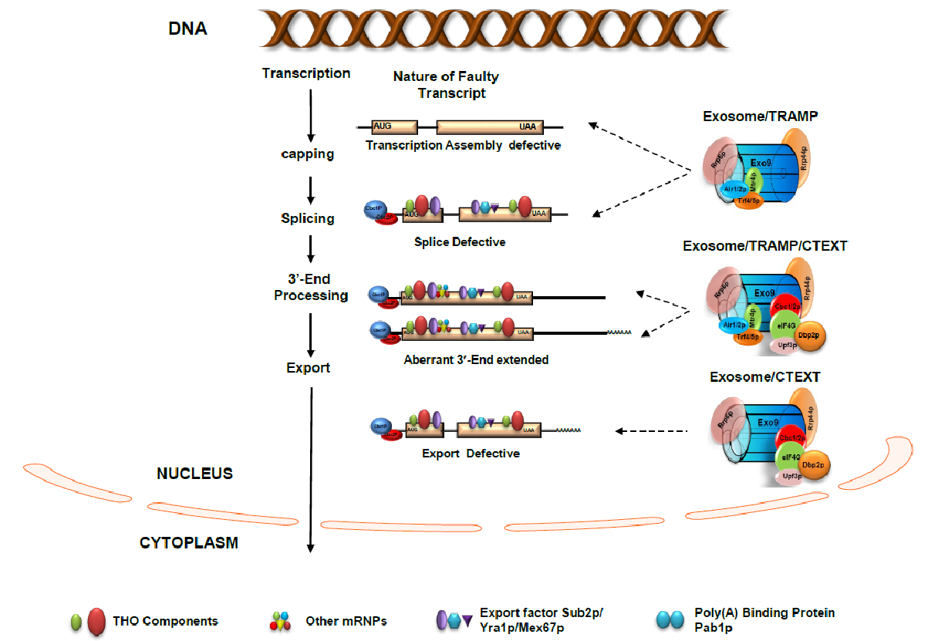
In all eukaryotes, mRNA biogenesis consists of the transcription of the protein-coding genes by RNA polymerase II, capping of the primary transcript at the 5′-end, splicing, and an end-maturation event at the 3′-termius of the message. During these events, each transcript interacts and associates with a vast repertoire of mRNA-binding factors and heterogeneous nuclear ribonucleoproteins. Association of the mRNA with these factors dictates the subsequent fates of mRNAs later in their life. Concerted execution of these nuclear events ultimately leads to the formation of an export-competent mRNP (messenger ribonucleoprotein) followed by its nuclear export and subsequent translation in the cytoplasm (Fig. 1). Notably, each of these nuclear events is tightly coupled and linked to ensure formation of productive mRNPs and lowers the risk of formation of erroneous messages. Despite this functional coupling, a substantial amount of non-productive, aberrant mRNPs are continuously produced, raising the possibility of translating these faulty messages, which in turn can produce even a higher amount of aggregation-prone, abnormal or otherwise non-functional polypeptide chains. Accumulation of such aggregation-prone polypeptides eventually increases the probability of having several kinds of disease states such as autoimmune and neurodegenerative diseases. Although this may seem alarming, every eukaryote has evolved highly organized quality-control mechanisms that thoroughly scrutinize the entire biogenesis process, from transcription to export. These mechanisms, collectively called mRNA surveillance mechanisms, rapidly monitor every nuclear event, promptly detect faulty messages, and degrade them selectively. Messenger RNA surveillance is paramount, as it limits the accumulation of aberrant messages, safeguards cells from their detrimental effects, and contributes to the fidelity of the gene-expression pipeline.
“The mRNA biogenesis is imprecise leading to the generation of diverse aberrant mRNAs in all eukaryotes”
mRNA Quality Control System scrutinizes the errors executed in mRNA biogenesis events
Despite the substantial number of faulty messages formed in a healthy cell at any given time, non-functional, aggregation-prone, defective polypeptides are seldom generated from such faulty messages because eukaryotes have a vigilant mRNA quality control system. This system critically monitors the entire biogenesis event, detects diverse classes of faulty messages, and promptly targets and degrades them in the nucleus, thereby preventing their export and unwanted translation and precluding the formation of abnormal proteins. Research from various laboratories, including our own, has shown that a highly conserved multi-protein complex called the nuclear RNA exosome is the major machinery in the nucleus involved in targeting and degrading faulty messages. RNA exosome displays extreme conservation in its structure from the simplest eukaryote, baker’s yeast, to humans and shows a high degree of similarity in its mode of action. This complex consists of eleven different subunits, of which only two play a vital role in degrading substrate RNAs. These subunits are called Rrp44 (Dis3) and Rrp6, both of which degrade the RNAs from their 3′-terminus in a processive manner.
Remarkably, the nuclear exosome can target and degrade all kinds of RNAs in the cell without assistance and can, in principle, degrade the entire cellular RNA pool. To adapt this molecular machine to target specific mRNAs (such as faulty mRNAs) selectively, the RNA exosome is assisted by a group of protein cofactors called exosomal cofactors. To date, three different exosomal cofactors are reported in the literature: the TRAMP (TRf4/5-Air1/2-Mtr4-Polyadenylation) complex, CTEXT (Cbc1-Tif4631-EXosomal-Targeting) complex, and NNS (Nrd1-Nab3-Sen1) complex (Figure 1). These cofactors help the nuclear exosome scrutinize the entire nuclear RNA pool, preferentially pick up aberrant/faulty mRNAs, and degrade these defective, unwanted messages in the nucleus in a selective fashion. Thus, these cofactors have the important responsibility of distinguishing aberrant/defective messages from normal functional messages.
Recent findings from many laboratories, including our own, indicate that principally four kinds of faulty messenger RNAs are generated in the nucleus of baker’s yeast, Saccharomyces cerevisiae, progressively through transcription and various mRNA biogenesis/maturation events. These faulty messages include transcription-assembly-defective, splice-defective, 3′-end maturation-event-defective, and export-defective transcripts. Our laboratory demonstrated that while TRAMP plays a vital role in recognizing and targeting transcription-assembly- and splice-defective messages, CTEXT principally targets and degrades 3′-end maturation-event-defective and export-defective transcripts (Figure 1). Importantly, all aberrant messages display export incompetence and thus cannot be exported efficiently from the nucleus to the cytoplasm, and are largely arrested in the nucleus. This selective nuclear retention helps distinguish them from normal functional messages that are exported readily. Importantly, proper distinction between aberrant and normal functional messages is critical because accidental targeting of the normal messages instead of aberrant ones may lead to cellular catastrophe, which remained an enigma until recently. A recent finding from our laboratory revealed that the third exosomal cofactor, the NNS complex, plays a fundamental role in distinguishing aberrant messages from normal messages. RNA polymerase II preferentially loads the NNS complex onto aberrant transcripts (but not on normal functional messages) in a transcription-dependent manner, thereby marking them as faulty messages.
NNS complex, thus, acts as a “molecular mark” in making the distinction between aberrant and normal messages. The current model thus suggests that aberrant mRNAs are recognized very early during their transcription and biogenesis when the NNS complex is loaded and recruited onto them. Recruitment of the NNS complex leads to the further loading of either the TRAMP or CTEXT complex depending on the phosphorylation status of the long c-terminal domain (CTD) of the largest subunit of RNA polymerase II. During the early phase of mRNP biogenesis, NNS recruits TRAMP onto transcription-elongation-defective and splice-defective messages. In contrast, NNS recruits CTEXT onto the 3′-end maturation-event-defective and export-defective transcripts specifically during the late phase of mRNP biogenesis.
The mRNA Quality Control System also preferentially degrades a small subset of functional mRNAs, thereby regulating several vital cellular processes
Interestingly, a recent finding from our lab indicated that the mRNA surveillance machinery, the nuclear RNA exosome/CTEXT, also participates in the selective nuclear degradation of nearly 250 normal functional mRNAs in Saccharomyces cerevisiae, which we termed “special” mRNAs. A global transcriptomic study uncovered these susceptible “special” messages and aimed to determine whether nuclear mRNA surveillance targets and degrades functional messages alongside their aberrant counterparts. Although, the discovery of the finding that mRNA surveillance degrades these small group of functional mRNAs is quite surprising, soon it was realized that the preferential decay of these functional messages reflects a novel mode of regulation of the corresponding genes at the post-transcriptional level that is aimed to regulate the cellular repertoire of these messages under specific environmental signal(s). Experiments designed to understand the reason for the susceptibility of these “special” messages indicated that they were export-inefficient and resemble “aberrant” messages in this context. Understanding the mechanism of their selective nuclear retention is therefore crucial to gaining insight into the regulation of their cellular abundance. Findings from our laboratory revealed that one of the model mRNAs, SKS1 harbours a “nuclear zip code” element in its transcript body that binds, Dbp2, a double stranded RNA helicase that specifically binds to SKS1 (specifically in its nuclear zip code element) and prevent the interaction of SKS1 with export factors Mex67/Yra1, and prevent its nuclear export and promotes its nuclear degradation. Analyses with eight other special mRNAs reveal that all bind Dbp2 and thereby promote their nuclear retention and degradation by the nuclear surveillance machine, exosome/CTEXT. However, the existence of the specific “nuclear zip code” in their transcript body remains to be delineated.
An in-depth, systematic study of the model special mRNA SKS1 revealed that it encodes a signaling kinase whose function is crucial for cellular survival under nutrient-limiting conditions. Consequently, expression of SKS1 is very low under high nutrient levels because the SKS1 mRNA is retained within the nucleus by Dbp2 and undergoes rapid degradation in the nucleus by the exosome/CTEXT. However, under nutrient limiting condition, Dbp2 itself translocates to the cytoplasm thereby permitting the export factors to interact efficiently with the SKS1 mRNA leading to its nuclear export and cytoplasmic translation to produce copious amount of Sks1 protein which is crucial for the uptake/internalization of scarce amounts of glucose/nitrogen from the surrounding medium and cell survival. The nuclear mRNA surveillance system thus plays a vital role in regulating cell survival under nutrient stress.
A parallel study also uncovered that the nuclear surveillance mechanism also regulates the “Unfolded Protein Response” (UPR) pathway – an intracellular signaling pathway activated in response to massive accumulation of unfolded proteins in the endoplasmic reticulum (ER) in response to specific stressors called “ER stress”. The transcription factor Hac1 is rapidly activated in the presence of ER stress, which is crucial for rapid activation of downstream genes encoding ER chaperones and heat-shock genes that refold denatured ER proteins and restore cellular homeostasis. Interestingly, the HAC1 mRNA was found to undergo rapid degradation by the exosome/CTEXT under normal (unstressed) condition. Our analyses showed that under unstressed conditions, the Rab GTPase Ypt1p is selectively recruited to HAC1 mRNA during transcription and further recruits the NNS complex, CTEXT, and the nuclear exosome sequentially to promote its nuclear decay. However, when ER stress is imposed, the nuclear decay of HAC1 mRNA is diminished because the Ypt1 promptly translocated from nucleus to cytoplasm and in the absence of nuclear Ypt1, the surveillance system fails to recognize HAC1 mRNA thereby leading to its active translation to produce a massive amount of Hac1, which is critical to facilitate expression of downstream ER chaperone genes to restore the cellular homeostasis.
Beyond the roles of the nuclear mRNA surveillance system in yeast survival under nutrient and ER stress, preliminary studies also indicate that the nuclear mRNA quality control system plays a vital role in fine-tuning telomere length regulation under ethanol stress and controlling ribosome biogenesis under nutrient stress. However, further studies are essential to uncover the exact mechanism underlying the regulation of these crucial cellular processes.
Concluding Remarks
All eukaryotes, from yeast to humans, have evolved a nuclear mRNA quality control, or surveillance, system vital for safeguarding cells from the injurious impacts of faulty messages arising spontaneously in healthy cells. The mRNA quality control system is crucial for minimizing the accumulation of aberrant messages in cells, which in turn limits the production of aggregation-prone and otherwise abnormal polypeptide chains. Despite significant advances in our understanding of nuclear mRNA surveillance in simpler model organisms such as baker’s yeast, the knowledge base on nuclear mRNA surveillance systems in higher organisms, including metazoans and humans, remains far from complete. For example, an accurate description of the different cofactors of the human nuclear exosome and their respective roles is still needed. Furthermore, a complete picture describing the modes of action of the major exosomal cofactors, hTRAMP, NEXT, and PAXT, concerning their roles and their relative contributions in the nuclear degradation of different kinds of faulty transcripts is currently lacking. Finally, solid evidence that the nuclear exosome and its nuclear cofactors are involved in the regulated nuclear turnover of normal functional transcripts (except for the cytoplasmic decay of AU-rich messages by the human exosome) to control their cellular repertoire in mammals/humans is currently lacking. Further research is necessary to address these unexplored aspects to gain insight into the mechanistic aspects of nuclear mRNA surveillance in humans.
Interestingly, research from various laboratories has presented a large body of evidence linking defects and/or abnormal functions of the surveillance with various disease states, such as neurological disorders, autoimmune diseases, and several kinds of cancers. These mutations map onto various components of the core nuclear exosome, hTRAMP, and NEXT human components. However, our understanding of which specific defects in the surveillance mechanism, owing to each of these mutations, lead to the onset and progression of these diseases remains limited. Further systematic research with a holistic approach is a prerequisite to unraveling mechanistic insights into the nuclear mRNA surveillance system in humans and understanding the biology of these diseases.